Somalia calls Israeli FM visit to Somaliland an ‘incursion’
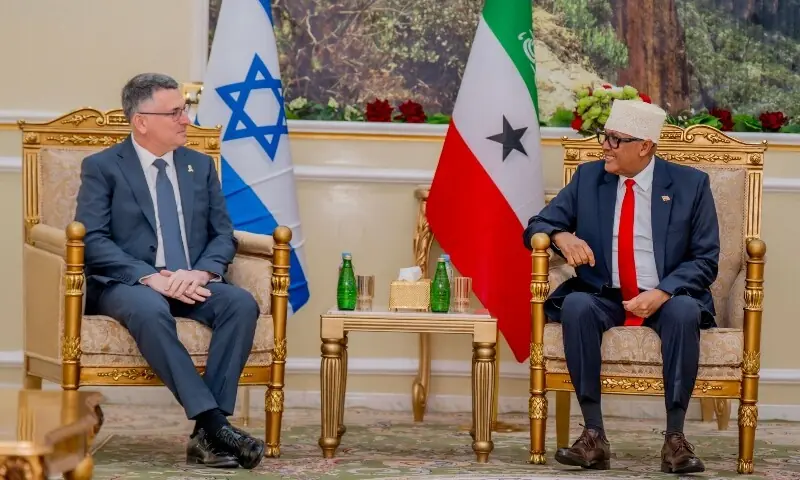

The Israeli foreign minister arrived in Somaliland on Tuesday in a high-profile visit, condemned by Somalia as an “unauthorised incursion”, after Israel recognised the breakaway region in the Horn of Africa.
Israel announced last month it was officially recognising Somaliland, a first for the self-proclaimed republic since it declared independence from Somalia in 1991.
Somaliland enjoys a strategic position on the Gulf of Aden and has its own currency, passport and army, but has struggled to win international recognition, amid fears of provoking Somalia and encouraging other separatist movements in Africa.
Israeli Foreign Minister Gideon Saar, whose delegation was welcomed at the airport by senior government officials, said recognising Somaliland had been “the moral thing to do”.
Somaliland President Abdirahman Abdullahi Mohamed praised Israel’s “courageous” decision, and said it would open up great economic and development opportunities.
“It promotes the strategic interest partnership of the two countries,” he said in a joint press conference.
Somalia reacted furiously to news of the visit, labelling it an “illegal” and “unauthorised incursion”.
In a statement, Somalia’s foreign ministry said it “reserves the right to take all appropriate diplomatic and legal measures… to safeguard its sovereignty, national unity, and territorial integrity”.
A special meeting of the African Union Peace and Security Council on Tuesday condemned “in the strongest terms” the recognition by Israel and called for its “immediate revocation”.
During the Israeli delegation’s short stay, sources said roads were blocked, with civilian movements restricted.
Following Israel’s recognition, militant group Al-Shabaab — which has fought the Somali government for around two decades — said they would fight any attempt by Israel to use Somaliland as a base.
‘Threat’ to stability
Analysts say the deal with Somaliland could provide Israel with better access to the Red Sea, enabling it to hit Houthi rebels in Yemen.
Somaliland’s location alongside one of the world’s busiest shipping lanes has made it a key partner for foreign countries.
Israel’s recognition was supported by the United States, but criticised by Egypt, Turkey, the six-nation Gulf Cooperation Council and the Saudi-based Organisation of Islamic Cooperation. The European Union insisted Somalia’s sovereignty should be respected.
Somali President Hassan Sheikh Mohamud called the Israeli decision a “threat” to stability in the already volatile Horn of Africa.
In an interview with Al Jazeera, he said Somaliland had accepted three conditions from Israel: the resettlement of Palestinians, the establishment of a military base on the Gulf of Aden, and joining the Abraham Accords to normalise ties with Israel.
Somaliland’s foreign ministry denied the first two conditions.
Somaliland has experienced greater stability than the rest of insurgency-hit Somalia.
It was briefly a recognised state in June 1960 when it gained independence from Britain, but voluntarily united with Italian-administered Somalia days later.
Somaliland’s leaders say that the union was never formally ratified and became void when the Somali state effectively collapsed in 1991.
20 nations, OIC reject Israel’s recognition of Somaliland
In December Pakistan joined 20 other nations and the Organisation of Islamic Cooperation (OIC) in rejecting Israel‘s recognition of self-declared Republic of Somaliland, with a joint statement saying that Tel Aviv’s measure reflected its “full and blatant disregard for international law”.
The statement also registered the countries’ rejection of any “potential link between such measure and any attempts to forcibly expel the Palestinian people out of their land”.
The joint statement was issued by the foreign ministers of Pakistan, Jordan, Egypt, Algeria, Comoros, Djibouti, Gambia, Iran, Iraq Kuwait, Libya, Maldives, Nigeria, Oman, Palestine, Qatar, Saudi Arabia, Somalia, Sudan, Turkiye, Yemen and the OIC.