
OVERTHROWING governments in Latin America has long been the US practice from a familiar playbook. The US has for decades intervened by military force to oust governments and assassinate leaders in the Western Hemisphere. More often than not, it has succeeded. Sometimes it has failed, as in trying to kill and remove Fidel Castro in Cuba epitomised by the disastrous Bay of Pigs invasion in 1961. This triggered the Cuban Missile Crisis that drove the US and the Soviet Union to the brink of nuclear war.
The US-backed coup in Chile in 1973 involved the assassination of its elected Marxist president Salvador Allende and installation of a brutal regime under Gen Augusto Pinochet. Another CIA-sponsored coup deposed Guatemala’s elected government in 1954. In 1989, the US invaded Panama to oust Manuel Noriega, capture and extradite him to stand trial in America. The US-led invasion of Grenada overthrew its government in 1983. Over 40 US interventions are said to have ‘succeeded’ in the past century and a half. This includes the invasion and capture in the mid-19th century of over half of Mexican territory. The US also engineered regime change and toppled governments in countries beyond Latin America — Iran, Afghanistan, Iraq and Libya.
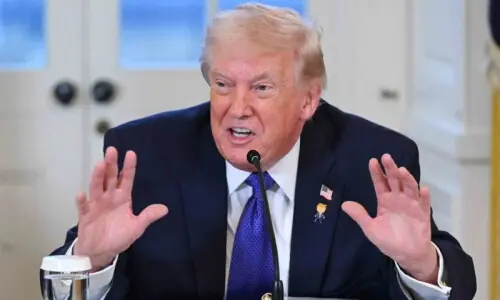
Against the backdrop of this predatory history, the US attack on Venezuela ordered by President Donald Trump followed a well-trodden path. But that didn’t make it any less egregious. President Nicolás Maduro was captured by American forces and taken to the US for trial. The armed intervention was illegal — a breach of international law and norms and violation of Venezuela’s sovereignty. It sent shock waves across the world and invited condemnation from many countries, while legal experts and some Democratic lawmakers called it an “act of war”. Five Latin American countries and Spain issued a joint statement which said, US actions “constitute an extremely dangerous precedent for peace and regional security”. It expressed concern about any “external appropriation of natural or strategic resources”. Venezuela’s interim President Delcy Rodríguez declared, “we will not be anyone’s colony”.
In a blatant display of imperial ambition, Trump vowed to run Venezuela, “take back” its oil and have American oil companies exploit its oil resources. Venezuela has the world’s largest oil reserves. This laid bare a key motivation of the intervention, which was not strategic deterrence against drug traffickers but commercial aggrandisement. It was a throwback to the past, when in the so-called ‘banana wars’, US-armed interventions sought to secure its commercial interests. Above all, Trump’s action was about establishing dominance over the Western Hemisphere, signalling Washington would dictate policy there and control its resources.
Trump seeks sole control of the Western Hemisphere and its resources.
The US military action came after months of escalating pressure on Maduro who Trump accused of links with drug smugglers without offering evidence. He also blamed Maduro for the influx of Venezuelan migrants into the US. Maduro’s offer for talks on narco-trafficking and oil was spurned by Washington. Instead, the US carried out strikes on Venezuelan vessels alleged to be transporting drugs and imposed a naval blockade to enforce an embargo on oil exports. Maduro accused Washington of aiming to overthrow him and take control of his country’s vast oil reserves.
The attack on Venezuela can be understood in the context of the Trump administration’s recently released National Security Strategy (NSS). This made enforcing the so-called ‘Trump corollary’ of the Monroe Doctrine in the Western Hemisphere a top priority. The original doctrine was to prevent European recolonisation and communist influence in the region. The ‘Trump corollary’ or ‘Donroe doctrine’ is designed to assert a proprietary claim and exclude China (whose trade and investment influence has been growing in Latin America) and other “non-Hemispheric” powers. Trump doesn’t just want the Hemisphere to be in Washington’s sphere of influence but for the US to have sole and exclusive control over its natural resources.
For all Trump’s earlier claims about non-intervention in the internal affairs of countries, also reiterated in the NSS, he has made regime change his policy. He issued warnings to Cuba, Columbia and Mexico about possible action and separately to Iran while repeating the threat to seize Greenland. The latter elicited a response from Denmark that such action will spell the end of Nato.
America’s experience with regime change has hardly been edifying, whether in Iraq, Afghanistan or Libya. It has always ended badly for the US and brought grief and suffering to those countries and shed so much of their blood. When the US tried to ‘run Iraq’ it proved a disaster. No wonder that a majority of Americans express fears about the US getting ‘too involved’ in the South American country, according to a Reuters/Ipsos poll. Alarmingly, the survey also found two-thirds of Republicans supported the attack.
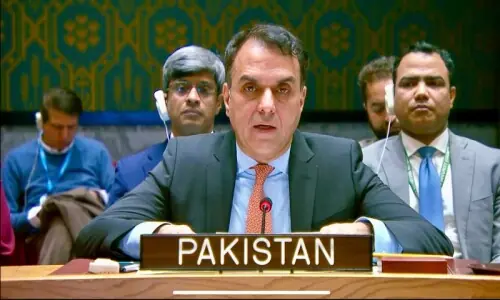
In the UN Security Council emergency meeting called to discuss Venezuela, the US was roundly condemned by China and Russia as well as American allies. Washington was accused of taking the world back to an “era of lawlessness” and undermining the “foundation of world order”. Pakistan’s envoy warned that “unilateral military” actions can lead to “unpredictable and uncontrolled outcomes” for years.
The Trump administration is unconcerned by international criticism. How Trump proposes to “run Venezuela” is the key question. As for his plan to “take over” oil resources, he announced that Venezuelan authorities will hand over up to 50 million barrels of sanctioned crude to the US. The money earned from its sale will be controlled by him. But for American oil companies to reap a bonanza is not simple, given Venezuela’s poor oil infrastructure and need for massive investment. Already US oil giant ExxonMobil has told Trump Venezuela is “uninvestable” without major changes. A private investor is cited in the Financial Times as saying, “No one wants to go in there when a random tweet can change the entire foreign policy of the country”.
The US may have bitten off more than it can chew. Venezuela can descend into chaos and greater regional instability can ensue with the US squandering whatever goodwill it has in the Hemisphere. As the New York Times put it in its editorial, Trump’s action represents “a dangerous and illegal approach to America’s place in the world”. Once again, the tactical success of the US action in Venezuela is likely to end in strategic failure.
The writer is a former ambassador to the US, UK and UN.
Published in Dawn, January 12th, 2026