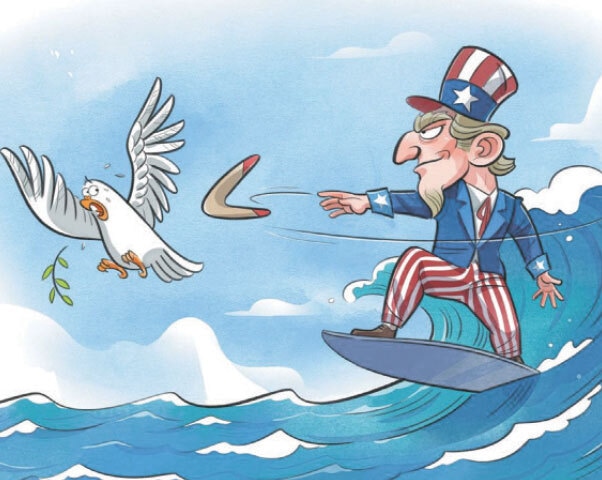
WHEN the United States attacks another country, it doesn’t just send in troops or launch missiles. It starts with language. What we’re seeing in Venezuela is not random messaging, but a well-designed narrative system — built around three basic steps and repeated through a set of familiar rhetorical tricks. And once you understand how this system works, you start noticing the same pattern again and again.
The first step is disguise. Change what an action is called, and you change how it is judged. So the United States did not refer to its action in Venezuela as an “invasion”. In fact, it did not speak the language of war at all. Instead, it talked about “capture”, “arrest” and “joint operations with law enforcement”.
All of these terms are synonymous with domestic policing and not war. The effect is powerful. Once it is able to make its action look like law enforcement, questions of sovereignty or the United Nations Charter quietly fade out from the conversation.
The violence the US has unleashed is further neutralised through technical language. So, bombing becomes a “precision strike”, invasion becomes an “operation” and the civilian harm it caused is downgraded to “collateral damage”. Such wording does more than soften the blow, presenting war as a form of technical management — something orderly, controlled, almost bureaucratic.
At the same time, the targeted state itself is personalised. A country is reduced to a single leader; sovereignty, institutions and the population fade into the background. Once a state is thus reduced to just one individual, regime change can easily be sold as criminal justice rather than aggression.
The second step is redirection. If attention is diverted elsewhere, legality becomes irrelevant. This is why so much emphasis is placed on elite units and footage of “dramatic raids”. Command rooms, night-vision images and special forces narratives dominate coverage. The audience is encouraged to admire competence and efficiency. The more impressive the operation looks, the less space there is to ask whether it should have happened at all.
Tactical success is then used to conceal strategic violence. A fast, “clean” operation is praised as restrained and responsible, although it says nothing about long-term consequences — regional instability, civilian suffering, economic collapse or endless cycles of intervention. Winning the scene replaces winning the peace.
Public debate is carefully redirected toward procedure rather than substance. Media discussions fixate on whether Congress was informed or whether the timing was appropriate. These arguments divert attention from the core issue — who authorised the US to use force across its borders in the first place.
Cause and effect are then quietly reversed. Interference came first, but the story is told backwards, as if instability demanded interference, rather than interference leading to instability. History is edited to make aggression appear inevitable. The third step is erasure. Control memory, and you control moral judgment.
Latin America is not a new story. The US has interfered there more than 40 times. But that history is wiped clean. Each action is presented as exceptional, as if it has no connection to what came before.
And before the public can fully process what happened in Venezuela, new headlines — Trump talking about occupying Greenland within two months, or news about military deployments aimed at Iran — appear. Attention shifts. Venezuela fades. Accountability never arrives.
Even imagery is carefully controlled. The public is shown pictures of Nicolas Maduro — poorly dressed, exhausted, humiliated. What is not shown is the brutal process behind those images: the killing of dozens of Cuban bodyguards who died protecting him, and the violence of the raid itself. The focus stays on spectacle, not cost.
When invasion is reframed as governance, and war becomes routine administration, the most dangerous transformation has already occurred. It doesn’t happen on the battlefield. It is all in the wording.
Published in Dawn, January 19th, 2026