India afraid peace board may try to ‘resolve Kashmir’

• Diplomats, press divided over New Delhi’s perceived reluctance to join Trump-led body
• Given his propensity to paint himself as a global peacemaker, The Hindu warns US president may offer to mediate Kashmir dispute
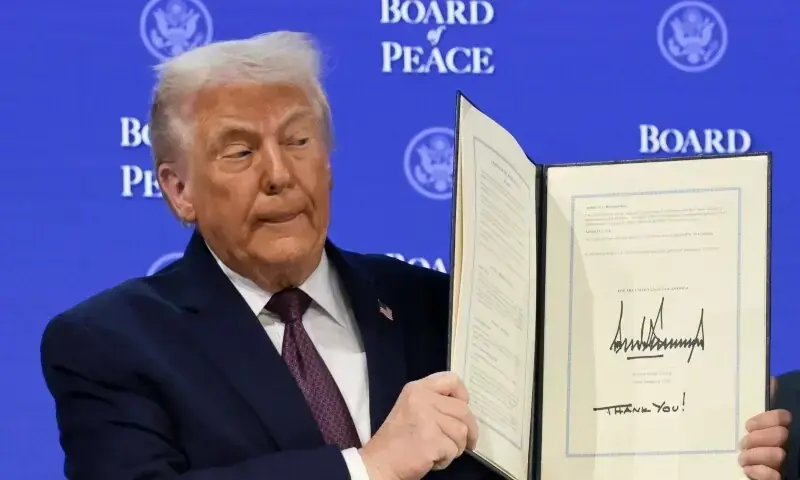
DESPITE being invited to join the ‘Board of Peace’ by President Donald Trump, India has yet to formally get involved in the process.
Conspicuous by its absence from the Davos ceremony where 20 world leaders — including Trump and Pakistan’s PM Shehbaz Sharif — signed the board’s charter, some in India are viewing New Delhi’s reluctance through the lens of the Kashmir dispute.
President Trump says the board’s goal is to make the ceasefire between Israel and Hamas in Gaza permanent and oversee an interim government in the Palestinian territory.
“This is not just for America, but for the whole world. I think we can spread it to other places. Like we did successfully in Gaza,” he had said at the time.
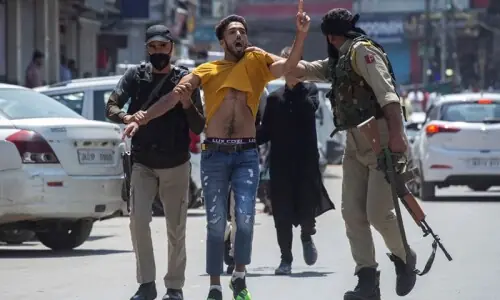
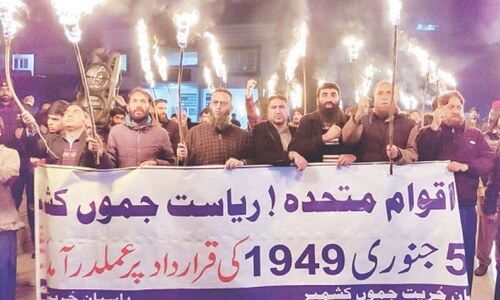
But there seems to be concern among some circles that if India signs up for the board — which Trump envisions as a future replacement for the United Nations — it may open up the disputed territory of held Kashmir to broader international or American scrutiny.
Although Trump has repeatedly offered to mediate on the Kashmir issue, especially in the wake of the May 2025 flare-up between the two South Asian rivals, New Delhi has firmly opposed all such overtures thus far.
According to a BBC Hindi report, the ‘Board of Peace’ is being formed at a time when the US is withdrawing from several UN organisations, raising the question of whether the board aims to render the world body irrelevant.
There is also a concern among some circles that the board will only strengthen a unipolar world, a system currently dominated by the US.
In a recent editorial on the issue, The Hindu newspaper painted Pakistan’s decision to join the board as “a warning signal to India”.
The newspaper attributed its alarm to the US president’s propensity to playing the ‘peacemaker’, having already claimed to have solved multiple regional and global conflicts during his first year in office.
“…[I]f Trump decides to include the Kashmir dispute in [his] peace plans, the Peace Board will try to resolve it. Once it joins the board, it will also be difficult for India to object to the deployment of its troops in the international peacekeeping force,” the editorial noted.
Former Indian ambassador to the United Nations, Syed Akbaruddin, recently wrote in the Times of India that the Security Council resolution has determined the term of this board is until Dec 31, 2027, and that it is obliged to report to the Security Council every six months.
This is done to ensure that this temporary arrangement does not turn into a permanent global model, he noted, adding that by contrast, Trump’s peace plan seems to have no set term and “could be used outside Gaza as well”.
He said that some UN officials are also indicating that this framework can be applied to other conflict areas.
But Ranjit Roy, who was India’s ambassador to Nepal and Vietnam, believes that it won’t be easy for New Delhi to take a decision on Trump’s ‘Board of Peace’.
“India’s dilemma has increased. Whether India accepts it or rejects it, it will have an impact. I think the risks of joining the Peace Board are high. First of all, Trump is its chairman and it seems pointless to expect justice from his transactional approach,” BBC Hindi quoted him as saying.
“It is not clear whether each country will have the same status in this,” said Roy.
“Just like in the UN General Assembly, each country has only one vote. When the Security Council approved it, it was limited to Gaza, but now that there have been changes, it could extend beyond Gaza.”
The editorial in The Hindu argued that “the rift in US-India relations and the delicate situation of trade talks may also be reasons for not rejecting Trump’s invitation at this stage. Doing so could incur Trump’s displeasure, as in the case of the French president.”
Published in Dawn, January 26th, 2026