THE economic comparison between Pakistan and India is usually presented through simplified narratives, headline figures and powerful propaganda in which India is portrayed as a ‘rising global economic powerhouse’, while Pakistan is depicted as a perpetually failing economy.
When this comparison is examined beyond slogans, the picture becomes far more complex and far less one-sided. The fact that India’s economy is larger than Pakistan’s is often used to construct the myth that size alone equals strength and prosperity, whereas, in reality, India’s massive gross domestic product (GDP) is largely a function of its enormous popu-lation, and aggregate numbers conceal deep structural weaknesses, extreme inequality and widespread deprivation.
Per capita income, quality of life, access to healthcare, education, sanitation and social protection are routinely pushed aside in favour of celebrating trillion-dollar milestones, even though hundreds of millions of Indians continue to live without basic necessities. India’s growth story is heavily concentrated in services, particularly information technology (IT), finance and digital platforms. These are sectors that benefit a relatively small, urban, English-speaking elite, while vast rural areas remain trapped in agricultural distress, debt cycles and underemployment, as evidenced by recurring farmer protests and alarming rates of agrarian suicides.
Manufacturing has failed to transform India into a true industrial powerhouse, as its share in GDP and global exports remains limited, supply chains remain fragmented, and job creation has lagged far behind the needs of a young and rapidly growing labour force.
Pakistan has historically maintained a more balanced economic structure in which agriculture, industry and services have played meaningful roles. Although deindustrialisation and policy inconsistency have weakened this balance in recent years, sectors such as textiles, agriculture-based exports, surgical instruments, sports goods and IT freelancing generate real foreign exchange and employment.
Another widely promoted myth is that India’s economic success is driven by massive foreign direct investment, but a closer look reveals that significant portions of these inflows are concentrated in portfolio investments, stock markets, real estate and digital platforms. These are areas that inflate valuations and enrich corporations, but they do not necessarily translate into any broad-based industrial growth or large-scale job creation.
In contrast, Pakistan’s foreign investment inflows are modest, but initiatives, such as the China-Pakistan Economic Corridor (CPEC), have focused on tangible infra-structure, energy capacity, and regional connectivity. Long-term economic returns are yet to fully materialise, but are structurally bound to be more productive than speculative capital flows.
Income inequality represents one of the most serious but among the least discussed vulnerabilities of the Indian economy, where a small group of billionaires controls a disproportionate share of the national wealth.
Pakistan does face severe poverty and inflationary pressures, but social cohesion supported by family networks, remittances from overseas workers, and a large informal economy has so far prevented the kind of extreme polarisation that is visible in India.
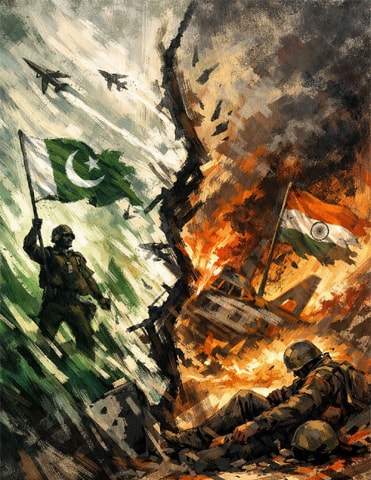
Defence spending is another area where India is portrayed as economically superior. The worth of this spending was seen by the world during last year’s conflict.
However, the greatest myth is the notion of permanent failure on one side, and inevitable success on the other, when in reality both countries struggle with structural inefficiencies, governance challenges and vulnerabilities embedded in the global economic system.
It is India’s strong international lobbying, strategic partnerships and influential media networks that help mask internal weaknesses and project an image of unstoppable ascent. Pakistan’s weaker diplomatic and communication capacity had often allowed crises to dominate international headlines. But all that has now changed as well.
The real question is not which economy is bigger, but which economic model is capable of delivering inclusive growth, social stability and long-term resilience. Measured by these standards, India’s growth appears flashy, uneven and ex-clusionary, while Pakistan’s economy, though fragile and mismanaged, retains room for reform, recovery and reorien-tation. Understanding this distinction is essential to dismantling myths about Indian economy and confronting realities.
Mian Iftikhar Ahmad
Faisalabad
Published in Dawn, January 27th, 2026