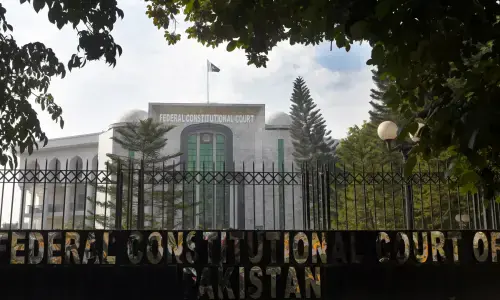
THE Federal Constitutional Court’s short order upholding the legality of the contentious super tax on high-earning individuals and businesses signifies an important turn in Pakistan’s struggle between fiscal expediency and tax certainty.
The FCC judgement settles more than 2,200 pending cases and secures recovery of an estimated Rs310bn in unpaid tax revenues — no doubt, a big relief for a fiscally strained state. Only the petroleum exploration sector has been granted relief because even a constitutionally valid fiscal step cannot be arbitrarily enforced where it risks breaching contractual obligations and triggering international arbitration.
The ruling reaffirms parliament’s exclusive authority to impose taxes, declaring that earlier high court interventions staying super tax recoveries amounted to judicial overreach. A precedent has thus been set that is likely to deter future judicial interference in tax collection.
However, the judgement does not address the question of whether legal certainty on a contentious tax measure can be equated with tax equity and sound economic policy. The super tax’s evolution from a temporary levy to a permanent feature of the tax regime shows it cannot.
Introduced in 2015 as a one-time levy to fund the rehabilitation of people displaced by the Zarb-i-Azb military operation in KP, the tax was repeatedly extended and expanded from select sectors to virtually the entire corporate landscape, as well as high-income individuals to bolster FBR collections. This gradual institutionalisation of an emergency levy as a permanent revenue spinner signals fiscal compulsions originating from the state’s failure to broaden the tax base. The levy confirms the state’s inability to effectively bring untaxed or undertaxed segments — notably large parts of retail, real estate and agriculture — into the net.
No wonder successive governments have either turned to a narrow pool of documented taxpayers — extracting more from those already compliant — or relied on more borrowings to finance and sustain their budgets. It is rightly feared by compliant businesses that the FCC decision may embolden the state to continue down this path. In other words, the ruling might have brought legal finality on the impugned levy but it has also exposed deep structural flaws in the taxation framework. A tax system dependent on easy-to-collect withholding taxes, surcharges and super taxes is neither equitable nor sustainable.
Without expansion of the tax base, improved enforcement and compliance and a shift away from stop-gap revenue measures, levies like the super tax risk becoming a permanent substitute for tax reform. It may suit the FBR but is costly for economic growth and investment. The FCC has spoken on the constitutionality and legality of the super tax. The answer to the question on how to fix the broken tax system has to come from our political leadership.
Published in Dawn, January 29th, 2026