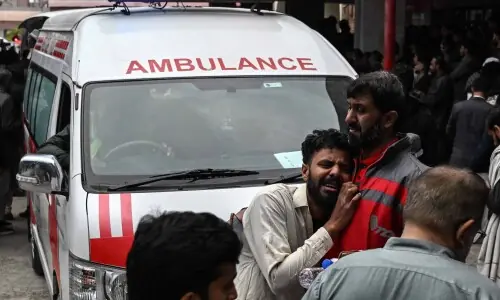
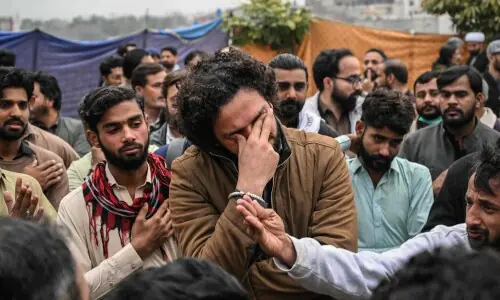
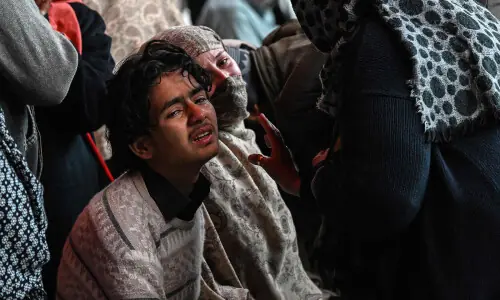
AFTER every terrorist atrocity, we are left with more questions than answers. This is also true in the case of yesterday’s barbaric suicide bombing of an imambargah in Islamabad during Friday prayers. It was the first sectarian massacre in several years, and the second major attack targeting the federal capital since last November’s blast outside a district and sessions court building.
The defence minister has said Afghanistan and India are responsible, but a deeper probe is required, as Pakistan has had to confront home-grown sectarian terrorism for the past four decades now. Officials say that the suspected bomber had travelled to Afghanistan, and initial findings suggest links to IS.
Various theories are being advanced by state functionaries, some of whom believe that the bombing could have been a response to the recent action against terrorists in Balochistan, though Baloch separatist groups are not usually known to carry out sectarian assaults. The attack is also being interpreted as the banned TTP’s handiwork — which is a strong possibility. Historically, groups that were known as the ‘Punjabi Taliban’, which later merged with the TTP, have a record of sectarian violence, and may have been reactivated to hit ‘soft’ targets.
IS has also been active in Pakistan, though the group has been largely quiet for a few years. This outfit has a similarly rabidly sectarian worldview. Only a thorough probe can unveil the real criminals behind this grotesque act of violence.
It must be asked how the terrorists were able to carry out an attack in what is supposed to be Pakistan’s most secure city. No doubt, it is near impossible to prevent a suicide bomber from setting off explosives when he decides to strike. But better intelligence can be employed to foil such attacks. It is also a fact that while the more bloodthirsty sectarian groups in Pakistan, such as the banned Lashkar-i-Jhangvi, have been largely defanged, many of their political supporters remain active, free to take out rallies and indulge in hate speech.
The state’s counterterrorism policy will remain ineffective until these groups are put out of business. Such groups, including the banned ASWJ, share a worldview with the TTP, which the state has declared the mortal enemy of Pakistan. Hence it is necessary to take action against the political and ideological backers of violent sectarian groups in order to close the door on further violence in the country.
Together, state and society must thwart the efforts of malign actors who wish to foment communal unrest. Pakistan has, over the decades, witnessed numerous instances of sectarian violence. It cannot afford a return to such dark times, which is why the state’s top priority must be to neutralise sectarian terrorist groups.
Published in Dawn, February 7th, 2026