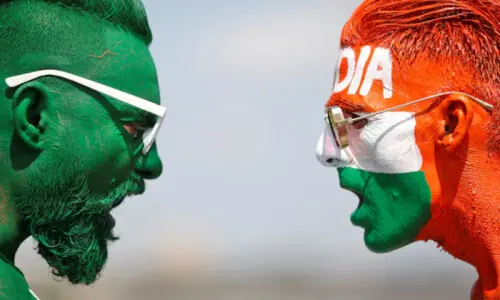
THE cricket world held its breath for one week when Pakistan threatened to boycott its T20 World Cup group stage fixture against India.
But with back-channel talks having broken the deadlock between the stakeholders, on Sunday evening at the R. Premadasa Stadium, it will exhale in one collective roar.
Pakistan versus India in a T20 World Cup is not merely a match; it is the fixture that keeps the sport’s heartbeat strong. Whatever the result, the game will remind millions why they fell in love with cricket in the first place.
The venue itself is part of the narrative. The Premadasa Stadium has hosted many thrillers, but rarely one carrying this much baggage.
Pakistan to face India today
A used pitch — likely the same surface on which Zimbabwe humbled Australia on Friday — awaits the two teams. It is slow, grippy and low. In such conditions the ball holds in the surface, turns a fraction and rewards the bowler who can vary pace and trajectory. Spin, not raw pace, will decide the evening.
Both sides have recognised the shift. India will lean on Varun Chakravarthy’s mystery, Axar Patel’s left-arm control and may also throw in Kuldeep Yadav’s wrist-spin — which has worried Pakistan over the past few years.
Pakistan will counter with a carousel of their own: Shadab Khan, Abrar Ahmed, Mohammad Nawaz and, most intriguingly, the 30-year-old off-spinner Usman Tariq.
Usman’s action has been the talk of the tournament. The brief pause at the crease, the low-arm sling, the ball that skids or dips — it has left batters guessing.
He has already been reported twice and cleared twice.
Pakistan captain Salman Ali Agha calls him the “trump card”. In the spin-friendly Colombo air, that card could be decisive.
If Usman lands his variations on the money, even India’s middle order — Suryakumar Yadav, Hardik Pandya, Rinku Singh — may find the boundaries suddenly distant.
Yet Pakistan cannot rely on spin alone. The fast-bowling equation presents its own conundrum. Shaheen Shah Afridi remains the marquee name, the leader of the attack, the man who has delivered in big games.
But the left-arm seamer Salman Mirza has been impressive in the lead-up, generating swing and hitting the deck hard. Conditions on Sunday may not offer extravagant movement, yet the temptation to play both, or to prefer Mirza’s current rhythm over Shaheen’s experience, is real. The management must decide whether sentiment or data guides the playing XI.
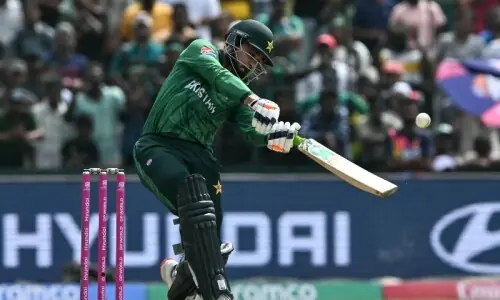
Pakistan’s batting, meanwhile, carries familiar vulnerabilities. The top order has fired in the first two matches, with Sahibzada Farhan and Saim Ayub providing brisk starts. But Salman Agha and former skipper Babar Azam have to make better contributions.
Against India’s varied batting line-up, especially if Abhishek Sharma is fit, any collapse could prove fatal. Abhishek, the explosive left-hander, missed India’s game again Namibia with a stomach infection. He has since been cleared and insists he is fit. If he walks out at the top, the powerplay could belong to India in a hurry. Weather adds another layer of uncertainty. Colombo has been humid, and forecasts speak of a low-pressure system lingering over the Bay of Bengal. Morning and afternoon showers are possible; the evening is expected to be overcast but largely dry, with temperatures hovering around 27-28°C and humidity in the low-to-mid 70s.
Political factor
Off the field, the political backdrop is impossible to ignore. Only days ago Pakistan had threatened to boycott the contest in solidarity with Bangladesh after the latter’s exclusion from the tournament.
Intensive negotiations in Lahore involving the International Cricket Council (ICC), the Pakistan Cricket Board and its Bangladesh counterpart produced a last-minute reversal as the ICC gave in to a few demands put forward by the PCB and the BCB. Now, fresh reports suggest that representatives of the BCB, PCB, the Afghanistan Cricket Board and the Board of Control for Cricket in India may hold informal meetings on the sidelines of Sunday’s game.
It remains to be seen whether those conversations yield concrete results on bilateral cricket or future tournaments. But the very fact they are happening in Colombo underlines how deeply intertwined sport and diplomacy have become.
For Pakistan, the challenge is clear. They enter as slight underdogs India have won 13 of the last 16 T20I meetings yet the conditions are more even than at any recent clash.
Premadasa Stadium is unlikely to be a 200-run ground on Sunday; 160-170 may be a fighting total. Discipline with the bat, control with the ball and, above all, composure under the weight of expectation will separate the two sides.
The Green Shirts have the tools. Usman’s variations, the left-arm pace dilemma, a settled top order and the knowledge that they have already beaten strong sides in this tournament.
But India remain the benchmark — clinical, deep and ruthless when the big moments arrive.
Come Sunday evening, 35,000 spectators will pack the Premadasa, millions more will tune in across the Subcontinent and beyond, and the world will remember why this fixture still matters. Win, lose or tie, cricket will be the richer for it.
The oxygen is back. Let the match begin.
Published in Dawn, February 15th, 2026