JOB creation and the ‘future of work’ are now the renewed focus of multilateral organisations trying to make growth inclusive and resilient, and to combat domestic instability fuelled by joblessness.
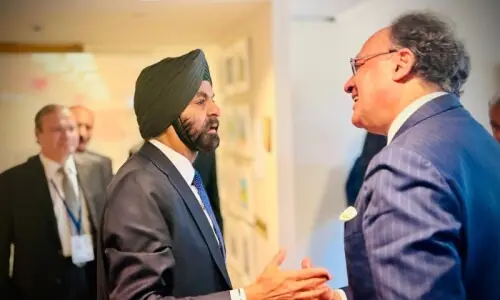
World Bank President Ajay Banga says, “We’re trying to move the bank group as a whole from the idea of projects to the idea of outcomes.” He told Reuters that employment creation will remain “a binding constraint on growth over the long-term”, as such, “Job creation is the North Star”.
With the productive economy suffocated, Pakistan is heading towards a severe employment crisis, leaving millions of young people without visible job opportunities, says Chairman of the Federation of Pakistan Chambers of Commerce & Industry Businessmen’s Panel Mian Anjum Nisar; the country is losing its most valuable assets — its workforce.
Jobs are created when factories run on full capacity with value-addition, without which job creation will be limited and vulnerable to external shocks, he explained, listing the various factors eroding the country’s economic competitiveness.
‘The future of work does not simply happen; it is shaped by choices governments, employers and workers make together’
Explaining that the government is fully aware of the economic challenges, Finance Minister Muhammad Aurangzeb acknowledged that, “There are firms which are leaving the country that is true. If the taxation is high or the energy cost is high or its financing cost is always moving in the right direction, those have been real issues,” he said while addressing the Pakistan Policy Dialogue in Islamabad.
However, Mr Aurangzeb stated that “it takes two to tango” and firms still relying must reconsider their practises as old, state-dependent business models are simply “not going to work in the New World Order”.
Some of the multinational firms switched to local sourcing which has helped their margins, “They are now able to export, therefore they stay, and if another firm has not been able to do that, then that’s something we know they need to think through.”
Local firms have invested in Pakistan International Airline’s privatisation, and 20 new foreign investors, including Google, Aramco, Wafi Energy, Turkish Petroleum, and others had entered the Pakistani market in the last 18 months, he highlighted.
Yet, Pakistan still needs to generate 2.5–3 million jobs a year — roughly 25–30m over the next decade — as millions of young people come of age, Mr Banga said, adding that failure to do so could fuel illegal migration or domestic instability.
However, “Equally troubling is the interaction between weak employment growth and declining real incomes,” says a Dawn editorial, further writing, “Cumulative inflation in recent years has outpaced income gains, resulting in a fall in real per capita household income and a rise in poverty risks. At the same time, inequality trends suggest that whatever limited growth has occurred has been unevenly distributed.”
To take care of this issue on the global scale, the International Labour Organisation (ILO) has redefined the “future of work”.
Calling for a shift in labour standard, ILO Director-General Gilbert F. Houngbo emphasised: “Modern labour governance must move beyond job-centred approaches towards worker-centred systems, where rights, social protection, skills development and workers’ voices accompany people across increasingly diverse and mobile careers, including in platform and digitally managed work.”
“The future of work does not simply happen. It is shaped by the choices governments, employers and workers make together.”
Speaking at the Summit’s Future of Work Forum in a session Mr Houngbo said, “Strong labour governance is not a barrier to growth; it is what makes growth inclusive and resilient.”
On Feb 9, Moody’s forecast Pakistan’s real GDP growth of around 3.5pc for 2026, up from 3.1pc in 2025, and said easing policy rates and lower inflation should support credit demand. It added that margins are expected to remain steady after declining following rate cuts.
The agency revised Pakistan’s banking sector outlook to stable from positive, citing that the operating environment is recovering “but only gradually” as the economic and fiscal outlook improves and the external position strengthens.
The move signals that volatility has eased without a strong growth push behind it, says Komal Kenneth Shakeel, Head of Partnerships and Collaborations at Ignite.
A biannual State Bank Monetary Policy report projected real GDP growth in the range of 3.75–4.75pc for FY26.The report also underscored evolving risks to the improved macroeconomic outlook —sources of vulnerability involve inflation, external account and GDP growth. It is important to speed up the progress on structural reforms to increase the economy’s resilience to adverse shocks, and to improve productivity and plug losses of state-owned enterprises, the report added.
Moreover, the utilisation of annual Public Sector Development Programme funds has inched up to 27pc in first seven months of FY2025 — well behind the approved disbursement schedule, but relatively higher than the 20pc recorded for the same period of the last fiscal year.
Under the mechanism announced by the Ministry of Finance for FY26, the PSDP spending should have crossed at least Rs443bn (43pc) of the allocation by Jan 31.
Published in Dawn, The Business and Finance Weekly, February 16th, 2026