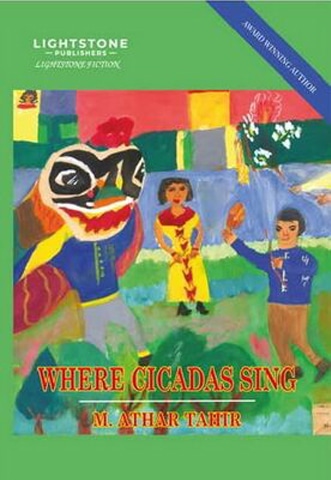
Where Cicadas Sing
By Athar Tahir
Lightstone Publishers
ISBN: 978-969-716-306-9
359pp.
Athar Tahir, the author of Where Cicadas Sing, is a highly acclaimed scholar and writer. He is an English poet, an essayist, a short story writer and an artist. At one time a Rhodes Scholar at Oxford University, he is the recipient of the Tamgha-i-Imtiaz and Sitara-i-Imtiaz, and is an elected Fellow of the Royal Asiatic Society of Great Britain and a Fellow of the Pakistan Academy of Letters.
He has also been awarded the Patras Bukhari Award for literature in English four times. His debut novel, Second Coming, was extremely well received. Where Cicadas Sing is the first independent but linked book of a quartet.
With all these credits to his name, Where Cicadas Sing had to be good. And it is. It is an elegantly structured novel, presented through the eyes of a young lad, Athar. The story spans about three years that he spends with his family in Malaysia (then called the Federation of Malaya) in the late 1950s and early 1960s.
According to the author, the symbolism of cicadas has a definite place in the novel. This humble insect figures in Greek and Roman mythology as well as in Eastern literature. It is often mentioned in Japanese poetry. It is proof of the author’s scholarship that he uses cicadas to bring the native and the foreign together for Athar.
An elegantly structured novel, told through through the eyes of a young lad, is the first part of four interconnected novels and has stellar prose but is let down by the lack of much happening in it
The writer never forgets who is telling the story, so the sentences remain short and the vocabulary stays simple. But, even within the confines of the innocence of childish reactions, the reader is made to understand the dynamics of both the boy’s immediate family and the complications abounding in the extended one.
The novel revolves around the father, for he is Athar’s hero. He is the one who shows Athar the world and interprets it for him. His most wonderful trait, from Athar’s point of view, is the love he shows to his children. He is interested in all that they do. He is a big part of their school life, eager to see them excel and willing to help in achieving this goal. Under his tutelage, Athar thrives. He learns myriad new things: to swim, to take good photographs, to keep a diary, to use a knife and fork and to behave correctly when meeting dignitaries.
Fortunately, the parents’ close relationship and love for their children create a safe haven for Athar and his siblings. Whatever changes occur in their lives, the strong and tender family bond keeps them centred and secure.
And there are changes galore. First, the family comes to Kuala Lumpur from Karachi. Athar and his sister are enrolled in a school and have to make new friends and deal with teachers whose very names are strange to them. After two years, they moved to Penang and have to get used to a new school. Athar yearns for the friends he leaves behind in Kuala Lumpur, especially for a classfellow, Azizah, to whom he has lost his boyish heart. After a year in Penang, the final change is wrought when Athar is sent to a boarding school in Pakistan. As he flies out, he wonders whether he will ever meet Azizah again.
Where Cicadas Sing is written exceptionally well. Tahir is at the pinnacle of his craft. This is a deceptively simple book, made possible only by the author’s command over the language. It is written for adults, but children can read it easily. The depiction of Athar revelling in his new surroundings, absorbing new sounds and sights and making friends and meeting people from different religions and ethnicities is masterly. The awe and wonder that young Athar feels at each new event are superbly conveyed to the reader.
The vehicle used, first person singular, gives the boy’s experience immediacy. It seems that he is relaying his impressions even as he is living through the incidents. And there are no filters. Athar’s thoughts and observations come through with the naturalness of a nine- or 10-year-old. Yet, in oblique ways, adult themes are also touched upon. With an endearing guilelessness, Athar comments upon the extramarital affair of one of his father’s acquaintances and the pornography on view in another one’s home.
Even though the first-rate prose makes the book easy to read, it is not a quick one. Interest begins to flag because nothing much happens in the story. Athar finds going on a picnic, attending a scout meeting and spending time at a funfair enthralling. But for the reader, these are all very humdrum. The absence of any real conflict or dilemma makes for a desultory read. The reader does not feel compelled to turn the page and see what happens next. The novel can be put away for later.
Moreover, many chapters are stand-alone narratives. They do not take the tale forward and can be omitted, just like a pearl on a string, though exquisite in itself, can be removed without harming the integrity of the necklace.
Many extremely captivating books have been written from children’s perspectives. To Kill a Mockingbird, The Book Thief and The Ice Candy Man are just a few of them. But Where Cicadas Sing has no mystery and no challenge. A chronicle of a happy child from a stable family going about his daily rounds of living and learning, even in a foreign country, does not make for an engrossing storyline.
However, this book is only the first of four interconnected novels. It has laid the foundation by introducing young Athar and his family. Tahir’s facility with words and clarity of thought can be trusted to take the saga to pinnacles of adventure and drama and so create an outstanding quartet.
It is sure to be worth reading since the last of the tetralogy, Second Coming, which is already in print, has already won the nation’s highest award for literature in English.
The reviewer is a freelance writer, author of the novel The Tea Trolley and the translator of Toofan Se Pehlay: Safar-i-Europe Ki Diary
Published in Dawn, Books & Authors, February 22nd, 2026