• In Arab world, Mike Huckabee’s words being interpreted as wavering of US support for two-state solution
• International law expert says statement puts Washington in a bind; diplomat should not be endorsing ‘aggressive actions’
WORDS are never just words. They carry history, suspicion and memory. A single sentence, spoken casually in Washington or by an American official, can travel thousands of miles and land like a strategic signal.
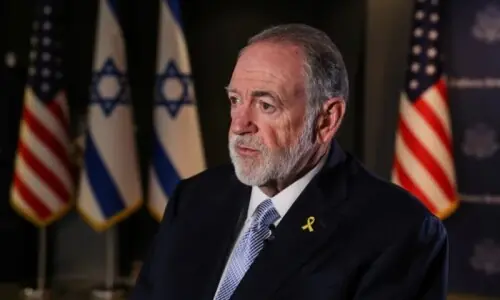
When US Ambassador to Israel Mike Huckabee told podcaster Tucker Carlson in an interview that “It would be fine if they (Israelis) took it all (Arab lands),” he may have intended a theological remark.
But in Arab capitals and the broader Muslim world, it was heard as something else — an endorsement of the ‘Greater Israel’ vision, peddled by Israeli Zionists.
The reaction was not scattered, rather collective. Fourteen governments — among them Pakistan, Egypt, Jordan, Saudi Arabia, United Arab Emirates, Qatar, Kuwait, Oman, Bahrain, Lebanon, Syria, Türkiye, Indonesia and the State of Palestine — joined hands with the Organisation of Islamic Cooperation, League of Arab States and Gulf Cooperation Council to denounce the remarks.
Their joint statement did not hide behind soft language, expressing “strong condemnation and profound concern” and affirming “categorical rejection of such dangerous and inflammatory remarks, which constitute a flagrant violation of the principles of international law and the Charter of the United Nations, and pose a grave threat to the security and stability of the region.”
This is not how governments usually react to a casual gaffe by an official. This is how they react when they feel something foundational is being questioned.
The controversy began when Mr Huckabee referred to the biblical promise of land from the river of Egypt to the Euphrates. When asked if Israel had the right to that territory, he replied that it would be fine if Israel took it all.
The map implied by that verse in the book of Genesis includes not only the occupied Palestinian territories but also parts of Egypt, Jordan, Lebanon, Syria, Iraq, Saudi Arabia and Turkey.
Sovereignty and international law
There were several reasons for the sharp reaction from Arab and Muslim states.
Firstly, it relates to the core issue of sovereignty of other states. In a region that has witnessed occupation and annexation, even rhetorical acceptance of territorial expansion triggers deep anxiety.
The second reason is the long-running Palestine dispute as the two-state formula, though weakened, remains the diplomatic touchstone. Arab governments see the ambassador’s remark as undermining any claim that US still backs a political horizon for Palestinian statehood.
Thirdly, the fear of domestic backlash forced Muslim leaders to react promptly. Cairo, Amman, Abu Dhabi and Riyadh justify cooperation with the US on the understanding that the US guarantees their territorial integrity. But when a senior American official appears to bless expansion, that understanding fades.
Fourthly, the statement meant setting a precedent. Diplomacy works on signals. An ambassador’s words are not treated as personal musings; they are read as indicators.
International law is clear on the basic principle that territory can’t be acquired by force. The UN Charter rests on sovereign equality and territorial integrity.
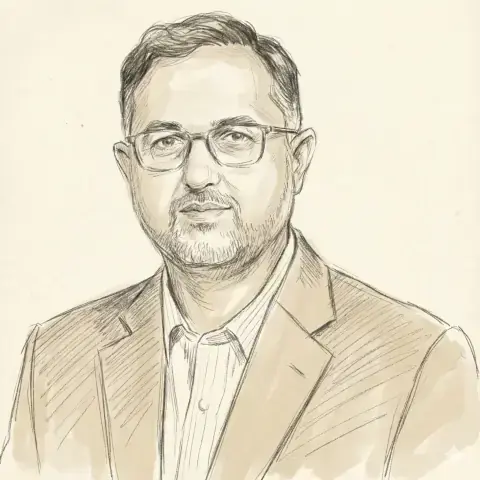
“The ambassador’s remarks regarding Israel’s territorial acquisitions in the Middle East are deemed unwarranted and represent a clear contravention of established international norms… Furthermore, as an accredited envoy, he is precluded from endorsing aggressive actions,” Ahmer Bilal Soofi, president of the Research Society of International Law, told Dawn.
The dispute over West Bank or East Jerusalem, notwithstanding, there is no legal doctrine to validate scripture-based territorial claims. Borders in the modern state system can only be changed by treaty or mutual deal.
“Arab leaders don’t expect Israel to cross the Jordan River, but the real question is whether the West Bank will be fully annexed. The full annexation of the West Bank would be a problem for normalisation,” said Adam Weinstein of the Quincy Institute’s Middle East Programme.
That is why the joint statement framed the issue in legal terms besides noting that such remarks contradict the stated vision of de-escalation and a political settlement leading to an independent Palestinian state.
Implications for US policy
For Washington, the implications go beyond one interview.
American influence in the Middle East does not run on aircraft carriers alone; it is anchored in the carefully maintained belief that Washington, despite its tilt towards Israel, still values stability. Egypt’s strategic location, Jordan’s role, Saudi Arabia’s oil leverage and the Gulf states’ security partnerships, all rest on that understanding.
If the Arab public concludes that US quietly supports territorial expansionist visions, their governments will face a higher political cost in sustaining cooperation with Washington. The consequences may not lead to dramatic breakups, but may yield hesitation, reduced diplomatic flexibility, and greater openness to other powers such as China and Russia.
Trust in this region is thin and expensive. Once eroded, it cannot be easily restored.
Mr Huckabee later attempted to clarify what he said. He argued that Israel does not want such territory and that his remarks were theological, not policy-related.
On social media, he also denounced the so-called Khazar theory as an “odious conspiracy theory” and accused “Islamist accounts” run from countries like Pakistan and Turkiye of spreading false smears about Israel. In doing so, he reframed the backlash as the product of anti-Semitic disinformation. By naming Pakistan and Turkiye, both signatories to the condemnation, he personalised the dispute.
That may satisfy the domestic audience in US, but it will do little to calm the Middle East, or even wriggle his government out of the tight spot he has put it in.
“The Ambassador’s statement has placed his sending state in a precarious position. Should the government endorse… this irresponsible statement… [it] would potentially incur significant costs… Conversely, if the government disavows his comment… he would have demonstrably exceeded his authority as an envoy under the Vienna Convention,” Mr Soofi explained.
In such a scenario, dissociation from his irresponsible views would necessitate his removal as an envoy as a minimum measure,” he maintained.
Published in Dawn, February 23rd, 2026