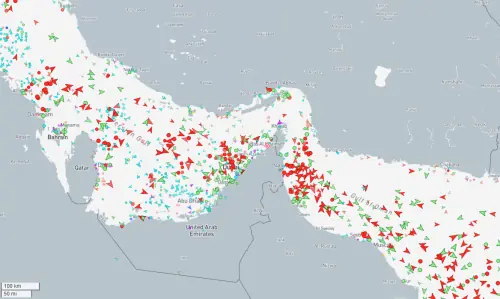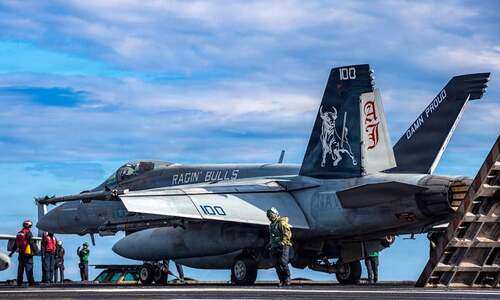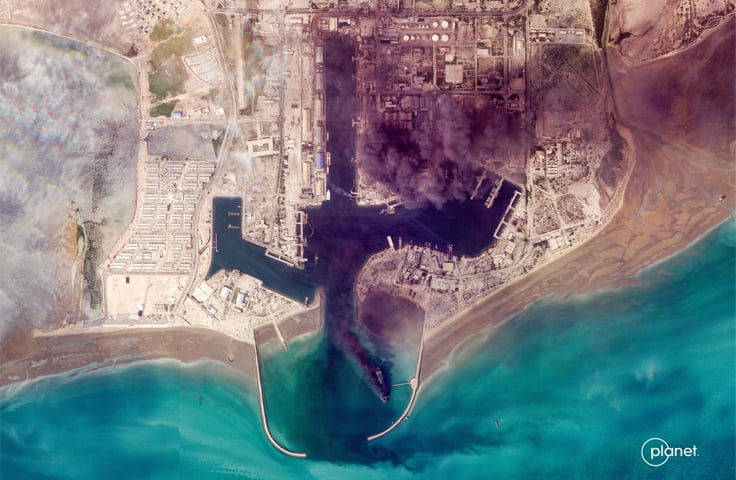
KARACHI: Escalating military conflict in the Middle East and the closure of the Strait of Hormuz have forced global shipping companies to adopt precautionary measures for the movement of goods by sea as well as for their staff and crew, while some firms have indicated the imposition of war-risk and contingency surcharges on cargo.
The Strait of Hormuz is a strategic maritime corridor through which nearly 25 per cent of the world’s oil passes. Any disruption to traffic through the narrow passage linking the Persian Gulf with the Gulf of Oman could lead to increases in crude oil and LNG prices as well as higher shipping insurance costs.
“Given that a large proportion of Pakistan’s trade transits through the Gulf region and the fact that most major shipping lines have already announced service disruptions, Pakistan’s trade will suffer delays and additional costs,” Pakistan Ships’ Agents Association (PSAA) Chairman Mohammad A. Rajpar told Dawn, warning that “there is also a threat of disruption to our LNG and oil supplies”.
Karachi Gateway Terminal Limited (KGTL), in an advisory, said shipping lines operating Gulf services had temporarily suspended booking acceptance from Pakistan and placed their services on hold until further notice. Accordingly, KGTL has suspended the acceptance of all new export cargo for Gulf services with immediate effect.
Pakistan’s trade likely to face delays, higher freight and insurance costs
Hapag-Lloyd, a maritime transport company, stated on its website that due to operational and security constraints in the Upper Gulf region, measures had been taken to ensure cargo safety, secure equipment placement and maintain operational standards.
The company has implemented a booking stop, with immediate effect and until further notice, for all cargo types from Africa to the Upper Gulf region, including the United Arab Emirates, Iraq, Kuwait, Qatar and the Eastern Province of Saudi Arabia.
In addition, all cargo moving via Jebel Ali on the MIAX Eastbound and EA2 Northbound services is included in the booking stop.
A contingency surcharge for shipments between the Red Sea and North Europe, the Mediterranean and North Africa will be introduced for all container types for sailings commencing March 3 until further notice.
The surcharge has been set at $1,500 per TEU for standard containers and $3,500 per container for reefer containers and special equipment.
Future sailings
Citing the deteriorating security situation in the Middle East amid escalating military conflict, Maersk announced on March 1 that it had decided, in coordination with its security partners, to pause future Trans-Suez sailings through the Bab el-Mandeb Strait. Until further notice, sailings on the ME11 (Middle East-India to Mediterranean) and MECL (Middle East-India to US East Coast) services will be rerouted around the Cape of Good Hope.
The company said it would continue to monitor the situation and resume the Trans-Suez route once conditions stabilise. Cargo acceptance for the Middle East region remains open.
DP World said operations at Jebel Ali Port had been temporarily paused as a precautionary measure. Mediterranean Shipping Company (MSC) has suspended all bookings for worldwide cargo destined for the Middle East until further notice. The company said bookings will resume once the security situation improves.
Cosco Shipping Lines said in an advisory that vessels already inside the Gulf had been instructed to proceed to safe waters to hover or anchor after completing operations where possible. Vessels heading towards the Gulf have been advised to prioritise navigational safety by reducing speed, moving to safe waters or awaiting further instructions at designated sheltered anchorages.
Emergency measures
FPCCI President Atif Ikram Sheikh has called for emergency measures to shield the country’s trade and industry from the escalating conflict in the Middle East. Ongoing geopolitical volatility poses a serious threat to Pakistan’s fragile economic recovery, energy security and export competitiveness, he said. With nearly 30pc of global petroleum consumption passing through the Strait of Hormuz, any prolonged disruption could trigger major supply chain shocks.
Pakistan remains heavily reliant on Gulf energy, importing more than $5.7 billion worth of crude petroleum annually, primarily from Saudi Arabia (about $3.2bn) and the UAE (around $2.3bn). Including refined petroleum products, total imports reached $10.71bn in FY25.
The FPCCI chief warned that soaring freight and insurance costs due to shipping rerouting could add 15 to 20 days to transit times for Pakistani exports to key markets in the EU, UK and the United States.
Freight costs on major routes could rise by up to 300pc, while marine insurance premiums have already increased due to war-risk classifications. This, he said, would raise the cost of imported raw materials and erode the price competitiveness of Pakistan’s textile and manufacturing exports.
Published in Dawn, March 3rd, 2026