China boosts military spending with eye on US, Taiwan
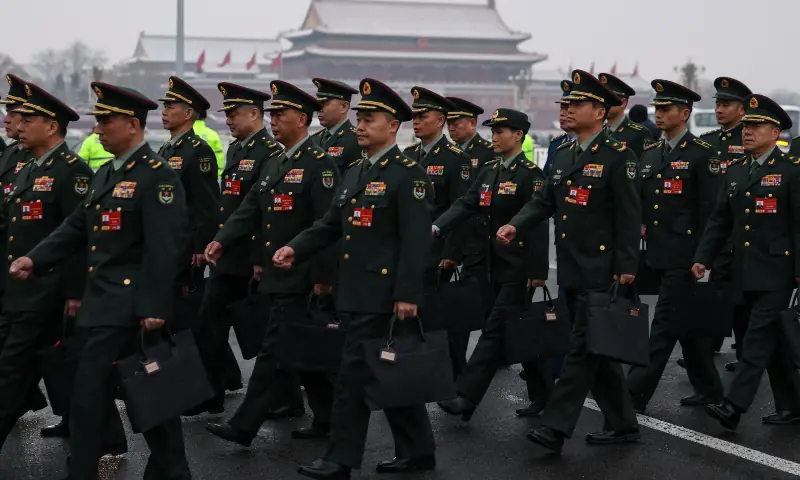

BEIJING: China announced a seven per cent boost to its defence budget for 2026 on Thursday, as Beijing steadily increases spending to counter the United States and enforce its claims over Taiwan and the South China Sea.
The latest rise keeps China’s spending at three times less than the United States, but the rival Asian power is working to close the gap. Beijing plans to spend 1.9096 trillion yuan ($276.8 billion) on defence, according to a report published at the opening of the nation’s “Two Sessions” political conclave.
The increase also marks a degree of continuity as Beijing pursues a sweeping anti-graft purge of the People’s Liberation Army (PLA) that included the ousting of top general Zhang Youxia in January.
Analysts said the budget will finance military salary increases, training, manoeuvres around Taiwan, cyberwarfare capabilities and advanced equipment purchases, among other things.
“China pursues an independent and self-reliant foreign policy. However, without robust military capabilities and technological prowess, our diplomatic stance would inevitably be subject to coercion or even dictated by certain nations, including the United States,” said military commentator Song Zhongping, a former Chinese army instructor.
“China is unwilling to be a vassal state,” said Song, who maintained that Japan and South Korea, by comparison, “only submit to American dictates”.
The PLA must also strengthen its capabilities, he said, to “fully restore” Chinese jurisdiction over the disputed Spratly Islands, a chain of reefs and atolls in the South China Sea that are also claimed by the Philippines and where there are believed to be vast natural resources.
The United States is the world’s biggest military spender, shelling out $997 billion in 2024 compared with China’s $314 billion, according to the Stockholm International Peace Research Institute (SIPRI).
‘Proportionate’
China has maintained a steady increase in military spending of around seven to eight per cent each year since 2016. However, its military spending as a percentage of GDP remains modest.
China’s defence budget stood at 1.7pc of GDP in 2024, well behind the US figure of 3.4pc and Russia’s 7.1pc, according to SIPRI. “That is proportional to its economy and legitimate defence needs,” said Niklas Swanstrom, director of the Stockholm-based Institute for Security and Development Policy.
China claims its defence policy is solely aimed at protecting its territory, which it says includes self-ruled Taiwan. It has only one military base abroad, in Djibouti, in contrast to the several hundred held by the United States.
“However, the absolute spending level (second globally) and rapid capability development concern neighbours,” Swanstrom said. China’s military buildup is fuelling an arms race in Asia and prompting some countries, particularly those with territorial disputes with China, to draw closer to Washington.
In Taiwan, leader Lai Ching-te wants to increase military spending in response to Beijing, which does not rule out the use of force to take control of the island. The Philippines has also granted US access to more of its military bases.
Japan has been shedding its strict pacifist stance, with a record defence budget worth $58 billion approved in December for the coming fiscal year to expand its military capabilities.
Beijing vs Washington
The question of whether China could win a conflict against the United States remains unanswered. The Chinese navy is considered to have more ships than any other country, but it lags behind the US Navy in tonnage, nuclear-powered submarines and aircraft carriers.
“The US remains the world’s first-class armed forces both in terms of its military hardware and the hard operational experience of its personnel,” said James Char, a Chinese military specialist at Nanyang Technological University in Singapore.
Swanstrom noted that the United States benefits from its superior global logistics, more advanced submarines and stealth technology, a larger nuclear arsenal, combat-experienced personnel and extensive alliance networks.
Published in Dawn, March 6th, 2026