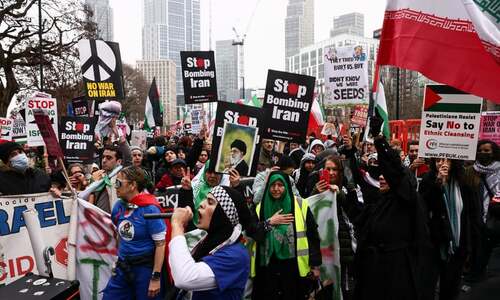

WAR. What is it good for? Thousands, if not hundreds of thousands of people are killed, entire nations and regions are devastated with the after-effects rippling for decades, if not centuries, seeding hate and rage that in turn sparks more wars down the line. But that doesn’t mean that war is all bad: depending on how you’re placed and how you play your cards, war can result not in generational trauma, but generational wealth because war can be great for business; all you really have to do is sacrifice whatever remains of your tattered conscience at the altar of accumulation.
So, let’s take a look at who stands to gain in the current US-Israeli war of aggression on Iran. Obviously, we have to start with the arms manufacturers who are seeing some handsome gains and are creating what they like to call ‘value’ for their shareholders. Northrop Grumman, which manufactures stealth bombers and, critically, the missile defence interceptors that are in such demand these days, saw its shares jump six per cent. RTX saw a 5pc gain on the back of their missile and artillery shells business and General Dynamics, known for manufacturing the M1 Abrams tank, Hydra-70 air-to-surface rockets and Gatling gun systems for F-16s, is also raking in the cash.
Tech companies like the incredibly shady Palantir have also been boosted and this is no surprise given how this company was founded with CIA backing and is deeply embedded with defence and intelligence agencies in the US, Europe and Nato. They’re the architects of the dystopian surveillance states that will define the years to come and so it’s no wonder that they’re drowning in gravy at this time.
A rising tide lifts all boats, and so European defence companies, too, are gorging on the scraps, with Germany’s Renk and Italy’s Leonardo also seeing a boost to their stock values. The gains aren’t just based on the current situation, but also on future projections. After all, we see Gulf states already begging for more interceptors and in whatever post-war scenario that emerges one thing is certain: each and every regional player will be lining up to buy weapons.
Who stands to gain in the war against Iran?
Israel is already salivating at the prospect: in a recent interview an Israeli defence analyst waxed lyrical about how “the Israeli security systems in the coming years will be very, very busy selling weapons systems”. When asked how Israel plans to produce all these weapons, the analyst pointed to “1.4 billion Indians” who will become Israel’s production line. So, yeah, that’s coming soon.
Those thinking that the economic disruption will hurt America more than others should think again: if Qatar’s LNG production and export is suspended, the US is poised to gain. They’ve already surpassed Qatar in LNG exports and while, yes, their production is currently nearly at capacity, the US plans to double its capacity by 2031. Here, Qatar’s loss is America’s gain.
But enough of the big boys and their toys. In today’s commodified world, even the littler guys can stand to gain thanks to the proliferation of sites like Kalshi and Polymarket in which you can actually bet on geopolitical outcomes — like what will happen in Iran — in much the same way as some would bet on run rates in a cricket match.
Currently, Polymarket has bets running on when the Iranian government will fall and on what date US ground troops will enter Iran and what the chances of Raza Pahlavi are. And given the nature of these bets, there are mounting accusations and even some evidence of insider trading by those privy to the decision-making processes of the US and Israeli military planners.
One Polymarket user named ‘Maga–myman’ is currently under investigation by Israeli police for being a bit too accurate with his pre-dictions. He made $500,000, accurately predicting the assassination of Ayatollah Khamenei, and prior to that, he not only accurately predicted the exact day on which the US and Israel launched the war on Iran, but placed the bet just 71 minutes before the first strikes when the possibility was only 17pc. There’s more: in 2024 the same user had predicted that Israel would attack Iran on Oct 26 and — surprise, surprise — he was right! Now he’s either an absolute savant or an insider privy to classified information who decided to make a few million dollars on the side.
He’s not the only one either; in February this year, Israel indicted a military reservist and a civilian who were using classified IDF intel to place bets on future military operations. Prior to these similar suspicions were raised when users accurately predicted the abduction of Venezuelan president Nicolás Maduro or the awarding of the Nobel Peace Prize to would-be quisling Corina Machado. So yes, if you’re low on morals and high on contacts, it’s a boon for you when things go boom.
The writer is a journalist.
Published in Dawn, March 9th, 2026