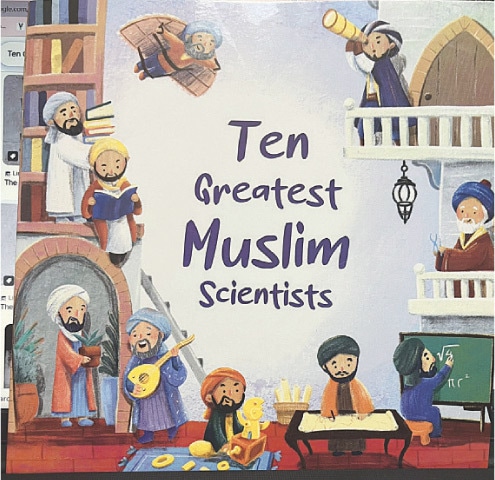
Did you know that, from flying from one place to another in an airplane to solving mathematical problems or creating music, everything we do today is due to a bunch of Muslim scientists who took the first step. In Ten Great Muslim Scientists, you get to meet these great people who are directly responsible for most of the things we love to do in this modern day and age.
Translated from ‘10 Ilmuwan Muslim Terhebat’, this heavily illustrated book introduces readers to those amazing Muslim scientists who invented machines and discovered stuff that still impacts our lives today. If you like to marvel at flying machines, you have Abbas bin Firnas (810 – 887 AD) to thank for creating the first successful flying device. If you are into telescopes and microscopes, you should thank Ibn Al-Haytham (965 – 1039 AD), known as the Father of Modern Optics.
A few more scientists, such as Al-Zahrawi (936 — 1013 AD) and Ibn Sina (980 — 1037 AD), also appear on these pages and are mentioned as the Father of Surgery and the Father of Modern Medicine, respectively.
Just imagine a life without doctors and medicine, and you will realise how important their contributions are. If you don’t know that the ultimate reference book for medical experts was penned by Al-Baitar (1197 — 1248 AD) or that Algebra was developed by Al-Khwarzami (780 – 850 AD), then you are in for a treat.
If without Al-Beruni (973 – 1048 AD) space travel wouldn’t have been possible today, then without Al-Idrisi (1100 – 1165 AD) travelling around the world would have been a task, because it was he who created the first world map.
Then there is Ibn Ismail Al-Jazari (1136 – 1206 AD), whose greatest invention was a hydraulic machine, aka a robot. And lastly, there is a page dedicated to Ishaq Al-Mawsili (767 – 850 AD), who created solmisation, the scale of do-re-me-fa-sol-la-si-do, which made composing music simpler.
Each scientist in this book speaks directly to the readers, which is the best way to capture their attention. He not only introduces himself, but also explains the reasons that led them to their invention or discovery.
Accompanying these pages are activities to lighten the mood and even involve your friends, who might also get to learn something they didn’t know.
So the next time you fly in a plane, consult a doctor or sing a song, think of the great Muslim scientists who made your life easier.
Published in Dawn, Young World, March 14th, 2026