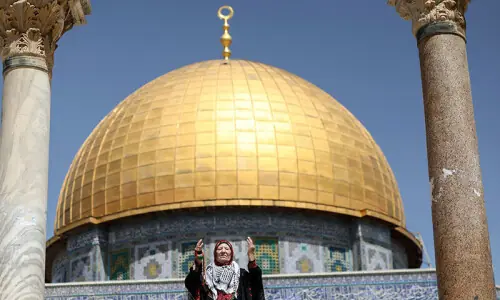
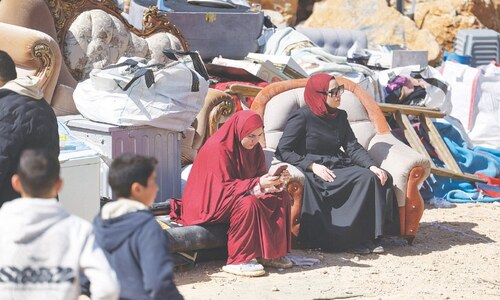
Jerusalem’s Muslims despair on Eidul Fitr as access to Al-Aqsa Mosque denied amid US-Israeli war on Iran
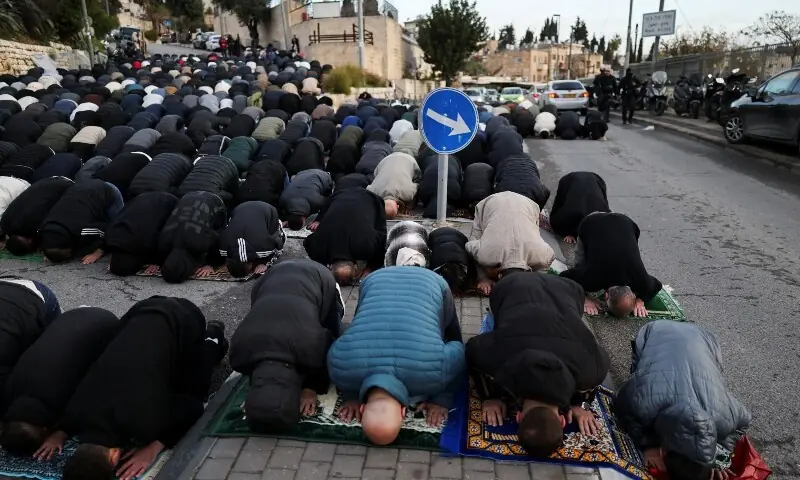

Hundreds of Muslim worshippers held Eidul Fitr prayers at the gates of Jerusalem’s Old City on Friday, with Israel closing access to the Al-Aqsa mosque and other holy sites over its war on Iran.
“Today, Al-Aqsa has been taken from us. It’s a sad and painful Ramazan,” Wajdi Mohammed Shweiki, a silver-haired Palestinian man in his 60s, told AFP.
“It’s a catastrophic situation for the inhabitants of Jerusalem, for Palestinians in general and for all Muslims across the globe.”
Since Israel and the United States started the war on Iran on February 28, Israeli authorities have closed access to Jerusalem’s world-renowned holy sites over security concerns — Al-Aqsa Mosque for Muslims, the Church of the Holy Sepulchre for Christians and the Western Wall for Jews.
As Iranian missile barrages head towards Israel, the authorities have banned gatherings of more than 50 people nationwide to limit potential casualties. In a sign of the risks, police said this week that shrapnel fragments had fallen on the Old City.
Researchers say this is the first time the Al-Aqsa Mosque — the third holiest site in Islam — has been closed during the last 10 days of Ramazan and for Eidul Fitr since Israel’s annexation of east Jerusalem in 1967.
As the holiday marked the end of Ramazan, worshippers denied access to the site arrived with prayer mats under their arms at dawn under the watchful supervision of Israeli police.
The crowd tried to push through the city gates, but the few dozen police officers repelled them, occasionally with kicks or slaps to the head and at least twice with tear gas.
Eventually, the worshippers managed to take up a position next to Herod’s Gate as the police relented for a few minutes and allowed the street prayers to take place.
An imam standing on a plastic stool delivered a short sermon.
“Pray, invoke Almighty God and hope that your prayers will be answered,” he told the worshippers.
“O God, grant victory to the oppressed.”
The Israeli police then pushed back the worshippers, who dispersed without resistance into the narrow streets, buying still-warm bread from street stalls as they went.
‘Broken heart’
The gathering of just a few hundred worshippers was a far cry from the typical way Eid is usually marked in Jerusalem, when some 100,000 people flock to Al-Aqsa.
The Israeli police said that “despite the high-alert status, police allowed prayers to be conducted on the street outside the Old City of Jerusalem without intervention”.
“However, officers were required to enforce… life-saving guidelines when crowds later exceeded authorised capacity and seemingly attempted to breach security perimeters into the Old City,” they said.
But while Israeli authorities claim the closure of Al-Aqsa is for safety reasons, there is fear among some Palestinians that it could be part of efforts to rewrite the strict rules governing access to Jerusalem’s holy sites.
“The occupier, under the pretext of security and for its own interests, has closed the mosque,” cleric Ayman Abu Najm, who had come from Beit Hanina, a Palestinian neighbourhood in east Jerusalem, said.
“In the history of the occupation, this is the longest period during which the Al-Aqsa Mosque has been closed.”
For some Muslims, the inability to access Al-Aqsa this year was felt as a deep personal loss.
“Ramazan without the Al-Aqsa Mosque is a very sad feeling, a feeling of having a broken heart,” said worshipper Zeyad Mona.