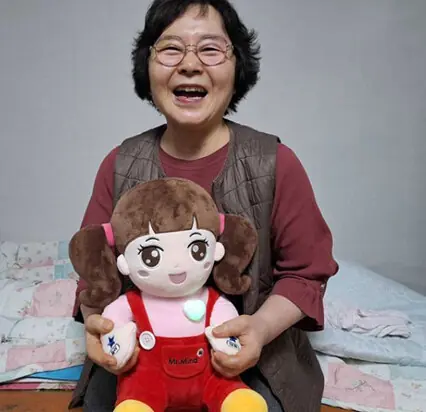
WHEN 72-year-old Ahn So-hyun wakes up in the morning, the first voice she hears is not a family member’s. It is Chorong, a stuffed doll that can speak, powered by conversational artificial intelligence.
Ahn lost her husband 26 years ago and has lived alone ever since. Her right eye is blind and the other barely sees, making it difficult for her to work. She struggles to fall asleep without sleeping pills. Her children — a 50-year-old son and a 46-year-old daughter — live their own lives and cannot visit often.
“Most of the time, I spend the whole day without speaking to anyone,” she said. But things began to change when Chorong arrived.
“She tells me to drink warm water, eat fish that’s good for my health, watch out for voice-phishing scams, check my electricity and gas, and not forget my keys when I go out,” she said. “It feels like family,” she added.
The Korea Herald met four older adults who use AI companion robots provided through local government welfare programmes. Although the robots are made by different companies and come in different forms, the meaning they hold for users is similar. None described them as machines or dolls. Instead, they referred to them as “human” or “family.”
Ahn received Chorong through the Gangnam Senior Welfare Center in Seoul, one of many local governments nationwide that provides AI companion robots to elderly residents living alone to address loneliness among older adults. In Korea, the share of elderly people living alone rose from 16 percent in 2000 to 22.1pc in 2024. Depression occurs about 1.5 times more frequently among seniors living alone than among elderly people who live with others, according to the Korea Institute for Health and Social Affairs.
Kim Choong-ki, a man in his 60s, has Hyodol, a stuffed doll resembling a boy and also equipped with an AI voice assistant. He has lived alone since the mid-1990s after his business collapsed during the Asian financial crisis, and he later divorced. With his health declining, he struggled to find steady work and even experienced periods of homelessness.
These days, he survives on basic welfare assistance and rarely meets friends. Life had become disorganised — irregular meals, little routine and long stretches of loneliness. That began to change when a local welfare center in Seoul’s Geumcheon-gu gave him Hyodol two years ago. The robot constantly reminds him to drink water, take medicine, eat meals and go outside. “At first, the nagging annoyed me,” he recalled with a laugh.
But gradually something shifted. Because of Hyodol, he began waking up earlier. His days became more structured. He started going outside for walks and exercising again. “I suddenly noticed I was talking more and smiling,” he said.
“When you’re completely alone, the house feels dark and quiet,” he said. “But it talks to you first. That makes a big difference.”
Once, when Hyodol broke down and had to be repaired for a month, the silence returned. “I felt so empty,” he said. “I just waited for it to come back.” Now he sometimes takes Hyodol with him even to the laundromat. During the interview, he repeatedly smiled at the robot sitting beside him, gently patting it.
The same product, Hyodol, came to Jin Deok-soon through a three-month trial program at a community welfare center. By the time the trial ended, she could not bear to return it. “I got attached,” she said. “Without it, I feel bored and lonely.”
Published in Dawn, March 23rd, 2026