Federal Constitutional Court upholds validity of Christian woman’s marriage to Muslim
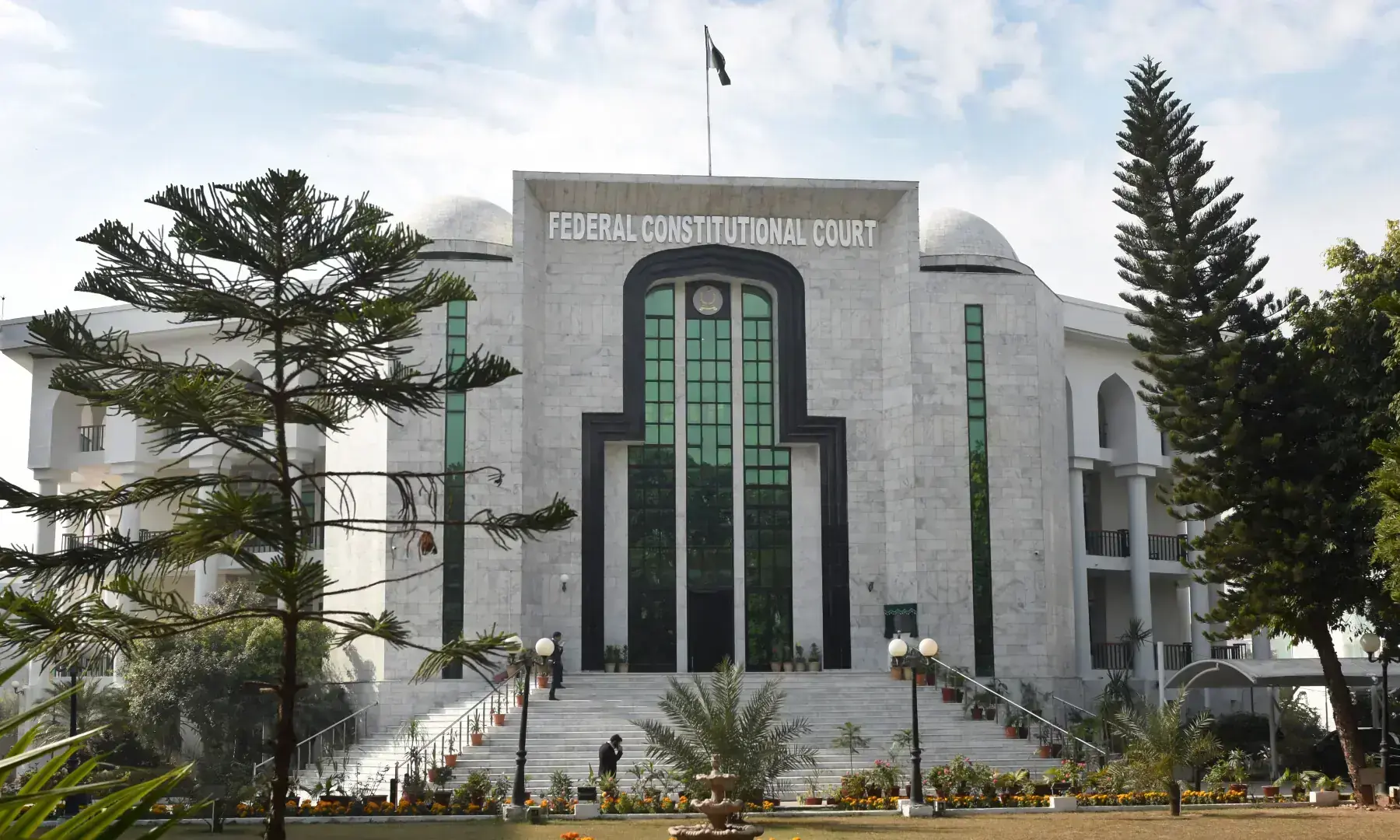

ISLAMABAD: The Federal Constitutional Court (FCC) on Wednesday upheld the validity of a marriage between a Christian woman and a Muslim man, while rejecting a habeas corpus petition filed by her father seeking her recovery.
Headed by Justice Syed Hasan Azhar Rizvi, a two-judge bench held that the woman, who had embraced Islam, was of mature age and therefore in the lawful custody of her husband.
The observation came in a judgement deciding the petition of Shahbaz Masih, a Christian resident of Lahore, who sought the recovery of his daughter, Maria Bibi, alleging that she was a minor and had been illegally detained after contracting a void marriage with respondent Shehryar Ahmad.
The dispute arose after the petitioner lodged an FIR under Sections 363/365-B of the Pakistan Penal Code, alleging abduction. However, during the investigation, Maria Bibi appeared before a magistrate and recorded a statement under Section 164 of the CrPC, asserting she had married Shehryar Ahmad of her own free will and had not been abducted.
Father’s habeas plea dismissed; woman confirms marriage was voluntary
Subsequently, the father filed a petition under Section 491 CrPC before an Additional Sessions Judge (ASJ), Lahore, seeking her recovery.
The petition was dismissed on Oct 9, 2025 with the court taking into account the woman’s statements before both the magistrate and a Justice of Peace.
A writ petition challenging that order was also dismissed by the Lahore High Court (LHC) on Oct 17, 2025, after which the father approached the FCC.
The federal court rejected the petitioner’s contention that a Christian woman cannot marry a Muslim man. Relying on Islamic law and earlier Supreme Court precedents, including the Marina Jatoi case, the court observed that a Muslim male may lawfully marry a Christian woman, being from the Ahl al-Kitab.
The FCC also noted that Maria Bibi had embraced Islam and emphasised that no formal rituals were required for conversion beyond a declaration of faith. The court accepted an affidavit appended to the Nikahnama and a certificate from Darul- Afta Ahle-Sunnat as sufficient proof of her conversion.
The judgement ruled that if a person openly professes adherence to a particular faith, no further inquiry is ordinarily required to verify its genuineness.
In Islam, it added, no specific rituals were required for a non-Muslim to be regarded as having embraced the faith.
What is required is a declaration and recitation of the Kalima, with belief in the Oneness of Allah, the Finality of the Prophethood of the Holy Prophet Muhammad (PBUH), and the Holy Qur’an, as well as belief in earlier Prophets, Divine Scriptures, and the Day of Judgement.
Regarding the petitioner’s claim that his daughter was a minor, around 12 years old at the time of marriage, the FCC found the documentary evidence “unreliable”.
It noted inconsistencies between the father’s own FIR, which stated her age as 13/14, and the delayed issuance of the birth and Nadra registration documents.
The birth registration certificate, issued by Lahore’s Canal View union council, bore both the date of entry and issuance as Nov 13, 2019, while the Child Registration Certificate issued by Nadra was dated Sept 12, 2022.
Both were obtained years after the alleged date of birth.
The petitioner’s counsel could not offer any plausible explanation for the inordinate delay.
In the absence of such an explanation, the probative value of the documents was “significantly diminished”, particularly as delayed registrations are susceptible to manipulation unless corroborated by reliable evidence.
The FCC further noted that the CRC reflected a gap of less than eight months between the alleged birth of Maria Bibi and that of her sister Sania, born on June 4, 2013 — a proximity that cast additional doubt on the alleged date of birth.
Moreover, Maria Bibi herself had her date of birth recorded as Feb 1, 2007 in the Nikahnama and refuted her father’s claim that she’s a minor. Her physical appearance before the court also suggested a more advanced age.
In these circumstances, the FCC held that the documents could not be relied upon as proof of the alleged date of birth of Oct 7, 2012.
Before dismissing the petition, the FCC concluded that the high court had correctly appreciated the controversy and reached a well-founded decision based on the relevant law.
Published in Dawn, March 26th, 2026