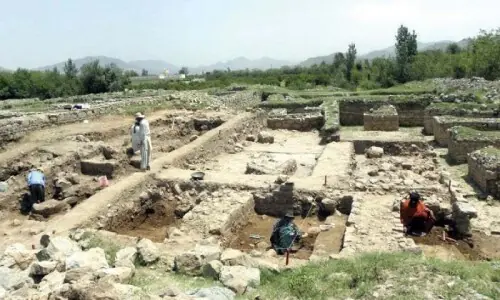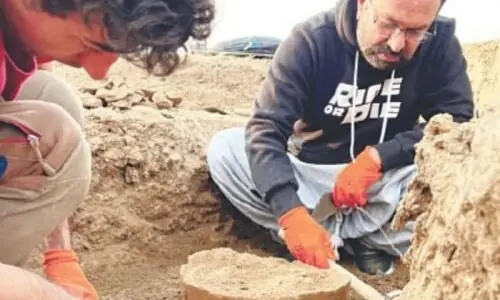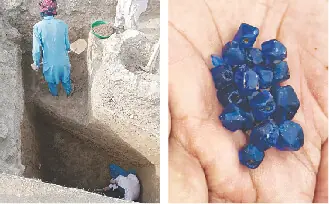
TAXILA: As many as 18 glass beads dating back to the early 2nd century BC to the 1st century AD have been discovered during recent excavations at the historic Bhir Mound, also regarded as the first city of the Taxila valley civilisation, which was abandoned between the 1st century BC and the 2nd century AD by the Bactrian Greeks, the last known inhabitants of the site.
“This appears to be part of a necklace, as the thread has rusted away while the beads survived. They were discovered in trench H-3 at a depth of 14 inches from the surface, a few yards from the Taxila Museum,” said Deputy Director of the Punjab Department of Archaeology Aasim Dogar, who heads the five-member excavation team.
The official noted that scientific research, systematic documentation and conservation efforts are helping preserve the region’s cultural heritage.
“The preliminary study suggests these newly discovered beads belong to the late Maurya period and the earliest Greek era in Taxila. Extensive archaeological research on such figurines confirms that these artefacts are characteristically local and indicate the artistic influences Taxila absorbed under the Mauryan rule,” Mr Dogar said. “Similar glass beads were earlier discovered by Sir John Marshall during excavations at Sirkap, the first metropolitan city of Taxila, between 1913 and 1934,” he added.
Japanese technology boosts modern excavation and conservation in Taxila
He said the discovery demonstrates that even in the BC era, the inhabitants of ancient Gandhara excelled in metalworking and had already invented glass. The presence of glass beads, he said, shows that Taxila was not only a cultural and educational hub but also an important industrial and commercial centre in ancient South Asia when the region played a major role in trade and craftsmanship. Taxila’s beads, he added, were widely traded across Central Asia and the Indian subcontinent.
“Preliminary dating places the artefacts between the early 2nd century BC and the 1st century AD, though specialists caution that further laboratory testing and contextual analysis are required before drawing definitive conclusions,” he said. Responding to a question, the senior archaeologist said that the utilisation of the latest Japanese and Chinese software and hardware, especially GPS technology, drone surveys, 3D scanning and digital mapping, has produced highly positive results.
He said key tools and equipment for excavation and quarrying were provided by the Japanese government through the Japan International Cooperation Agency (JICA) under the project titled Improvement of Equipment for Exhibition and Conservation of the Taxila Museum. The project was implemented with Japanese grant assistance amounting to 48.8 million yen in February this year.
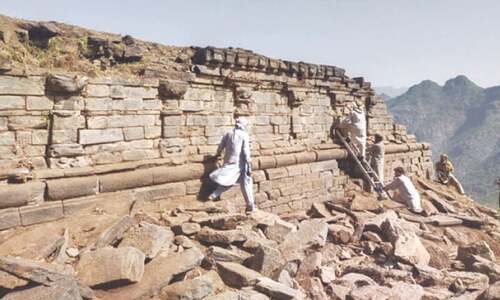
The Bhir Mound holds immense archaeological significance. According to experts, its remains represent one stage of the historic city of Taxila. The earliest town in Taxila was situated at the Hathial mound in the southwest corner of the Sirkap site. It lasted from the late second millennium BC until the Achaemenid period, with remains from the latter phase still present in the mound. Bhir Mound represents the second city of Taxila, beginning in the pre-Achaemenid period and lasting until the early Hellenistic period.
Historical accounts testify that Panini, the author of the renowned Sanskrit grammar text, lived in Taxila; Caraka, a famous master of medicine, also had a house on Bhir Mound; and Kautilya — the Brahman adviser to Chandragupta Maurya and author of the classic treatise on statecraft, the Arthasastra — was a resident of the ancient city as well.
Bhir Mound, along with nearby excavations, forms part of the Ruins of Taxila, which were inscribed as a Unesco World Heritage Site in 1980.
Published in Dawn, April 8th, 2026