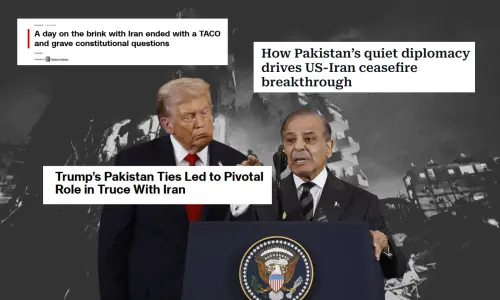
PAKISTAN’S leadership deserves all the credit it will receive. Prime Minister Shehbaz Sharif, Foreign Minister Ishaq Dar and Chief of Defence Forces Field Marshal Asim Munir, ably supported by a foreign service that performed with quiet distinction, pulled off in the early hours of Wednesday what had seemed, till the very end, a highly improbable diplomatic feat.
It bears putting into perspective what the stakes involved were. US President Donald Trump had announced that he would wipe out an “entire civilisation” if Iran did not surrender by Tuesday, 8pm Eastern Time.
Proud and unyielding, Tehran had made it amply clear that no threat or use of force would compel it to kneel. Amidst this gathering storm, Pakistan seemed to be one of the few voices of sanity actually working towards a resolution. Civilian and military leaders spent what was likely the toughest day of their careers navigating an active minefield of regional diplomatic and political sensitivities. Undaunted, they continued their attempts to bring one of the world’s oldest civilisations and the most powerful military force in human history to the negotiating table. At the eleventh hour, they succeeded. And the world thanks them for it.
There is, of course, much that remains to be seen. Still, what has been achieved is remarkable. Islamabad convinced not just Tehran and Washington but other major stakeholders as well that they must put an immediate stop to the bloodshed. The significance of this feat is all the more striking when one considers the extraordinary balancing act it required. Pakistan somehow managed to keep Saudi Arabia, Iran and the US onside while it quietly constructed the framework for a much-needed off-ramp.
Hours ahead of Mr Trump’s deadline, a major Saudi industrial facility was bombed. At the UN, several regional powers — among them many that Pakistan considers brotherly nations — had been pushing for an authorisation of force to reopen the Strait of Hormuz. Faced with these daunting choices, Pakistan abstained from that vote to give diplomacy a chance, while its military and civilian leadership condemned the strikes on the Saudi facility to reassure Riyadh. And through all of this, the leadership managed to keep Iran engaged in talks. It was, in the truest sense, a high-wire act.
But Pakistan must not stop here. Having demonstrated that it holds real clout in the region — rooted in its relationships across the Arab world, its standing as a Muslim-majority nuclear state, and the trust it has earned on both sides of the Persian Gulf — Islamabad is now uniquely positioned to help negotiate a lasting peace. It must consider using its good offices to convince the Arabs and Iranians that a regional pact for mutual harmony and coexistence is not merely desirable but necessary. The conduct of the Arab states through this crisis is instructive: faced with pressure to retaliate against Iran, they appear to have concluded that this was not their war to fight. That assessment, if Pakistan helped shape it, speaks to a depth of influence that should not be squandered. Rather than depleting themselves against one another, the nations of the region must now work together to address Israel’s ambitions, which have been articulated openly, including by senior US officials, and which threaten the stability of the entire region. Pakistan, having earned its place at the table, must now help set the agenda.
Published in Dawn, April 9th, 2026