Israel seeks peace talks with Lebanon ‘as soon as possible’ as world condemns Tel Aviv’s bombardment amid US-Iran truce

Israel’s Prime Minister Benjamin Netanyahu said on Thursday he had ordered his ministers to begin direct talks with Lebanon, pushing for Hezbollah’s disarmament amid mounting concern that its ongoing strikes could cause the fragile US-Iran truce to unravel.
A Lebanese government official told AFP shortly after Netanyahu’s announcement that Beirut “wants a ceasefire” declared before starting any negotiations with Israel, a day after deadly strikes across the country.
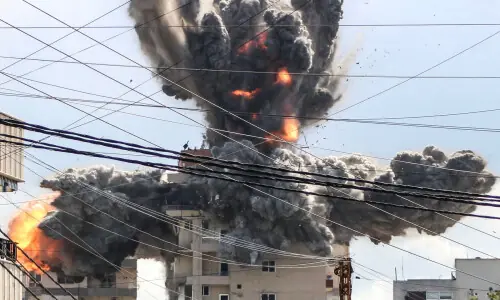
At least 300 people were killed and more than 1,000 wounded in the bombardment on Wednesday, the Lebanese health ministry said, while Hezbollah said it was engaged in close-quarters combat against Israeli forces on the ground on Thursday in the south Lebanon town of Bint Jbeil.
Netanyahu’s order for direct negotiations with Lebanon’s government was focused on disarming Hezbollah and establishing peace, according to a statement from his office, but he offered no immediate respite from the bombardment.
“Lebanon wants a ceasefire before starting negotiations,” said the Lebanese government official, who has knowledge of the matter and requested anonymity.
Even as Netanyahu spoke, Israel’s military issued a new evacuation order for Beirut’s southern suburbs, just a day after the wave of strikes.
“In light of Lebanon’s repeated requests to open direct negotiations with Israel, I instructed the cabinet yesterday to begin direct negotiations with Lebanon as soon as possible,” Netanyahu said.
“Negotiations will focus on disarming Hezbollah and establishing peace relations between Israel and Lebanon.”
He later said there was no ceasefire in Lebanon.
Separately, US President Trump confirmed to NBC News that he had asked Netanyahu to pull back on the strikes in Lebanon to help ensure the success of the upcoming negotiations.
“I spoke with Bibi (Netanyahu) and he’s going to low-key it. I just think we have to be sort of a little more low-key,” Trump said.
Meanwhile, Hezbollah lawmaker Ali Fayyad said that the group rejected direct negotiations with Israel and that the Lebanese government should demand a ceasefire as a precondition before any further steps are taken.
Israeli assault on Lebanon, which the UN described as “carnage”, has been condemned worldwide.
Brussels, Moscow and Ankara demanded that the US-Iran two-week ceasefire be extended to Lebanon.
“We view the situation in southern Lebanon with particular concern,” Germany’s Chancellor Friedrich Merz said, echoing statements from Paris and London.
“The severity with which Israel is waging war there could cause the peace process as a whole to fail, and that must not be allowed to happen,” he warned.
For their part, Iran’s parliamentary speaker Mohammad Bagher Ghalibaf said Tehran sees Lebanon as an “inseparable part of the ceasefire” and President Masoud Pezeshkian said Israel’s strikes rendered “meaningless” talks with US envoys planned for the end of the week in Islamabad.
‘Where is Hezbollah here?’
Hezbollah said it had fired rockets towards Israel in response to what it called a violation of the ceasefire.
President Donald Trump claimed victory in the Middle East war after agreeing a two-week truce to allow talks between US and Iranian negotiators to end a conflict that has already killed thousands and plunged the global economy into turmoil — but both Israel and the US insist the fighting in Lebanon is not covered by the ceasefire.
“We are continuing to strike Hezbollah with force, precision and determination,” Netanyahu said, in a social media post.
“Our message is clear: anyone who acts against Israeli civilians, we will strike them. We will continue to hit Hezbollah wherever necessary.”
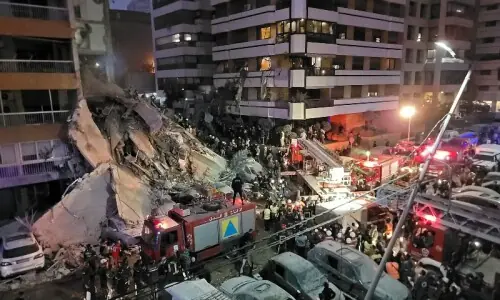
The day after the strikes, rescuers were still hard at work in the rubble of a building hit in the heart of a seafront residential neighbourhood of Beirut.
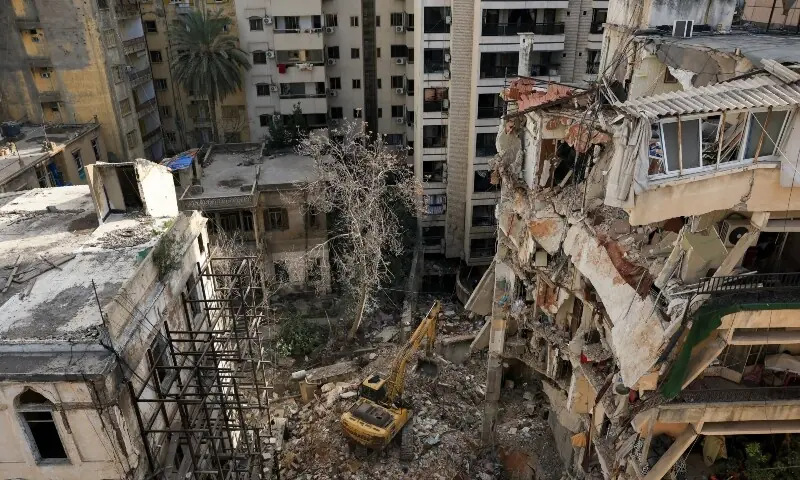
Half the building had collapsed, some rooms sliced in two by the deadly strike, a dining room and a water fountain exposed.
The other half of the building is nothing but a heap of stone and twisted metal, a school report card here, a law course from Saint Joseph University there, a child’s stuffed toy.
According to the civil defence, several bodies are still under the rubble.
“We don’t know where my niece is … the rescue teams have been working tirelessly since yesterday, but they haven’t found her,” Taha Qarqamaz told AFP.
Another of his nieces died of her injuries in the hospital. Two more are in intensive care.
“Look, these are school notebooks, class notes, books! Where is Hezbollah here? There is no Hezbollah in this neighbourhood!” protested his friend, Khaled Salam.
High-stakes talks
If the Islamabad talks go ahead, a key point of contention remains the Strait of Hormuz, through which a fifth of the world’s oil as well as vast quantities of natural gas and fertiliser pass in peacetime.
Iran announced alternative routes on Thursday for ships travelling through the strait, citing the risk of sea mines.
But it was unclear if Tehran was in practice allowing vessels to pass through the strait, following reports on Wednesday suggesting it was shut — something the White House called “completely unacceptable”.