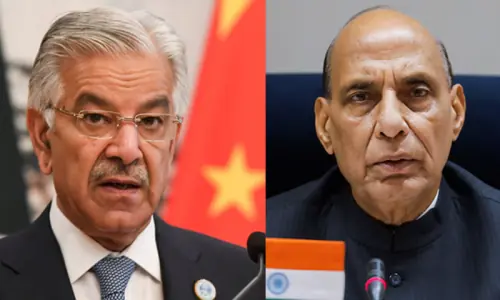

THE occasion was a meeting of the Shanghai Cooperation Organisation — a meeting which took place in the Kyrghyz capital Bishkek. Defence ministers from China and India were in attendance along with others from Uzbekistan, Turkmenistan and many Central Asian republics who are also members of the SCO. It was here that the Indian defence minister made a statement that was, coming from him, quite surprising. “Terrorism,” Rajnath Singh told everyone, “has no nationality, no theology”.
It is a statement that should have been lauded by all but back home in India it proved unpalatable. No sooner had Singh made these remarks than the Congress-led opposition kicked into high gear. Congress leader Jairam Ramesh took to X to state: “Yesterday, the defence minister, obviously with the approval of and at the instance of the prime minister, gave a shameful clean chit to Pakistan while speaking in Bishkek. … Clearly this new stance in relation to Pakistan is all part of the PM’s policy of appeasement of the US and calibrated capitulation to China. The defence minister’s shocking statements are as anti-national as the PM’s bizarre clean chit to China on June 19, 2020.”
All this is noteworthy as it reflects both the conundrums India faces in formulating a post-terror foreign policy as well as what its rabid focus on demonising Pakistan has done to its internal politics. The context of the meeting is also of note. Most participants were Muslim countries — such as Uzbekistan, Turkmenistan, Iran and Kyrgyzstan itself. Add China — a fervent Pakistan ally — and you have a group unlikely to be friendly to the sort of demonisation of Islam and Pakistan that is routine inside India.
Pakistan has moved on and so has the world.
Beyond the make-up of the audience is the reality of the world. India’s efforts to isolate Pakistan globally have failed. The role Pakistan is playing in helping negotiations in the conflict between the US and Iran has been commended widely. The role, along with a decisive victory in the war against India, has transformed its position on the world stage. It has increased Pakistan’s stature and made it less vulnerable to the accusations that India is used to making.
This creates a conundrum for India. The Modi government has arguably made Pakistan the centre of its foreign and domestic policy. Hatred of Pakistan has been used to whet unseen levels of Islamophobia and discrimination against Indian Muslims. The Indian film industry and media seem to use this hatred as a fulcrum for box office hits and drawing audiences. An entire generation of Pakistan-hating Indians has grown up under the shadow of this propaganda.
It is this Islamophobia that has until now supplied direction for Indian foreign policy. India’s overtures to Donald Trump were dictated in no small part because of his eagerness to denigrate Muslims as candidates. That pattern persisted in Trump’s first term which prompted all the bonhomie with Modi. Indians saw right-wing Americans as their buddies as they shared an aversion to Muslims and their faith. Trump’s second term and the turn of the far right against immigrants and Indians has been a shock.
The post-Operation Sindoor situation has worsened matters. Modi’s refusal to acknowledge the role President Trump played in halting the war — something he could not do without damaging his image as ‘vishwaguru’ at home — presented an opportunity to Pakistan. Pakistan has seized that opportunity.
The US-led ‘war on terror’ is over and the world no longer defines alliances through terrorism. The new wars are being fought over natural resources — who has them and who wants them. Pakistan has emerged as a unique broker with ties to both the existing and emerging superpowers. India’s foreign policy, by contrast, is based on a dated frame and lacks relevance.
Given this, it is possible that the defence minister’s remarks reflected a recognition of new realities. Situating India as a state that fights terror in general and is not fixated only on Pakistan is one way to start recalibrating foreign policy. As the reaction to Rajnath Singh’s remarks reveals, this may be harder than envisaged. Instead of lauding remarks that everyone should agree with — since terror indeed does not have a religion — the supposedly less Islamophobic Congress appears to be insisting on statements steeped in anti-Muslim rhetoric.
Pakistan has moved on and so has the world. India, however, remains stuck in a hate-filled and Pakistan-obsessed mindset, the cost of which is global isolation and irrelevance. Nobody is interested in joining hands to isolate the country serving world peace. Unfortunately, even when the Indian leadership was on the verge of recognising new realities it is being thwarted by the systemic hatred that it helped create.
The writer is an attorney teaching constitutional law and political philosophy.
Published in Dawn, May 2nd, 2026