Pakistan has fiscal space to fight climate crisis: Aurangzeb

• Calls macroeconomic stability ‘basic hygiene’ for unlocking climate funds
• WB official says global economy has resources to bridge financing gap
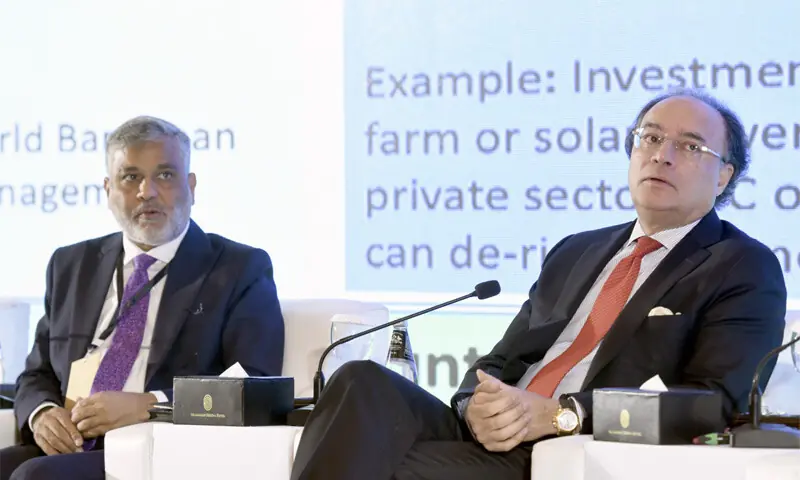
ISLAMABAD: Pakistan has adequate local financial capacity to address the impact of climate change, Finance Minister Muhammad Aurangzeb said on Tuesday, stressing that the country should first utilise available domestic resources effectively instead of immediately seeking international support.
He was speaking at a session titled ‘Mobilising Climate Financing for Pakistan’ during the Breathe Pakistan Climate Conference.
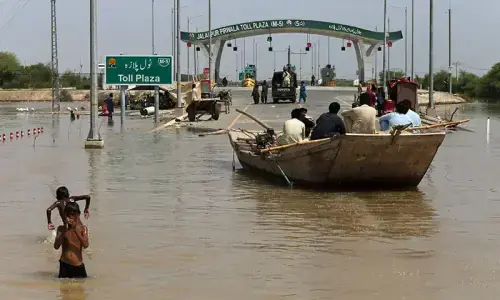
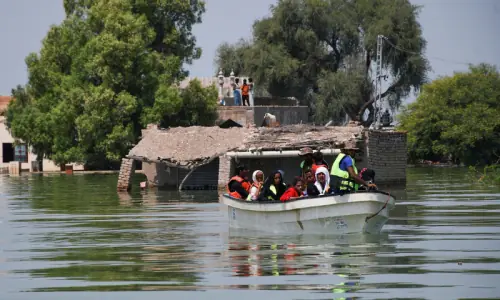
Referring to the devastating floods of 2022, the finance minister said the 2025 floods were even more intense and widespread, with three rivers and almost the entire country affected.
“Despite some demands to seek international funding, the government decided not to, as it deemed there was a fiscal buffer and fiscal space available,”Aurangzeb said. “Let’s first use the funds that are available now and put them to good and effective use.”
The minister said the “ball on climate funding” was now in Pakistan’s court and stressed that macroeconomic stability was as essential as “basic hygiene” to unlock climate-related financing.
He also emphasised the need for coordinated efforts among all ministries to bring the climate change discourse into the mainstream, warning that otherwise it would remain confined to academic discussions.
“It is quite clear that we have to work very closely with our counterparts, including the ministries of climate change and planning. We need to take a whole-of-government approach,” he said.
Adeel Abbas, senior climate change specialist and regional climate lead at the World Bank Group, presented global statistics on climate financing and noted that tackling climate change was a collective responsibility requiring efforts to bridge the “huge financing gap”.
Explaining climate financing, he described it as an “innovative instrument” that can utilise revenues generated through carbon finance.

“While we say $6.3 billion is required for climate, we know that more than $28 trillion was invested last year in long-term structured financing, so those resources are there in the global economy,” he said.
Dr Murtaza Syed of the Asian Infrastructure Investment Bank said fiscal risks and macroeconomic vulnerabilities made it “very difficult” for developing countries to access climate finance.
“We do not have enough financing going for emerging markets and developing economies, and yet the global fight against climate change cannot be won without these countries on board,” he said.
However, he also stressed the importance of domestic financing, stressing that countries like Pakistan could not rely solely on external funding to mobilise the required resources.
Pakistan Banks Association Chairman Zafar Masud said Pakistan needed to declare a climate emergency and ensure it translated into action rather than remaining a policy statement. He also proposed the “radical idea” of establishing a climate-specialised bank.
“There is no lack of funding, both locally and internationally. The real issue is mindset and awareness. People need to be made aware of how climate change can directly impact them,” Masud said.
Speaking on climate financing, Anouj Mehta, adviser at the Asian Development Bank, highlighted the issue of affordability and questioned how green bonds could be made more accessible. In this regard, he cited the examples of bonds floated by Thailand and Uruguay.
Another session titled “From Pipelines to Capital: Delivering Climate Finance at Scale” featured Alain Beauvillard, director of strategy, policy and innovation at the Green Climate Fund (GCF); Shauzab Ali, principal project officer at ADB; and Hamza Ali Haroon, regional director for South and West Asia at the CVF-V20 Secretariat.
Published in Dawn, May 7th, 2026