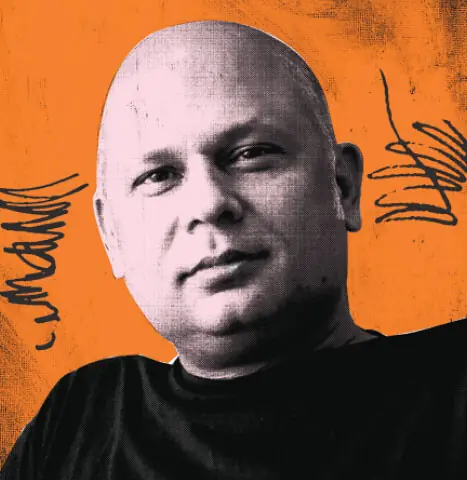
In recent years, we have seen emerging on the literary horizon of the Urdu world a sustained Jaun Elia frenzy among the young. While in many ways this is a reassuring tidal vogue, what we have here is a grand display of a complex figure that has a Janus face, for in the mêlée of a rowdy popularity, one of the faces of Jain Elia has become obscured.
Indeed, this mêlée has thrown into the blind spot a deeply philosophical and mythological aspect of our poet’s creative thought — his creative thought that is symbolic and abstract, often hauntingly self-referential, grounded deep in real or imaginal far-history.
This hidden aspect of Jaun Elia integrates the whole gamut of Western philosophical milieu, from Pre-Socratics and Plato through Ibn Sina to Wittgenstein, and it comes laced with the scriptural and mystical traditions of the ancient Near East, especially Mesopotamia: that is, the valley of Tigris and Euphrates reddened with the blood of Hussain and Hallaj.
This is a bit of a mouthful, and it certainly is, since this Jaun Elia can be dauntingly multilayered, intricate and undulating, not so easy to grasp. His shattering epic Ramuz (an unfamiliar, far-fetched word meaning “secret codes”) threatens to defeat the ordinary reader due to its intimidating vocabulary and terrifying metaphysical and mythological swings. And here is the Jaun Elia drowned out in the loud cheer of crowds thronging the streets of the Urdu world, a Jaun Elia we do not know.
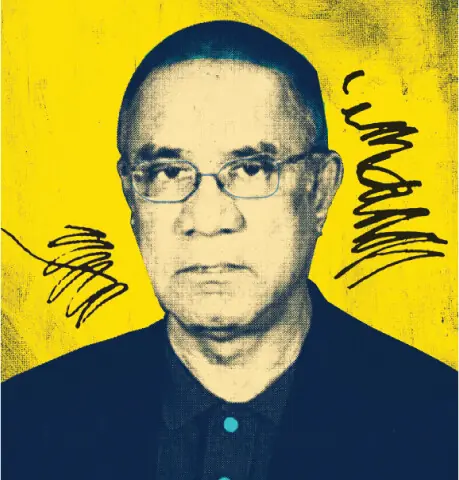
Recently, Dr Nasir Abbas Nayyar wrote on these pages of Dawn an elegant essay unveiling before us the Janus face of Jaun Elia, pointing out that there is much more in the Elia repertoire than the hype. This article of mine can be considered a reinforcement of Nayyar sahib’s timely essay.
But it ought to be acknowledged that already, many years ago, my beloved senior friend and Jaun Elia’s nephew, the late Syed Mumtaz Saeed, had pointed out emphatically that the greatness of this poet lies not in his crowd-pleasing ghazals (monorhyme lyrical poems with thematically independent verses) but in nazms (thematically connected body of verses), and that he was so given to the sonorous cheers of musha’iras that he ignored nazm writing. As for the grand Ramuz, Mumtaz Saeed sahib says that it has the possibility of becoming one of the greatest nazms of Urdu. Did our poet ever complete this epic? Who knows…!
Yes, Jaun Elia can be a far cry from his familiar image as a frivolous poet of the “sharm, dehshat, jhijak, pareshani” [shyness, terror, hesitation, disconcert] fame —
Tablet of the Journey
I am exhausted —
From this end to that end,
Yes, I am too exhausted!
Edge after edge there is a journey of the vision of light
And there is exhaustion
Exhaustion is rapture begotten by journey
And I overflow with rapture
On the eyelashes of the empty chambers of Nothingness,
the vision in light weeps.
Now descends fog in its eyes
and fog puts on spectacles.
Obliterating its own estimations.
I am exhausted, from this end to that end, Too exhausted! When the journey was reckoned,
Then, what a particle of the speck
revealed to me remains an intimate affair
Which I shall not entrust to anyone
The reckoning of the journey is a personal matter of the particle.
The night of being is spread from galaxies to galaxies
I am inscribed by the dust of time
That inscription which is written on the very whirlwind of the dust
I am that inscription which has been read here in the fog
of the lost vision …
(Ramuz)
The Sophist
One who exists
Is the one who is bent every moment
On an effort to keep me away from
My refined thoughts and
My lauded ideas
So it came to pass last night
that the one begotten by Protagoras
born of defiled seed
tossing and turning on my bed
said without being prompted:
“words are higher than meanings.”
“Yes, words are manufactured
They are the gifts of thousand upon thousand years of
Fear-creating innovations of speech —
They are lineages,
Lineages which have their authenticating chains of narrators
Then, words have a history
And meaning has no history.”
(Shayad)
Is this the same Jaun Elia we popularly know?
The columnist teaches at the Institute of Business Administration, Karachi. All translations are by him
Published in Dawn, Books & Authors, May 10th, 2026