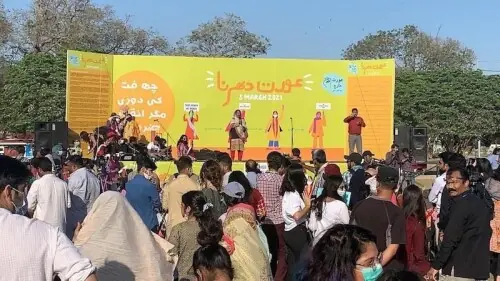
THE Sindh government’s 28-point list of restrictions imposed on Aurat March Karachi is a distressing example of familiar double standards: women are celebrated in speeches and choreographed photo opportunities, only for the state to recoil the moment they demand their rights.
The organisers sought permission to march peacefully for women’s rights. What they received, instead, was a document dripping with authoritarian anxiety. The message could not have been clearer: women may gather, but only if they remain politically harmless.
Rather than facilitating peaceful assembly, the administration chose to police slogans, speech and even clothing. The vague and sweeping conditions betray insecurity.
Why does a march calling attention to gender violence and economic inequality provoke such discomfort in official circles? Why are women demanding bodily autonomy and constitutional rights treated as a threat?
Secure governments do not fear placards, nor do they attempt to dictate what citizens may wear while exercising their rights.
Across Pakistan, as in the rest of the world, the overwhelming majority of perpetrators of violence against women are men. Women face harassment in streets, workplaces and homes. They are subjected to ‘honour’ killings, domestic abuse, forced marriages and institutional discrimination.
Yet instead of confronting the structures that enable such violence, the state’s instinct is to regulate women themselves. The state appears unable to tolerate women speaking in their own voice without bureaucratic approval.
There is an undertone of ‘women should be seen and not heard’ running through these directives — an outdated view masquerading as administrative procedure.
Just consider: in 2026, women in Pakistan must still seek permission to demand dignity while the state reserves the right to determine how loudly, how politically and even how appropriately dressed they may be while doing so. We have miles to go before we can claim to be a progressive society.
Published in Dawn, May 10th, 2026