Provinces asked to raise Rs400bn more to meet IMF goals
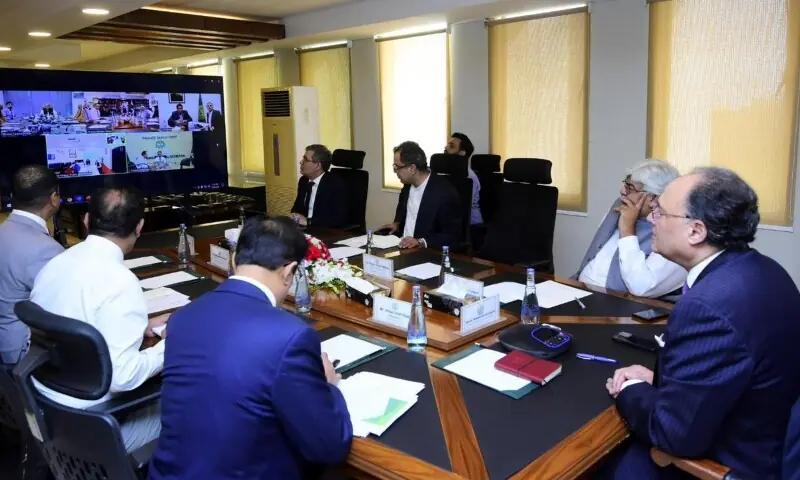

ISLAMABAD: The federal government asked the provinces on Monday to increase their revenue contribution by at least Rs400 billion, nearly 40 per cent of their existing share, in the coming fiscal year through more effective collection strategies in agriculture, property and services to remain in the good books of the International Monetary Fund (IMF).
At a consultative meeting with provincial finance ministers, Finance Minister Muhammad Aurangzeb conveyed the IMF’s deep satisfaction over the robust fiscal performance of both the four provinces and the Centre during the current fiscal year.
Speaking to provincial ministers via video link, Mr Aurangzeb said the IMF mission currently visiting Islamabad, as well as the federal government, expected the federating units to remain equally prudent in their fiscal operations for the remainder of the current year and to perform even better next year, a senior Ministry of Finance official who attended the meeting told Dawn.
The IMF staff mission, led by mission chief Iva Petrova, has been in Islamabad since May 13 to finalise, in consultation with government authorities, next year’s budget targets and strategies for achieving them.
Aurangzeb praises fiscal discipline, seeks stronger tax collection in property, services and agriculture
Provinces told to revise revenue targets
The provinces were asked to review their revenue targets and collection strategies for next year to increase their contribution to the country’s overall tax-to-GDP ratio. The two major revenue-generating provinces of Sindh and Punjab were specifically asked to improve their revenue contribution by around 40pc compared to this year.
With limited scope for expansion in Balochistan and Khyber Pakhtunkhwa, both facing varying security and governance challenges, the two larger provinces were asked to generate at least Rs400bn in additional revenue next year on top of what they are expected to deliver this year.
Sindh was reminded that much more needed to be done in the property tax sector, while Punjab’s Agricultural Income Tax contribution was described as far below its potential. As a result, the provincial contribution to the tax-to-GDP ratio was considered unsustainable. Mr Aurangzeb told all provinces that AIT collection needed to be expanded aggressively.
Matching fiscal effort
The IMF has asked the Centre to introduce at least Rs430bn worth of additional budgetary measures in the upcoming budget, alongside a nearly matching amount of Rs430bn to be generated by the four provinces.
This would raise total provincial revenues to Rs1.95tr next year, compared to the Rs1.264tr expected this year.
The provinces are expected to achieve these targets through improved collection of GST on services and agricultural income tax. They would then provide a cash surplus equivalent to 1.4pc of GDP to Centre. This surplus is expected to amount to nearly Rs2tr, compared to the Rs1.46tr provincial surplus projected for the current year.
The FBR’s revenue target for the next fiscal year has been projected at Rs15.264tr, approximately 13.7pc or Rs1.836tr higher than the current fiscal year target.
Under this annual projection, the FBR’s half-year target ending December 2026 has separately been set at Rs7.022tr. This suggests the IMF expects around 12pc organic revenue growth, based on its estimate of 8.4pc average inflation and 3.5pc economic growth, with the remaining gains to come through budgetary, administrative and digital reforms, as well as enforcement measures.
Provincial development budgets are estimated at Rs2.5tr next year, compared to Rs2.1tr in the current fiscal year.
During the first three quarters, the four provinces jointly provided a healthy cash surplus of Rs1.636tr to the Centre over nine months — Rs172bn higher than the Rs1.464tr target set for the entire year under the IMF programme.
During the same period last year, the provinces had missed the budget target, jointly producing a Rs1.053tr cash surplus against Rs1.2tr annual target.
Punjab led the provinces by generating an Rs824bn budget surplus over nine months, followed by Sindh with Rs441bn. Informed sources said both provinces had effectively curtailed spending under their respective Annual Development Programmes. KP also posted a Rs253bn surplus, followed by Balochistan with Rs118bn.
Published in Dawn, May 19th, 2026