
DONALD Trump says that he was persuaded by interventions from the rulers of Qatar, the UAE and Saudi Arabia to desist from resuming the US-Israeli military assault on Iran scheduled for yesterday. According to the US president, he’s been informed “that serious negotiations are now taking place, and that … a Deal will be made” which is acceptable to everyone.
Similar sentiments have been expressed before, and no one appears to have convinced Trump that holding a gun to Iran’s head is unlikely to facilitate any kind of agreement. It’s easy to understand, though, why Riyadh, Abu Dhabi and Doha might be petrified by the prospect of renewed hostilities. Somewhat understandably, the Gulf states feel unfairly victimised by a war most of them didn’t desire. They are miffed by the fact that the Western military bases they host at great expense turned them into targets instead of providing a protective shield.
Notwithstanding their professed neutrality at the outset of the conflict, it was naive to expect that in the evolving circumstances a belligerent power’s facilities in the neighbourhood would escape Iran’s attention, or that Tehran would not weaponise its leverage over the Strait of Hormuz. To be fair, the Gulf palaces were more aware of these possibilities than the White House, but any calls for restraint went unheeded in February. Trump might now be more open to solicitations from Arab client states because he’s keen to get out of the mess into which Israel led him. Yet his ego demands he must be perceived as a winner, hence his insistence on Iran relinquishing its nuclear capabilities.
Had Tehran seriously wished to manufacture a nuclear weapon, it probably could have done so long ago, or at least after Trump in his first term pulled out of a multilateral deal that limited Iran’s capacity to refine uranium beyond the level required for civilian purposes. But after the 2025-26 wars, the need for a deterrent must seem more urgent. A nuclear weapons-free Middle East remains a desirable goal, but it’s almost impossible to envisage any future US government demanding that Israel surrender its weapons of mass destruction.
The Gulf states may be petrified at the thought of more hostilities.
That could be one reason why the UAE has doubled down on its attachment to Israel as its chief ally and saviour. Iron Dome anti-missile technology has reportedly been delivered. It evidently failed to stave off last Sunday’s drone attack on a nuclear power station in Abu Dhabi. Iran or its proxies are the chief suspects, but the drones came across the western border that separates the Emirates from Saudi Arabia. Saudi involvement is unlikely, of course, but Riyadh and Abu Dhabi have been at loggerheads on various geopolitical pursuits, from Yemen to Somalia, Sudan and Libya.
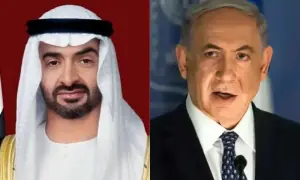
When Benjamin Netanyahu claimed last week that he had flown to the UAE for a summit at the height of the aggression against Iran, leading to “a historic breakthrough in relations”, Abu Dhabi’s implausible denial was couched in bizarre terms, insisting that “any claims regarding unannounced visits or undisclosed arrangements are entirely unfounded unless officially announced by the relevant authorities in the UAE”. In other words, let sleeping secrets lie. Netanyahu’s acting chief of staff later noted that the Israeli prime minister “was received in Abu Dhabi with the honour of kings” and that “the sheikh… personally drove [the Israeli PM] … from the plane to the palace”. What was agreed at their talks “will be talked about for generations to come”.
The latter indication may well be accurate, but it suggests that the UAE wishes to escape its geography — it lies across the Persian Gulf from Iran — and align itself even more closely to a genocidal state. Qatar has suffered as much as Dubai in its loss of Western expats and tourists, yet it hasn’t so far fallen into the Zionist trap. Nor have the Saudis, despite pressure from Washington. It has been reported that both Doha and Riyadh resisted Abu Dhabi’s imprecations to join the Israeli-US war against Iran. Both the UAE and the Saudis are said to have retaliated against Iran, but not in coordination. The Saudis eventually latched on to Pakistan’s thus far unrewarded bid for conciliation, while the UAE has, according to reports, been expelling Shia workers (many of them Pakistanis).
It has become difficult to sift facts from propaganda, half-truths and disinformation that flow from all sides, but what’s incontrovertible is that none of the global economic repercussions we are witnessing would have transpired without the mindless absurdity of Epic Fury. No previous US president fell into this Israeli trap, and the idiotic incumbent is struggling to wriggle out of it. One can only wish him luck, but what the grinding mills of geopolitics might have in store for Zionism-adjacent Gulf entities remains an open question.
Published in Dawn, May 20th, 2026