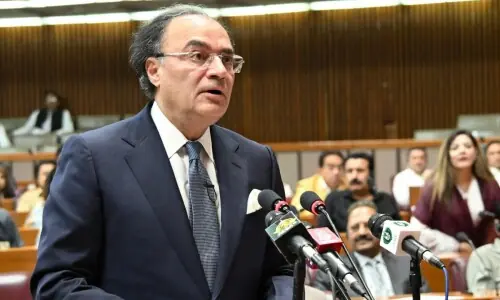
A BROAD outline of the next budget has emerged after recent talks between the government and the IMF. And there is little that suggests a departure from the stabilisation-heavy approach that defines economic management under the current IMF programme. The understanding between the government and the IMF reinforces what was already anticipated.
Fiscal consolidation driven by tight monetary policy and revenue extraction will remain the central pillar of the next budget. Growth, investment and employment generation will continue to take a back seat. The commitment to maintain a primary surplus of 2pc of GDP has effectively been declared untouchable. Combined with an “appropriately tight” monetary stance, higher petroleum levy collections, fresh tax measures and reduced subsidies, the next budget appears to be another exercise in balancing numbers than reviving growth.
Simply put, it means continued compression of domestic demand, suppression of industrial expansion and reduced fiscal space for development investment. The Gulf conflict has provided another excuse for maintaining the stabilisation momentum. The IMF has explicitly referred to the impact of regional disruptions in discussions with Pakistan.
That said, the truth is that even in the absence of external shocks, the economy was hardly showing signs of sustainable recovery to support growth. Inflation may have eased from its peaks and reserves stabilised somewhat, but the economy’s underlying structure remains weak, debt-ridden and dependent on external financing.
Though an IMF mission statement spoke of “gradual fiscal consolidation” through broadening the tax base, improving tax administration and enhancing spending efficiency, the broader direction is unchanged. As previously, the burden of adjustment is likely to again fall disproportionately on low- and middle-income households and compliant businesses.
More striking is how the entire fiscal architecture continues to revolve around meeting stabilisation targets without addressing the structural weaknesses that repeatedly push us into balance-of-payments crises. Fiscal consolidation continues to be harped upon to mask the failure to implement long-delayed reforms aimed at improving productivity, boosting exports and fixing governance. Agriculture is trapped in low productivity and outdated market structures. Industrial competitiveness continues to decline because of the high cost of doing business, policy unpredictability and a difficult business environment. Narrowly concentrated exports are unable to compete in the global markets.
The stabilisation achieved through painful growth compression steps could have been used as a platform for structural reforms. Those reforms were needed to remove bottlenecks to productivity, encourage industrial modernisation and create export-oriented growth. Instead, policymakers do not seem to mind debt rollovers and lurching from tranche to tranche. The tragedy is that when the current IMF programme ends, this period may well be cited as another lost opportunity.
Published in Dawn, May 23rd, 2026