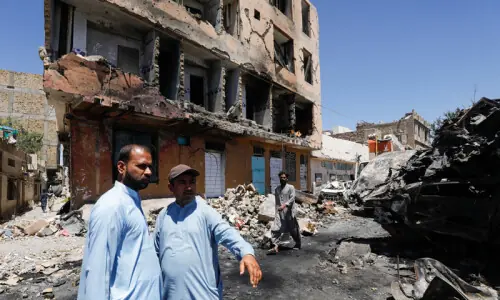
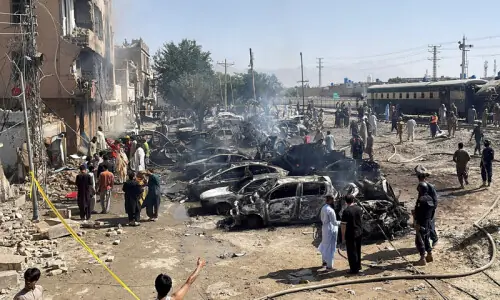
A PALL has descended on Eid festivities. The Sunday suicide bombing in Quetta has left many grieving their loved ones at a time when others will be celebrating the bonds of faith and family. According to the official count, more than a dozen lives were snuffed out, and at least 20 people were left injured; later reports put the toll much higher.
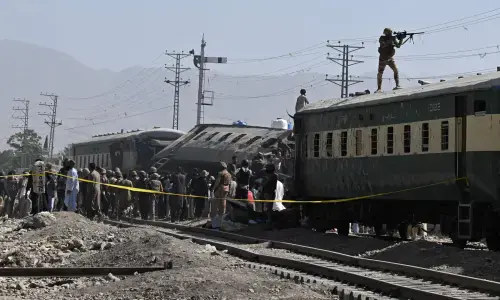
Maimed bodies of women and children were seen being carted from the site on stretchers. One wonders what monstrous instinct compelled the perpetrators to commit such senseless violence. Officials and hospital sources later noted that the victims were mainly passengers of the ill-fated shuttle train, on their way to board the Peshawar-bound Jaffar Express, as well as pedestrians and residents living along the railway track where the bombing occurred. The Balochistan Liberation Army claimed the attack, cementing its credentials as a terrorist outfit that resorts to violence against defenceless victims.
The fact that terrorists were once again able to target travellers is of particular concern. It seems that the Jaffar Express, which connects the provinces of Balochistan and KP and passes through Sindh and Punjab, has become a symbolic target for malicious elements. This is a major problem for those responsible for ensuring the security of both the citizenry and the infrastructure of the province; the authorities must devise an actionable plan to address this menace.
It is also deeply regrettable that actors claiming to represent Baloch interests have made a legitimate target of what are otherwise unarmed civilians. No ideology can justify the murder of innocents, and there must be zero tolerance for such hateful elements. The state must receive all the support it requires to take action and neutralise these merchants of death.
That said, there must also be some reflection on why Balochistan continues to slip out of the hands of those tasked with its administration and governance. The state keeps reiterating the role of hostile foreign actors in fomenting unrest, yet seems to be short on ideas on how to prevent the ingress of such actors and their ideologies in Baloch society. The sense of alienation within the Baloch people, which allows these foreign forces to feed on the locals’ dissatisfaction and disillusionment, is rarely addressed.
Political wisdom dictates that the people of Balochistan must be empowered and, in turn, also be responsible for peace and stability within their society. But this can only happen if the province is allowed to experience an unhindered and relatively clean political process. Lastly, the centre has made a mistake by pushing away Baloch leaders who may have harboured grievances but still respected the Constitution and denounced violence. It is time to re-engage with them and let them propose solutions for the province’s multiple troubles.
Published in Dawn, May 26th, 2026