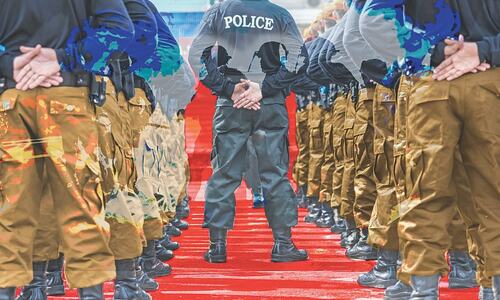

POLICE stations are seen as a state’s physical and operational manifestation, where victims must feel the state’s protective presence. They must function as ‘shock therapy’ centres, a frontline service and protectors of human liberties. In the age of technology, are more police stations needed in districts, or can existing ones be supplemented by e-police stations?
Police stations may vary in size, jurisdiction and tasks. In ancient Rome, the Vigiles saw to law enforcement. Asia and the Middle East lacked permanent establishments; the military and local magistrates performed the task of policing. In the UK, Robert Peel created police stations to serve as patrol bases, lockups and administrative offices. France adopted a centralised structure, with police posts across cities. Municipal police departments emerged in US cities. Japan has community policing — the Koban system based in small neighbourhoods, focusing on building community trust.
As per Police Rules, 1934, in Pakistan, the number of police stations is based on population and crime rates. Insecurity and terrorism must also be factored in. Police stations operate in notified jurisdictions or have specialised tasks like women protection, cybercrime and excise. Rural outpost stations operate in Pakistan, India and Canada, with fewer facilities and staff. Globally, police are transitioning from force to public service; in postcolonial states, police chiefs overlook police-public mistrust. Police stations present a shabby look and hardly cater to victims’ needs. Today, model police stations are set up without evaluating service delivery. Taxpayers must know how they differ from traditional ones.
Physical changes aren’t enough; better attitudes and public service are vital. For example, women police stations were set up to deal only with women victims, but anti-women crime didn’t decline significantly. To improve outreach, KP Police set up women desks mainly in urban areas. More women police should have quality training, with greater outreach. SHOs should directly receive operational funds to ensure transparency, discourage corruption and save victims from bearing the cost. KP took the lead, but improvement is needed.
Infrastructural changes aren’t enough.
Post 9/11, several police stations faced attacks, exposing security loopholes. KP tried to standardise their design. More investment in policing, including community outreach, communication and accountability, will improve safety. In rural areas, police stations still function without technological backup. Beyond numerical models, technology-driven solutions will enhance public service.
Community interests will be served by ensuring the tenure and accountability of SHOs through public oversight. Often, a long chain of command inconveniences complainants who prefer to approach senior ranks to seek help from police stations. Making the latter effective means empowering the staff. Policing without public engagement won’t help; institutionalising the public’s role is necessary. Under colonial rule, public interactions were part of policing; after independence, distrust widened.
Beat officers recorded their observations, making foot patrolling an effective means of collecting information and intelligence. Vehicular mobility may be faster, but has reduced direct public contact. Social media may reduce the gap. Village touring and open houses were effective, but with corruption and lethargy, village touring ended — officers used to visit police stations, meet field officers, judges and ordinary folk to better understand the dynamics of an area and crime patterns. Police station inspections are now a mere formality. They used to help in crime prevention and detection. Crime review meetings were regular, but are now simply PowerPoint presentations. Meetings helped assess the capabilities of junior officers, crime hotspots and criminals’ modus operandi. Burking of crime and manipulating crime statistics abet criminals and affect the government’s grasp of reality, resulting in fewer funds and resources for police.
To end the ‘tout culture’ and influence of unauthorised middlemen, transparency, accountability, public support, technological intervention, better outreach and clear complaints and investigation processes are needed. Digital reporting systems, complaint tracking and facilitation desks can be useful. Officers supporting or benefiting from touts must face disciplinary action. Police stations must uphold citizens’ dignity and ensure justice is delivered without bias; officers must be trained to serve. Through transparent procedures, reforms and community policing, Pakistan can rebuild public trust in law enforcement. A reformed police service will strengthen the rule of law and create a safer, more democratic society.
The writer is the author of Pakistan: In Between Extremism and Peace.
X: @alibabakhel
Published in Dawn, May 27th, 2026