Govt mulls scrapping export tax in budget

• 1pc advance tax removal may bring a meagre Rs100bn relief
• Textile sector pushes for broader reforms, refunds, and lower energy costs
• 68pc tax burden eroding competitiveness; industry demands restoration of Final Tax Regime
ISLAMABAD: The government is considering abolishing the one per cent advance tax on exporters in the upcoming federal budget, a move that could provide relief of around Rs100 billion.
However, no broader fiscal support for the struggling sector is currently on the table.
Officials familiar with the budget discussions told Dawn on Friday that the proposal is under active consideration as part of limited, targeted measures for the export industry, particularly the textile sector, which has been pressing for wide-ranging reforms.
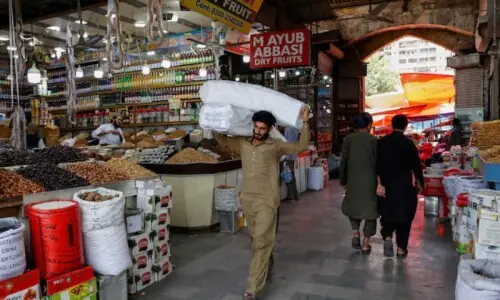
The 1pc advance tax, charged on export proceeds, has long been criticised by exporters as a liquidity-draining measure that ties up working capital despite thin margins and delayed refunds.
Industry data showed that exporters alone had paid nearly Rs200bn in excess on account of 1pc advance income tax during FY25 and FY26.
“This is essentially returning a fraction of what has already been collected,” said a leading exporter, pointing to the cumulative burden of taxes, high energy costs, and blocked refunds that continue to constrain operations.
The textile sector, which accounts for the bulk of Pakistan’s exports, submitted a comprehensive set of proposals ahead of the budget, including the restoration of the Final Tax Regime (FTR), a reduction in energy tariffs, clearance of over Rs327bn in pending refunds, and the revival of export incentives.
However, sources indicated that most of these demands are unlikely to be accommodated in the upcoming budget, which remains constrained by revenue targets and ongoing stabilisation commitments.
Industry data place Pakistan at a significant disadvantage in terms of effective taxation. Exporters face an estimated burden of over 68.27pc, exceeding regional competitors.
By contrast, Vietnam maintains a corporate tax rate of around 20pc, Bangladesh ranges from 22.5 to 27.5pc, and India applies a graduated structure from 26 to 34pc. These comparatively lower and more predictable regimes enable exporters in competing countries to retain margins and reinvest in capacity expansion.
The gap indicates that Pakistan’s taxation framework is not only higher but also more complex, with multiple levies contributing to the cumulative burden.
Exporters pointed out that the advance tax is particularly burdensome because it is applied at the point of transaction, regardless of profitability, effectively increasing the cost of doing business in an already high-tax environment. The proposed relief of Rs100bn, while significant in absolute terms, is modest when viewed against the sector’s liquidity requirements and accumulated tax payments.
Energy pricing emerges as one of the most critical constraints. Industrial electricity tariffs in Pakistan stand at approximately 11.5 cents per kilowatt-hour, compared to 6.3 cents in India, 8 cents in Vietnam, and as low as 5 cents in Uzbekistan.
Gas prices show an even sharper divergence, with Pakistan at about $13.5 per mmBtu versus $6 to $7 in India and Vietnam and around $3 in Uzbekistan. In addition to higher tariffs, Pakistan faces supply reliability issues, whereas countries such as China and Vietnam offer stable supply along with preferential industrial tariffs.
The combined effect is a substantial increase in production costs, directly affecting export competitiveness.
Indirect taxation
Pakistan’s indirect tax regime is characterised by a uniform 18pc GST on both inputs and finished goods, with refund delays extending from months to several years. In contrast, regional competitors apply differentiated rates and efficient refund systems. Bangladesh applies reduced or zero-rated value-added tax (VAT) on export inputs, India operates a structured GST system with refunds typically processed within two to four weeks, while Vietnam and China offer near-immediate or automated refund mechanisms.
This divergence creates a liquidity disadvantage for Pakistani exporters, as working capital remains tied up in delayed refunds.
Pakistan Textile Exporters Association (PTEA) Patron-in-Chief Khurram Mukhtar, in a statement, said Pakistan’s export sector and the entire textile value chain are unfortunately fighting against a mindset that appears bent on penalising the very ecosystem that earns foreign exchange, creates jobs and sustains documented economic activity.
The harsh reality today is that the more exporters grow, the more they are burdened. In many cases, the more you export, the more you lose, he said.
The government’s own documented figures reveal that the shift from the FTR to the Normal Tax Regime (NTR) has resulted in an estimated additional revenue extraction of approximately Rs90bn.
Exporters should have the option to remain under FTR or to voluntarily opt for NTR. This was perhaps one of the rare moments in Pakistan’s history when the entire textile chain converged on a concrete and balanced proposal. Unfortunately, even this unified recommendation does not appear to be receiving serious consideration, he added.
The Export Facilitation Scheme (EFS) was one of the few excellent reforms introduced in recent years. It was fully digitalised, bringing transparency and efficiency to the system. However, the exclusion of domestic commerce from EFS significantly increased the burden on exporters and disrupted the integrated textile value chain, he remarked.
“We have repeatedly stressed that the super tax should be abolished in a phased manner along with Minimum Turnover Tax (MTR), inter-company dividend taxation and taxation on bonus shares, particularly when bonus shares are a non-cash item and do not represent actual income generation”, he said.
Similarly, exporters proposed a progressive GST framework: raw materials may be taxed at 5pc, fabrics at 10pc, and finished products at the standard GST rate, thereby ensuring that primary revenue collection occurs at the finished product stage rather than trapping capital throughout the manufacturing chain.
Published in Dawn, May 30th, 2026