

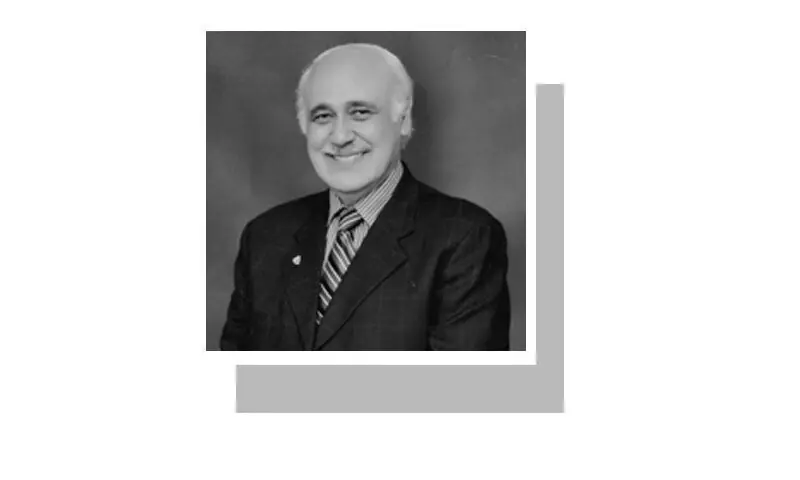

SHE restored the dignity of life to so many of her patients. It is tragic that Dr Naseem Salahuddin should have suffered the cruel indignity of death. Dr Naseem had gone to attend a WHO meeting in Morocco. She and her husband Dr Iftikhar Salahuddin were in a car accident, in which she died.
Both were well-known professionally. Dr Iftikhar, an ENT surgeon, is also a skilled photographer turned author. His sumptuous illustrated publications included Jerusalem: A Journey Back in Time (2013), If Stones Could Speak: Echoes from the Past (2016), and Persia: Land of Emperors and Kings (2023).
Dr Naseem’s own book — Among My Own: The Untold Stories of My People (2022) — is modest by comparison, more intimate. Its 260 pages covered 56 case studies out of the countless patients she had treated during her long career as an infectious disease specialist. At another level, her book read like a social commentary on contemporary Pakistan — its class divisions, the foibles of the hypochondriac rich, the helpless poor trapped between crushing poverty and brittle conventions.
Dr Naseem’s inspiration the Russian playwright Anton Chekhov (also a physician), wrote: “Each life lives again in me.” Each of the cases she described yielded a parable for her. It contained a deeper truth.
Dr Naseem spent her life providing succour to patients.
She watches a Sindhi hari transport his sickly son in a creaking cart to the nearest town hospital and death. She attends a 40-year-old mother, exhausted after bearing 22 children including four sets of twins — “all sick, weak and illiterate”. She condemns intermarriages that lead to congenital deafness and dwarfism. At one wedding, she notices that the family members of the bride and the groom “all were short-statured, had square jaws, and most wore thick glasses. It was quite apparent that all of them were cloned from the same original pair of genes”.
She listens with concern when a junior government servant explains: “My wife is mentally deranged[.] Every morning, before my daughter leaves for school and I leave for work, we feed her and then tie her to the bed with a rope until one of us returns home to feed or wash her, or change her clothes”.
The rich have their own problems — chronic hypochondria, AIDS contracted in Bangkok, self-indulgent obesity, drug and nicotine addiction. She notes the 65-year-old to whom “coughing was as natural as breathing. His fingers had turned yellow, his eyes bulged, and his voice was hoarse; he felt proud of his chain-smoking prowess of over 50 cigarettes a day.” Gradually, he deteriorated until he died: “Cancer had cured him of smoking.”
Another silent killer — hepatitis — often goes undetected. Hepatitis B is preventable with a vaccine; hepatitis C is not. Dr Naseem traced the infection of some patients to a local nai or barber who used blood-stained blades. She scolded him. He replied that she was ruining his business. The obvious retort was: “You are ruining lives.”
A similar poignant case was handled by the late Dr Zeenat Hussain, who ran mobile clinics near Lahore to increase awareness of hepatitis. A mother of three sons came to her, suffering from hepatitis. The sons took turns to look after their mother. At their bachelor home, they shared the same infected razor. First one, then the second and finally the third died. The sick mother was left alone to die.
Dr Naseem had to confront orthodoxy — as she put it, ‘dawa versus dum’. The maulvi brought by the patient’s relatives performed rituals while the medical team gave the necessary medicines. Not surprisingly, the family attributed the patient’s recovery to the spiritual ministrations rather than to science.
Perhaps the most moving case Dr Naseem encountered was not of a living patient but of a dead person, for whom a distraught daughter needed a death certificate. Dr Naseem drove into “the uninhabited, sandy desert” beyond DHA Phase 8, Karachi. Among the inquisitive crowd of mourners, she recognised other patients — the “One-eyed One”, “The Toothless One”, the “One-legged One”.
She recalled the dead man’s wife — another patient — who had died a shabby death years earlier. She contrasts that death with one where an American corpse “slept in bridal white satin[;] cosmetology had transformed her into Sleeping Beauty”.
Dr Naseem spent her life providing succour to patients — some begging for a cure, others suffering their dwindling days before they departed “unhonoured, unwept, unsung”.
In Dr Naseem’s passing, Pakistan has lost not just a skilled medical specialist but a sensitive pen. (She frequently wrote for this paper.) As her favourite Chekhov wrote: “I believe that nothing passes away without leaving a trace.” Dr Naseem’s lifetime of service survives her as an enduring example of selfless humanism.
The writer is an author.
Published in Dawn, June 4th, 2026


























