
THE federal budget is rightly bemoaned as a futile exercise. The space available for anything particularly creative — meaningfully redistributive or growth-enabling — is extremely limited. Instead, nearly every budget of the last decade and a half has been an exercise in managing the fiscal deficit under an IMF programme. Once that’s accounted for, the remaining scraps are distributed as largesse mostly between different arms of the state (and those close to those arms).
Every sitting government can, with some merit, claim to be the inheritor of a particularly bad situation. That this extractive revenue appetite is dictated by long-standing issues not of its own creation. That ballooning debt has to be serviced and for that more revenue is an inescapable necessity. That the luxury of pursuing growth does not exist, especially when the IMF looms large. That the straitjacket imposed by entrenched economic dysfunction cannot be thrown off so easily.
This would be an evadable charge if it’s a party’s first time in government. But if time spent as the face of the federal government lies in the double digits, perhaps some reflection and accountability are merited.
Stretching back to the previous assembly, this will be the current dispensation’s fifth straight budget (under three different finance ministers). Surely that’s enough time to muster some creativity and some resolve to escape the so-called straitjacket. Yet all one can fear is a familiar accounting exercise that aims to extract a few more rupees from a narrow, weary economic base.
All one can fear is a familiar accounting exercise that aims to extract a few more rupees from a narrow, weary economic base.
Within this base, it’s worth remembering that the vast majority of people are already reeling from a fresh cost-of-living crisis triggered by the imperialist war on Iran. With pump prices still at least 40 per cent higher than their pre-war base, and with second-order effects of pricier oil impacting at least 25pc of household spending, any further increase in the tax burden will be nothing short of disastrous.
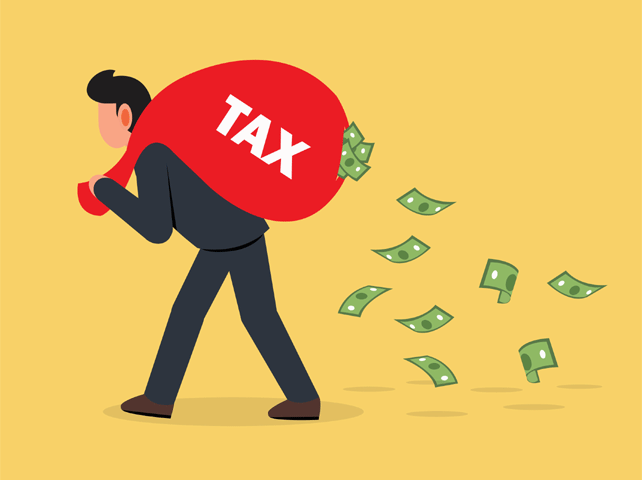
On the income tax front, the salaried segment has already been recast as a pliant, low-effort source of nearly half a trillion rupees annually. Those below the threshold who can’t be milked through this mechanism are still paying through the sales tax and petroleum levy net. The latter two in particular remain regressive in their incidence and impact.
At a time when inflationary pressures have rendered real income growth stagnant for almost a decade, the increased direct and indirect tax burden represents an additional constraint on consumption. One hears plenty of stories of households actively downgrading their lifestyles under mounting financial pressure. Small car owners switching down to motorbikes; children being pulled out of category A or B schools and being sent to smaller, lower-cost ones. Spending on leisure making way for just the basic essentials.
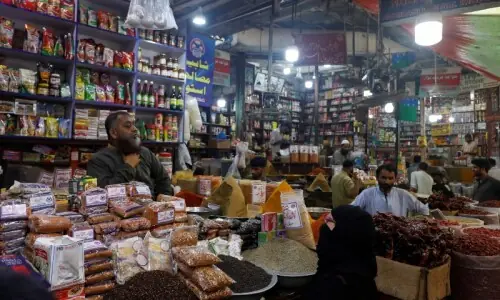
To counter these anecdotes, some officials and government partisans often respond by pointing out pockets of high consumption in major urban centres. Look at all the jam-packed restaurants. Look at all the footfall in shopping malls. Look at all the new specialty coffee shops opening not just in Lahore, Karachi and Islamabad, but also apparently in Faisalabad and Gujranwala.
All of this is meant to do two things — the first is to undercut the story of economic hardship that depressing anecdotes (and the actual consumption surveys) tell us. The second thing is to provide a comforting story of economic progress that somehow exists beyond the data. For this reason, the notion of the informal economy is often trotted out — Pakistan may be ‘officially’ poor, but unofficially it’s doing much better.
There are two things wrong with this approach. The first is that it assumes that the informal economy somehow shows distributional patterns different from the formal economy. Yes, like in any developing country, there is a small segment of privileged high earners who can eat at restaurants and drink matcha. And yes, some of their income will be undocumented and derived from the informal sector.
However, this segment is small in relative terms. Pakistan just happens to be a very populous country. The top 1pc would still constitute 2.5 million people; a number large enough to occupy tables and shops in a few commercial localities in the top three to four cities of the country.
At the other end, the vast majority of those working in the informal sector are scrambling to meet basic subsistence requirements. There is no major accumulation taking place, no pockets being lined, and certainly not enough being made to contradict the poverty and hardship that recent survey accounts categorically reveal.
The second problem is that if one takes the ‘hidden prosperity’ argument at face value, it raises a far more serious question about the government’s ability to tax its citizens fairly. If undocumented wealth and high-end consumption driven by the informal economy are to be cited as proof of economic progress, then there is no good reason why more effort should not be directed at bringing them into the tax net with a view to easing the burden on those already ensnared.
On that front, somehow the government repeatedly throws its hands up in meek despair, sustaining unearned privileges of various elites and the tax avoidance and evasion of specific lobbies (such as large retailers and wholesalers).
In my view, if the budget is nothing other than an exercise in managing revenue, then there are only two metrics worth evaluating it on: to what extent does the government intend to cut down on its own waste and stop diverting resources towards improving the quality of life of its officials at the expense of the larger population? And to what extent is it spreading the burden outside a small formal sector and the hapless working Pakistanis currently caught in an extractive withholding and indirect tax regime?
The writer teaches politics and sociology at Lums.
X: @umairjav
Published in Dawn, June 8th, 2026