Iran launches first attack on Israel since truce

• Salvo comes after Tel Aviv strikes Beirut; IRGC warns of broader response in case of further aggression
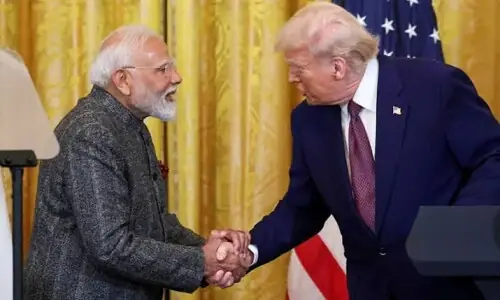
• Trump urges Netanyahu not to retaliate after Iranian strikes, says ‘each of them had their fun’
• Claims both sides very close to peace deal, ‘wouldn’t want to blow it up’
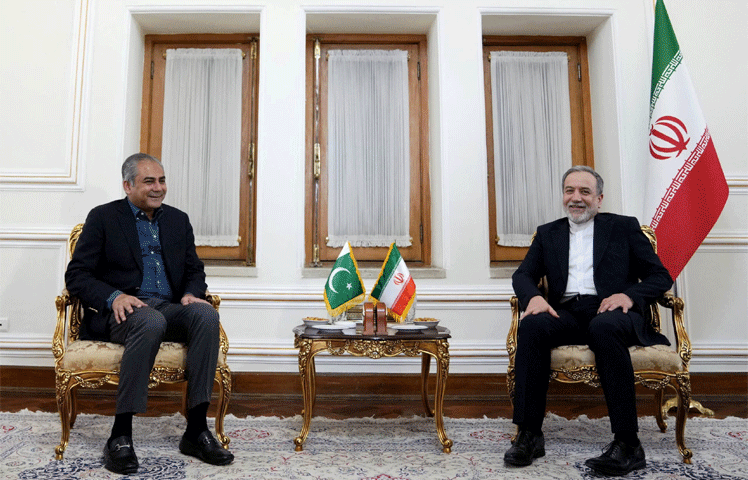
• Naqvi discusses peace process with Araghchi, delivers PM Shehbaz’s letter addressed to Ayatollah Khamenei
JERUSALEM: Air raid sirens sounded in Israel on Sunday as its military worked to intercept barrages of incoming Iranian missiles, the first salvo since a ceasefire took hold in April.
Iran’s Revolutionary Guards called the attack a “warning” after Israel struck Beirut’s southern suburbs earlier in the day, threatening wider strikes in the event of repeated aggression as the Middle East war reached its 100th day.
On Sunday, Israel announced it had “struck a militant command centre in Beirut’s Dahiyeh district, in response to Hezbollah’s fire towards Israeli territory”. The raid killed two people and wounded 20 more, Lebanon’s health ministry said.
Mohammad Bagher Ghalibaf, Iran’s parliament speaker and its chief negotiator in talks with Washington, accused the US of having given a “green light” for the Beirut attack, saying US and Israeli assets were now “legitimate targets”.
Hours later, the Israeli military reported at least three waves of incoming missiles, saying its air defences were “identifying and intercepting threats”.
The US embassy in Jerusalem directed all staff and their families to shelter in place.
The head of Iran’s military central command said Israel had “crossed all red lines” with the Beirut strike, demanding it halt its campaign in Lebanon. “Tonight’s operation was a warning,” the IRGC said. “If such aggressions are repeated, the responses will be broader and will cover all US-Zionist targets in the region.”
Shortly after the attack, Iran announced it was closing its airspace over the country’s west, while neighbouring Iraq and nearby Syria followed suit.
The attacks came after US Central Command (Centcom) said it destroyed two Iranian drones “that threatened international maritime traffic in the Strait of Hormuz”, hours after announcing it struck four other drones and coastal surveillance radar sites.
“American forces remain postured and ready to continue defending against Iranian aggression,” it added.
Following the Iranian strikes, Iranian Foreign Minister Abbas Araghchi held phone calls with French, Qatari foreign ministers. Earlier in the day, he spoke to his counterparts in Britain and Turkiye.
Trump urges against retaliation
Meanwhile, US news outlet Axios reported that US President Donald Trump said he will call Benjamin Netanyahu to urge him not to retaliate against Iranian missile strikes.
“I am going to call Bibi right now and tell him not to retaliate,” Trump was quoted as saying by journalist Barak Ravid in a phone interview.
“Each of them had their fun. Israel had its strike and Iran had its strike. We don’t need another one,” Trump said, according to excerpts Ravid posted on X.
“The Iranian strikes didn’t hurt anybody. Hopefully Israel is not going to retaliate. If Bibi strikes them back it’s just gonna keep going like the last 47 years, or the last 3,000 years,” the US president said.
“We are very close to a final deal with Iran. It is going to be a good deal. I don’t want it to blow up because of what is happening now,” he added.
In a separate interview with Fox News, Trump said the Iranian strikes were not going to help negotiations, which were “very close” to reaching an agreement.
“We’re very close. I would say an agreement would be signed on Monday, Tuesday or Wednesday of this coming week. And now this takes place.”
He urged Iran to “get back to the table and make a deal.” Trump also criticized Israel’s strikes on Beirut on Sunday, saying he was “not happy about it.”
Diplomatic channels remain open
There were some signs of ongoing diplomatic efforts over the weekend, with Pakistan’s interior minister Mohsin Naqvi visiting Tehran.
The minister discussed bilateral relations and the state of the US-Iran peace process during a meeting with Iranian Foreign Minister Abbas Araghchi.
“During the meeting, alongside reviewing bilateral relations, both sides exchanged views on the latest status of the ongoing diplomatic process mediated by Pakistan to end the imposed US-Zionist war against Iran,” it said in a post on X.
They further discussed issues of mutual interest and ways to further strengthen cooperation between the two neighbouring countries.
During the meeting with Mr Araghchi, Mr Naqvi also delivered the letter from PM Shehbaz Sharif addressed to Iran’s supreme leader, Ayatollah Mojtaba Khamenei.
Earlier, Mohsen Rezaei, an adviser to Iranian supreme leader Ayatollah Mojtaba Khamenei, had told CNN negotiations with the US “are at a deadlock, and Trump must break this deadlock”, calling for the release of some $24 billion in frozen Iranian assets.
But Trump said in the same interview that he would not unfreeze Iranian assets before reaching an initial agreement with Tehran. “If they behave, if they do a good job, we start talking,” he said.
In fact, Washington may seek to use those funds to pay for damage wrought by Iranian strikes on Gulf allies, according to a source familiar with Treasury Secretary Scott Bessent’s thinking.
Published in Dawn, June 8th, 2026