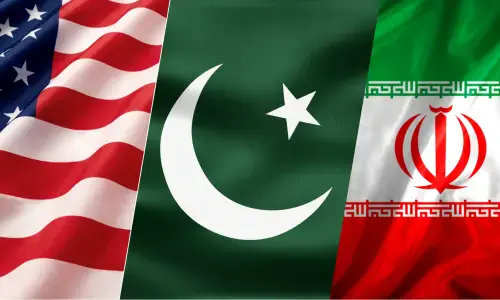

‘WAR of choice; peace of necessity’ is more than a gripping sound bite. It sums up a momentous blunder by Washington. None of America’s war aims have been achieved. The Iranian regime is still there, as is its nuclear material stockpile, the missile capabilities, and the ability to dominate the region. And by its successful control of the Strait of Hormuz, Iran has taken its deterrence capability to the next higher level.
Beyond Iran, Russia has made significant geopolitical and economic gains. China’s diplomatic profile has further risen, not just in the region but globally. And many middle powers are trying to fend for themselves by forming their own groupings. As reported by the Guardian recently, a former State Department official Mira Rapp-Hooper has described the war as a “superpower suicide”.
President Donald Trump had no plan, strategy or clearly thought-through war aims. He not only lacks knowledge about Iran but also has little understanding of the complexities of the contemporary world. In an interview to Vanity Fair last year, Susie Wiles, the White House chief of staff, said that Trump has an alcoholic’s personality, feeling no restraint and imbued with the belief that he can do anything and that nothing can stop him.
Trump’s aura of power and personalised, whimsical and predatory conduct of foreign affairs is inherently risky, but when framed by America’s historical tendency to go to war as the first recourse of action it is set up for failure. The country’s overwhelming military power and enormous economic strength give it such wide margin for safety and latitude for error that it sabotages the careful deliberation of issues and policy choices. Hubris and ignorance are a bad combination. No wonder America treats military power as equal to victory.
Since it became a superpower, the US has been getting into wars and exiting impulsively, creating consequences for itself and its partners. The wars were incited by an overweening pride in its military power and prompted by domestic political interest groups, as explained in Jack Snyder’s book Myths of Empire: Domestic Politics and International Ambition.
Policy in America is all about politics, which is all about power.
Given Americans’ own historical experience, going to war comes naturally to them. It is almost as if an American war is righteous by definition. In recent history, driven by a supreme consciousness of power and the hubris of the unipolar moment, and then scarred by 9/11, America simplified and distorted emerging global challenges and resorted to unilateralism. The result was failed wars in Afghanistan and the Middle East.
Endless wars caused resentment abroad and grievances at home. The failing elite-led system has now merged with mass politics causing its own set of problems. It has enhanced the influence of money and media on politics. Policy in America is now all about politics, which is all about power. Among other things, policy and politics have aligned to boost US support for Israel increasing its influence on Washington, and thus further degrading America’s public policy process. Such is the influence of Israel that Trump listened to Benjamin Netanyahu on Iran and not his own intel and military chiefs who counselled caution.
Donald Trump is now getting out of the war not out of reasons of morality or wisdom but because of its unpopularity due to the economic cost for the average American. So like the Afghan war, and the Iraq and Vietnam wars before it, the US is getting out because of domestic politics. No wonder, Americans will never quite know why the wars failed. This is a perfect recipe for continuing to get into and out of future wars.
None of the wars since World War II that were started by America itself were won by Washington, or ended up in honourable peace deals. There were just exit deals. There’ll be an agreement of sorts with Iran, too, but it will be piecemeal, partial and dragged out. That is perhaps the only way for Donald Trump to smudge any impression of failure.
A note of caution. We should be careful in reading larger meanings into the Iran war. America’s hegemony might be vanishing but its dominant position in geopolitics and global economy, that it shares with China, will stay. China, still occupied with its peaceful rise, will remain reluctant for some time to engage militarily beyond its periphery.
America still has the power to contribute to the global good if it wants to, the stake to take on forces that threaten US and global security, and the capacity, if not the will, to deter challenges to whatever remains of the international order. Force is often necessary just as war is sometimes just. It might be a mistake to depend on America but a blunder to ignore it.
The writer, a former ambassador, is adjunct professor at Georgetown University.
Published in Dawn, June 10th, 2026