

Iran war fuels political backlash, inflation debate in the US
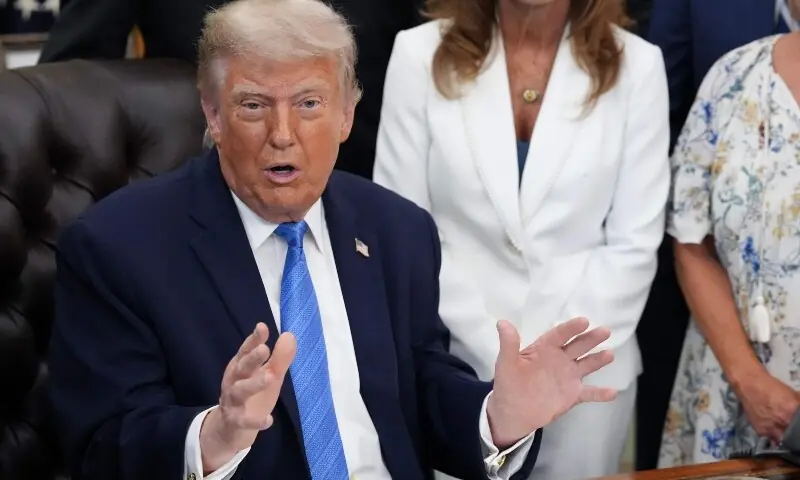

WASHINGTON: Rising inflation and persistent energy price pressures have sharpened political divisions in Washington, with Democrats blaming President Donald Trump’s Iran policy and trade agenda for worsening economic conditions for American households.
The latest figures showing inflation at 4.2 per cent in May, compared with wage growth of 3.4pc over the same period, have revived concerns that real incomes are being eroded as the cost of living continues to rise.
Senate Democratic leader Chuck Schumer criticised the administration’s handling of the economy and foreign policy in a sharply worded social media post.
“Another month of Trump’s illegal Iran war, another month of Trump’s tariffs, another month of Republican control of Congress. The result? A new all-time high for Trumpflation,” he wrote.
He also highlighted remarks by economist Heather Long of Navy Federal Credit Union, who warned that inflation was outpacing wages.
“Inflation is so high that it’s erasing all wage gains,” she said. “Inflation: 4.2pc in May for the past year. Wage growth: 3.4pc in May for the past year. Americans are getting squeezed financially.”
Senator Jeanne Shaheen, ranking member of the Senate Foreign Relations and Armed Services Committees, accused President Trump of breaking key campaign promises on war and the economy.
“President Trump promised no new wars. He promised to lower your energy costs and tame inflation,” she said.
“Instead, he started a reckless war with Iran. He’s spiked gas prices. And inflation has soared month after month. He lied, and it’s the American people who are paying the price.”
In the House of Representatives, Democratic leader Hakeem Jeffries described the conflict as a “reckless war of choice,” calling it “Day 100 of the reckless war of choice in Iran” and urging congressional action.
“It’s time for the Republican-controlled Senate to move our war powers resolution,” he said. “So we can end this costly conflict immediately.”
Analysts say the transmission channel between the conflict and US inflation runs primarily through global energy markets, where disruptions in supply expectations can quickly feed into higher fuel costs for American consumers.

Matthew Kroenig of the Atlantic Council warned that energy markets remain highly sensitive to geopolitical instability. “The energy market is global, and disruptions to supply anywhere result in price spikes in the United States,” he said.
Former US intelligence official Beth Sanner warned that widening regional instability involving Iran, Israel, Gaza, Lebanon and Syria risked complicating diplomatic efforts and sustaining long-term uncertainty across the Middle East.
Beyond the United States, economists note that prolonged instability in global energy markets also carries indirect consequences for import-dependent economies such as Pakistan.
Higher oil prices tend to feed into transport costs, food inflation and external account pressures, making emerging markets particularly vulnerable to sustained volatility.
As the conflict continues, the debate in Washington is increasingly defined by inflation data, household financial stress and questions over the scope of US military engagement abroad.
While policymakers focus on domestic economic pain, analysts warn that geopolitical shocks are reinforcing inflationary pressures that extend well beyond the United States.




























