
OLD science fiction had a simple trick. When something had to sound impossibly advanced, writers added the word ‘quantum’ to it. Quantum engine. Quantum lock. Quantum field. Nobody knew exactly what it meant, but everyone understood that the future had arrived.
Artificial intelligence now performs a similar function in policy language. Add AI as a prefix to any ordinary state reform, and it sounds futuristic.
In reality, AI is not some glamour to be sprinkled over systems, and it is most definitely not just a chatbot. If Pakistan is serious about building an AI future, we must begin with two fundamental questions: what exactly do we want AI to do, and what will power it?
Pakistan’s AI policy effectively answers the first question. It imagines a future in which AI contributes to governance, industry, public services, education, health and national productivity, and this ambition is important. However, the answer to the second question remains vague because Pakistan’s AI conversation still treats the technology too often as an application, a chatbot, a pilot project, rather than as a question of national infrastructure.
If AI is to be embedded into governance, we cannot rely entirely on foreign models.
When we say Pakistan needs to develop its AI ecosystem, we should not imagine this as merely building a Pakistani chatbot that speaks our languages. A serious AI ecosystem means the ability to power, host, adapt, audit and govern AI systems across public services, research, industry and everyday life. It also means knowing where our data lives, whose machines process it, who can inspect the systems that shape public decisions and what rights citizens retain when their lives become raw material for digital systems.
This is precisely why AI cannot be designed as one large centralised project. It will appear through departments, in hospitals, schools, courts, revenue offices, agriculture programmes and law enforcement agencies. Each will have its own data, risks and accountability needs. This is why Pakistan needs nationally coordinated infrastructure for local use cases.
This piece, thus, is an attempt to develop a practical checklist of what Pakistan needs to turn its AI ambition into real capacity.
The foremost issue is dependence, ie, relying so heavily on foreign models, chips, cloud systems and data centres that Pakistan cannot control cost, access or accountability. Pakistan should use the best global AI tools where useful, but not assume foreign systems will always be available, affordable or appropriate for sensitive public functions, especially as much of Big Tech is now tied to foreign military and security infrastructures.
The answer is a hybrid model, ie, use global tools where possible, and build sovereign capacity where dependence becomes dangerous. There is no wisdom in pretending that Pakistan can immediately replicate the capabilities of the world’s largest technology companies. But if AI is to be embedded into governance, public service delivery and other citizen-facing systems, we cannot rely entirely on foreign models, foreign data centres and foreign rules.
Sovereign capacity begins with electricity. AI runs on data centres, chips, cooling systems and uninterrupted power. Pakistan has already acknowledged this by announcing 2,000 megawatts for Bitcoin mining and AI data centres. The number is useful because it shows that AI is an energy allocation question, but it also reveals the confusion of treating speculative crypto mining and sovereign AI compute as the same national priority.
For powering AI, our strongest opening is solar-powered compute infrastructure, backed by power storage and grid redundancy. Solar is cheaper, easier to source, quicker to scale, suited to high sunlight regions and less exposed to imported fuel shocks.
Electricity, however, is only useful if Pakistan can access the compute it must run. That means data centres, GPUs and local hosting for sensitive workloads, not necessarily training frontier models from scratch. Pakistan is not under a blanket ban on Nvidia products, and ordinary consumer GPUs are not the issue.
The real constraint is access to advanced data centre AI accelerators, which can require US export licensing. This cannot be left to vendors or individual ministries. If compute is strategic infrastructure, then chip access is foreign policy, and Pakistan’s Foreign Office should treat it as a formal tech diplomacy agenda.
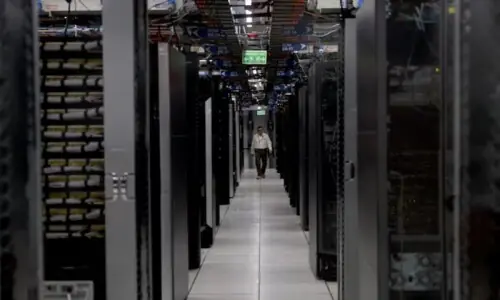
Then come the data centres themselves. They need land, fibre connectivity, cooling systems, security, maintenance teams, backup power and, in many cases, careful water planning. China’s ‘Eastern Data, Western Computing’ initiative offers a useful lesson because data centres are not random buildings, but part of a national geography of power, land, connectivity and demand. Pakistan does not need to copy that model, but it does need the same seriousness in deciding where compute infrastructure should sit.
Next come human resources and data. Training users alone isn’t enough. Universities need shared GPU clusters, research grants, and incentives to build models that serve local needs, rather than only teaching students how to use foreign tools. At the same time, the state must begin the harder work of digitising local data in health, education, agriculture, courts and public services. Without local data, local AI will remain shallow, and without safeguards, it will become dangerous.
This is where Pakistan’s missing data protection framework becomes central. The country is talking about training AI on local data before it has enacted a comprehensive personal data protection law.
If citizens’ records, languages, movements, complaints, cases or health information are to feed AI systems, Pakistan needs a rights-friendly regime built around consent, purpose limitation, anonymisation, audits, remedies and clear limits on what should never be used for training.
In the end, Pakistan’s AI ambition will not be proven by another policy launch. It will be visible through our fiscal choices for FY2026-27. If they don’t fund power, compute, universities, digitisation and data protection, then AI will remain exactly what ‘quantum’ once was in science fiction, ie, a word that made the future sound close, while keeping it only imaginary.
The writer is the founder of Media Matters for Democracy.
Published in Dawn, June 12th, 2026