ISLAMABAD: PTI, the main opposition party in the National Assembly, on Friday rejected the federal budget for FY2026-27, terming it a “refined exercise in elite self-preservation”.
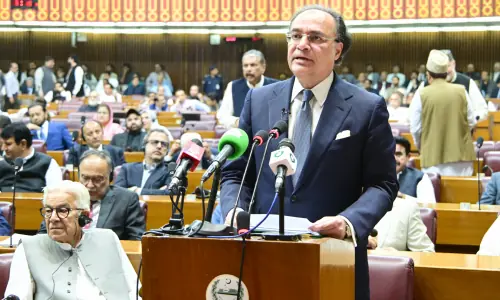
In an NA session earlier today, the federal government unveiled a Rs18.8 trillion budget for the upcoming fiscal year.
In a statement, PTI Secretary Information Sheikh Waqas Akram said that even the Pakistan Economic Survey released on Thursday showed that the country had been facing a continued decline across sectors compared with the PTI’s tenure.
While commenting on the budget, he stated that the government had projected a growth rate of 3.7 per cent as proof of economic resurgence. He noted that the previous administration, despite a global pandemic that paralysed economies worldwide, had recorded growth of nearly 6pc in its final year, while also strengthening the current account and remittances.
“The present government, with characteristic modesty, treats its modest achievement as a historic breakthrough, while relying heavily on remittances, foreign borrowing, and factors that deliver little tangible benefit to those who live and work within the economy,” Akram said.
The information secretary added that poverty had undergone a “sharp and conspicuous reversal”, pushing millions more citizens below the line of basic subsistence.
“The poorest sections of society are now left to manage as best they can, their circumstances made considerably more difficult by conditions this budget claims to have mastered.
“The government, in its boundless generosity, acknowledges that recent conflict-driven oil price increases and flood losses placed fresh and unexpected burdens on every household, only to then celebrate the introduction of targeted subsidies it was compelled to provide because broader relief had become too expensive,” he added.
Akram further noted that the salaried class, already the most heavily taxed segment of the formal economy, continued to find that meeting basic household obligations has become an exercise in sustained improvisation.
“Real incomes have been steadily diminished, while the relief measures contained in this budget — reductions for higher income brackets and the abolition or reduction of super tax on select business revenues — extend thoughtful consideration primarily to those already well positioned to absorb economic pressure.”
Akram remarked that over the last three to four budgets, the government had imposed every conceivable tax, abolished most reduced tax rates, removed zero-rating under the Fifth Schedule, and withdrawn numerous exemptions.
“Beyond a few minor measures, the proposed budget offers nothing substantive for the common citizen or small businesses.”
He stated that small businesses and traders now face a new fixed tax regime, expanded withholding tax on unregistered purchases, and intensified production monitoring through digital invoicing.
“At the same time, the government was shifting toward aggressive enforcement through large-scale, faceless audits, with dedicated teams in Islamabad prepared to target businesses indiscriminately.”
“Penalties for late filing and non-compliance have been significantly increased. This approach does not aim to broaden the tax base or bring new taxpayers into the net. Instead, it relies on harassment and coercion of already compliant taxpayers to extract more revenue, while doing little to address widespread tax evasion,” he said.
Akram also maintained that the budget continued a well-established pattern of statistical flexibility and selective historical recollection.
“The presentation of regional tensions as a source of strategic advantage and defence export opportunities, even as the region experienced conflict, displays a notable indifference to the human and economic costs borne by ordinary citizens”, he said.
The PTI information secretary observed that debt servicing now accounted for Rs8,054 billion out of a total expenditure of Rs18,771 billion, effectively crowding out resources that might otherwise support development or meaningful welfare measures.
“The emphasis on privatisation, including the disposal of PIA and the planned transfer of DISCOs and other entities, is presented as a landmark achievement.”
In practice, he remarked that it risks resembling an accelerated disposal of national assets whose primary beneficiaries may prove to be connected interests rather than the public at large or the employees concerned.
“External financing arrangements such as the Panda Bond and Eurobonds are described as signs of restored international confidence, even as they deepen long-term dependence and effectively transfer future obligations to subsequent generations,” he concluded.
Meanwhile, during the budget session in the National Assembly, PTI lawmakers also staged a protest, chanting slogans and raising placards before later walking out.