Usama and Jasir’s friendship began in third grade and quickly became unbreakable. They ate from the same lunch boxes, shared secrets, exchanged funny jokes during class and ran together towards the school gate every day when the bell rang. Teachers loved watching them. The boys were different in many ways, but they always laughed together.
By the time they were in middle school, things started to change. Their friendship began to feel different, and their conversations slowly took a new direction. Their talks in the morning were no longer about cricket matches, but about political discussions they had heard their families having at home.
Usama liked a leader who spoke politely and promised improvements, while Jasir supported a leader who spoke with fearless passion and strength. In the early days, their arguments were harmless and playful.
“You only support him because your father does,” Jasir joked one day.
Usama replied with a laugh, “At least I don’t like noise more than ideas.”
They kept debating everywhere: during breaks, at lunch and even on their way home. Their friends enjoyed the show like a friendly competition. Nobody thought it was serious, not even the two of them.
But slowly, their light-hearted arguments began to change. The jokes turned into hurtful comments. The laughter disappeared. Almost every conversation ended in an argument, with both boys upset and silent afterwards.
If Usama praised his favourite leader, Jasir took it personally. If Jasir spoke proudly, Usama felt as though he was being mocked. Soon, they stopped eating together and began sitting on opposite sides of the classroom. Still, neither of them wanted to admit they were wrong.
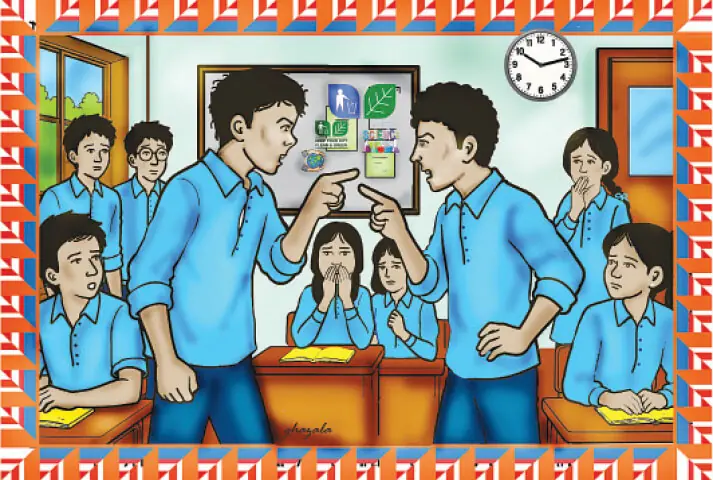
The situation worsened one day when a classroom discussion turned into a heated argument. Words came out quickly, and some students laughed while others encouraged them. Then, without warning, Jasir pushed Usama. Usama reacted immediately, pushing him back even harder. Within seconds, they were locked in a messy fight, like cats and dogs, grabbing shirts, clutching each other’s collars, throwing punches and yelling angrily. Teachers rushed in to separate them as the whole class looked on in disbelief.
The consequences were painful for both of them. Jasir was expelled from school because of his repeated misbehaviour, while Usama was suspended for ten days. Soon, everyone knew what had happened. The classroom became quieter without their arguments, yet something important seemed to be missing.
During his suspension, Usama spent a lot of time alone thinking about what had happened. He remembered how they used to race to the school gate, laugh together and enjoy each other’s company. There was a time when disagreements never felt like battles.
Was a difference of opinion really worth losing a friend over?
He understood something that hurt: he was no longer arguing to share ideas. He was arguing simply to win, to prove he was better and to make Jasir agree with him.
When Usama returned to school, everything felt different. His seat seemed lonely and Jasir’s desk was empty. There were no arguments, no debates and no laughter, only silence.
One afternoon, Usama saw Jasir near the school gate, putting his books into his bag. Their eyes met, and both looked away for a moment. Then Usama gathered the courage to walk towards him.
“I am sorry,” he said. “I forgot that people can think differently and still be right in their own way. Being different does not make someone wrong.”
Jasir nodded.
“I forgot that different opinions do not mean we have to fight.”
They did not hug or smile, but the heaviness between them became lighter. Both boys realised that the world is full of different thoughts and that respecting others matters more than winning an argument. They understood that people are not meant to think the same way, and that respect is more important than being right. They still had strong opinions, but they never again allowed them to create distance between themselves and others.
Published in Dawn, Young World, June 20th, 2026