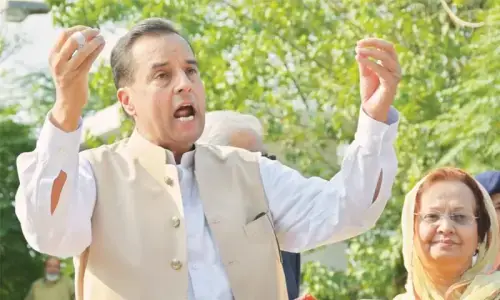
LAHORE: Speakers at a symposium here have highlighted the shortcomings in the education system in the country that are creating hurdles to religious freedom and equality.
The symposium on “advancing religious freedom through education and exploring the emerging challenges, opportunities, and responses” was held at the Human Rights Commission of Pakistan (HRCP) on Thursday.
Veteran educationist Neelam Hussain said when she grew up and was in school, there were no stark differences among Muslim, Christian and Parsi students in her school as it was an era before the Gen Zia regime.
“Our education policy was shifted by three martial laws and hybrid regimes,” she declared, saying that rote-based pedagogy had made things worse because it didn’t allow students to ask questions. She added that when religion was taught at home, the condition was better. She pointed out that education in Pakistan was promoting militant Islam, hatred for others.
“Classroom is a frightening place, especially for the minorities,” said Neelam, adding that our education system was a kind of violence against children.
Rights activist and executive director of Centre for Social Justice Peter Jacob highlighted challenges to the school education, saying that there was too much material from only the majority community that all students were made to learn. He said learning of the Quran was compulsory till higher education for all students in Punjab. Jacob said that learning Arabic was problematic for students belonging to the minorities.
“The other challenge is the school administration where religious freedom is curtailed.”
He pointed out that according to the Constitution of the country, no students should be made to learn what’s not his religion.
Peter Jacob said that the educational institutes run by the minorities were not fully returned to them after the denationalisation and only half of the schools and colleges of the minority communities were denationalised. The minority communities were asked to pay heavy amounts. Ten schools of the Ahmadiyya community were not denationalised though they had paid Rs10m to the government at the time of denationalisation and that amount was still with the government.”
However, Mr Jacob highlighted some development too, saying that on the content level, hate material had been curtailed in recent years while the content on jihad had also been cut. “However, the superiority complex of the majority community is still there,” he added.
He said the outsourcing of the schools in Punjab could be an opportunity for change.
Shahid Rehmat, the founder of Youth Development Foundation, shared his experiences as a student, saying that his fellows tried to convert him during his education. Though they would say it as a joke, it was impacting his mind and there was a conflict in whether he should convert to enjoy privileges or stick to his religion. He suggested using technology like AI to detect the hate material in books, adding that his organisation was training that device in many languages, including Seraiki.
Dr Sara Rizvi Jafree spoke about social media that could become a powerful tool to promote religious tolerance. She said the laws there institutional implementation was very weak. She pointed out that teacher education in Pakistan did not have peace-building aspects to it.
The panel discussion was moderated by Sikandar Shah.
Earlier, in her keynote address, Hina Jilani said the Pakistani judiciary was influenced by pressure groups. She said that changes to the education system during the Gen Zia regime gave a sense of superiority to the majority population and the biases led to rigid attitudes that worked against the minorities. Saying that discrimination based on religion and race had always been there, she stressedthat it could be prevented through education. She pointed out that Article 20 of the Constitution gives freedom of religion and expression to all citizens.
Justice Jilani had given 17 directions to federal and provincial governments for protection of the minorities and held the state accountable for violations but most of the judiciary also did not care that much.
Published in Dawn, June 19th, 2026