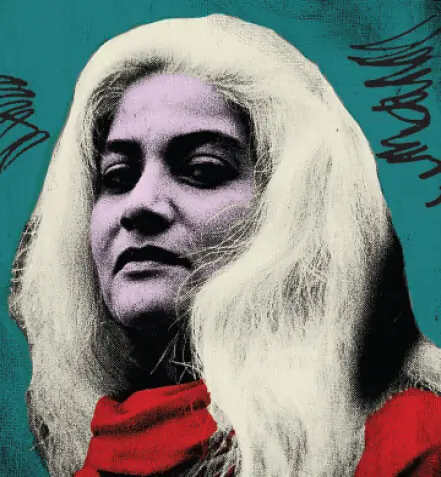
The audience goes into raptures as Amir Khusro’s ‘Chhaap tilak’ fills the air. The qawwal Fareed Ayaz sings it with great tenderness: “My fair, delicate wrists with green bangles on them; You have held my wrists tightly with just a glance.” The audience, and the all-male qawwals, find nothing strange about a man singing personified as a woman.
The Sufi path to pure love and devotion to God is often symbolised as a woman yearning for the Beloved. The feminine voice represents the journey from worldly or majazi love to Divine or haqiqi love, expressed as yearning and surrender to God.
Gender fluidity is a recurring theme in Pakistani cultural traditions. Few notice that the scriptwriters and songwriters of early blockbuster Pakistani cinema were men who seemed to understand the emotions and desires of women. A ghazal written by a male poet sounds equally natural if sung by a man or a woman. The power of the poem lies in its emotional authenticity rather than the author’s gender.
This convention is rooted in Urdu literary tradition, where it was natural for a male poet to express longing, vulnerability, helplessness — emotions normally associated with the feminine. The male poet writing in a female voice is not claiming to be a woman. Rather, he creates a meeting place of identities by crossing social and physical boundaries, for a true understanding of the human experience.
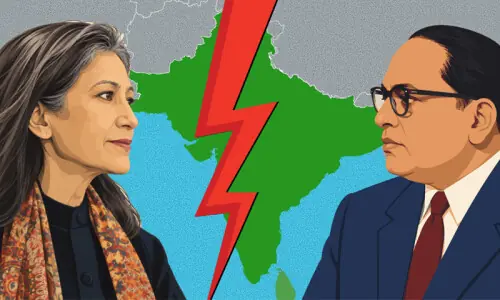
From Sufi poetry and Urdu prose to history and diplomacy, Pakistan and the Subcontinent have a long tradition of embracing multiple identities
The Urdu language itself has unexpected gendered nouns that reflect these crossings: fauj [army], daarrhi [beard] and moochh [moustache] are feminine. Fauj is masculine in Arabic, but both Turkish and Persian do not have gendered nouns — the three languages that most influenced Urdu vocabulary. Instead, the Urdu fauj reflects the feminine Sanskrit word for army, sena. Talwar [sword], bandooq [rifle], hukoomat [government], sultanat [empire], riyasat [state] and taaqat [power] are also surprisingly feminine. Yet, dupatta [scarf], a singularly female dress, along with ghoonghat [bridal veil] and kajal [kohl] are masculine.
Some connected word sets establish a relational gender: darwaza [door} is masculine while khirrki [window] is feminine. A kamaan [bow] is feminine while the teer [arrow] is masculine. Fitrat [disposition] is feminine, while fayl [action] is masculine. In some linked words, such as maal-o-daulat, maal [property] is masculine while daulat [wealth] is feminine. Or aab-o-hawa, where aab [water] is masculine and hawa [breeze] is feminine. There would be a wealth of symbolic meanings to uncover.
South Asian cultural traditions have always contained spaces where gender boundaries are symbolically crossed. Many South Asian male film stars have appeared as women, from Amitabh Bachchan to Moin Akhtar. The film Aurat Raj (1979), produced at the height of Gen Ziaul Haq’s ‘Islamisation’ drive, is probably the most overt exploration of gender through role reversals.
Until the British colonialists declared crossdressing a crime under the Criminal Tribes Act (1871), Khwaja siras had a position of great respect. Itibar Khan, confidante of Mughal emperor Babar, became the Governor of Delhi under Akbar. Khwaja Agah was the commander of Agra, and Basti Khan was a high-ranking official during Aurangzeb’s reign. Pakistan is one of six countries that officially recognise a third gender.
Gender fluidity in Pakistani culture is more nuanced than the obvious third gender identity. A man can be masculine relative to his household, but feminine in his spiritual journey, intensely patriarchal, yet deeply respectful of women. These multiple layers co-exist comfortably without merging into a single fixed identity.
The same fluidity of identity extends beyond gender. It may be reflected, for example, in the coexistence of national, ethnic and religious identities or relational identities of biradari [kinship], rishta [relationship] and waasta [connections], with their accompanying loyalties. Politicians are less likely to be ideologues than someone’s relative, disciple, patron or rival.
Perhaps Pakistan’s unexpected role as a saalis [mediator] in the recent Middle East conflict, negotiating peace with Iran, the Arab world, America and China, springs from the same cultural tradition of bridging and negotiating multiple identities. Khusro perhaps best expresses the challenge of navigating complex negotiations through the voice of a female persona: “Please protect the honour of my veil/ The path to the well is extremely difficult.”
Durriya Kazi is a Karachi-based artist.
She may be reached at
durriyakazi1918@gmail.com
Published in Dawn, EOS, July 5th, 2026