Super Typhoon Bavi closes in on US Pacific territories
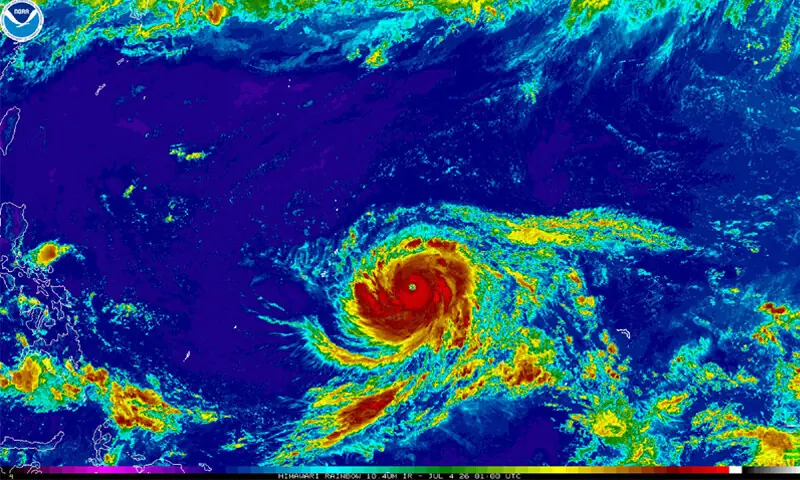

• Storm packs sustained winds of 269km per hour, gusts up to 324km per hour
• Emergency shelters open as residents stock seven days of supplies; Guam, Northern Marianas under state of emergency
• Communities secure homes, evacuate ahead of landfall
SAIPAN: People in the US territories of Guam and the Northern Mariana Islands readied themselves on Saturday as the second super typhoon since April drew closer, bringing the equivalent of Category 5 hurricane winds.
Super Typhoon Bavi was moving westward with sustained winds of 269 kilometres per hour and gusts of 324km per hour, the Joint Typhoon Warning Centre said in an update at 7pm local time.
The eye of the storm was expected to pass Monday very close to the small island of Rota between Guam and Saipan, the main island of the Northern Marianas, with winds set to strengthen to 278km per hour.
“My girls were saying to me it’s scary, but it will be okay. My house is concrete, so the worst that can happen is a window could blow in,” Arabella Paulino, 48, said on a Guam beach as the sky darkened.
“Typhoon Sinkalu in April wasn’t as bad as Mawar in 2023. That brought my whole house down,” Derma Soaladaob, 51, said. “I stay up north, but I’m going to a hotel. I have a concrete house but with the noise and the wind, it’s scary.”
Guam was set to go into Condition of Readiness 2 — meaning a typhoon was expected within 24 hours — starting at 10pm.
Emergency shelters were due to open Sunday at 7am, the governor’s office said. Residents were told to bring enough food and water to last seven days for each family member to the shelters, as well as medicines and bedding. Pets were not allowed.
Any plans for celebrating the United States’ 250th anniversary on Saturday, also Liberation Day for Saipan, were quickly overtaken by storm preparations.
Both territories declared a state of emergency. Many of the islands’ roughly 200,000 inhabitants queued at gas stations and thronged hardware stores to buy plywood to board up windows while stocking up on essentials.
Jeff Garcia, 48, who lives in Kagman Village in the Northern Marianas, said safety was the top priority, adding that they had weathered super typhoons before.
“We bought basic needs like water, candles, batteries, and canned goods,” Garcia said. “As a community, our greatest defence is our unity, our preparation and our discipline.”
The Northern Marianas archipelago and nearby Guam are home to around 210,000 people. Major battles were fought in the area during World War II.
Super Typhoon Sinlaku, which hit in mid-April, knocked out power for tens of thousands of people, uprooted trees, overturned cars and ripped metal roofs off buildings. A cargo ship, the MV Mariana, suffered engine failure and overturned.
One crew member’s body was recovered; five others were missing and presumed dead.
The American Red Cross warned that some locals were still in temporary shelters, even as it deployed disaster teams ahead of Bavi’s arrival.
Em Marilla, 42, of Saipan, said the thought of going through it all again without electricity and water was sad. “Furthermore, the application process for assistance takes far too long, and having to keep spending out of pocket for our daily needs is truly draining,” Marilla said.
Published in Dawn, July 5th, 2026