NA panel backs existing MDCAT passing criteria, rejects proposal to lower marks

ISLAMABAD: The National Assembly Standing Committee on National Health Services, Regulations and Coordination on Friday unanimously supported maintaining the current MDCAT passing criteria and explicitly opposed any reduction in the passing marks.
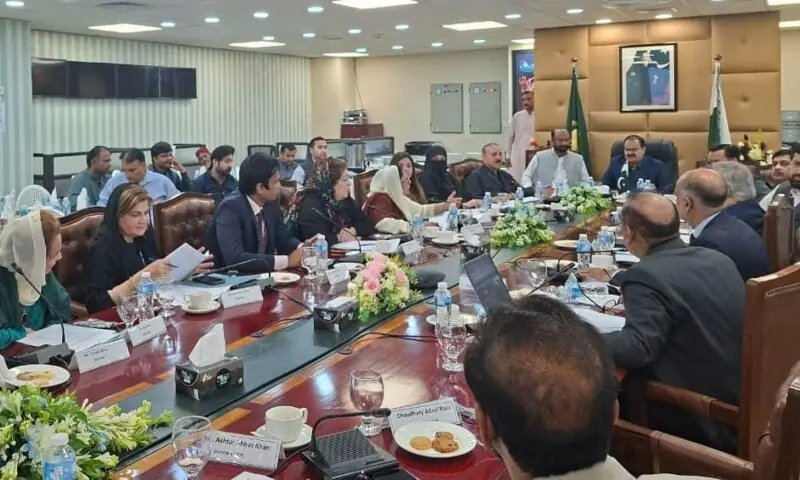
The committee met here with Dr Mahesh Kumar Mallani in the chair to review preparations for MDCAT 2026, matters relating to medical education, and reforms in the pharmacy sector. The committee was informed that the Medical and Dental College Admission Test (MDCAT) 2026 will be held on Aug 16, 2026.
To further strengthen transparency and fairness in the examination process, the question bank has been expanded from 6,000 questions last year to 8,000 this year. The committee was also briefed that each province will be provided with three separate question papers, from which one will be selected for the examination.
The committee was informed that admissions to medical and dental colleges will be determined on the basis of 10pc matriculation marks, 40pc intermediate marks and a 50pc MDCAT score.
The MDCAT paper will comprise 45pc Biology, 25pc Chemistry, 20pc Physics, 5pc English and 5pc Logical Reasoning.
The committee was apprised that approximately 135,000 students have registered for MDCAT 2026 so far. Since nine days remain before the registration deadline, the number of applicants is expected to increase further.
The examination will consist of 180 multiple-choice questions (MCQs), with no negative marking, a duration of three hours, and minimum qualifying marks of 55pc for MBBS and 50pc for BDS admissions. The committee deliberated on the fee structure of private medical colleges and decided that annual tuition fees should be capped between Rs1.8 million and Rs2.5 million.
Private medical colleges will also be required to justify their fee structures. Furthermore, a third-party audit will be conducted to determine the actual per-student cost of medical education. To further enhance transparency in the admission process, members of the committee will hold meetings with the concerned vice chancellors of their respective provinces after July 20, 2026.
The body was informed that 188 medical colleges are currently registered with the Pakistan Medical and Dental Council (PMDC), including 60 private institutions. It was noted that private medical colleges produce approximately 22,000 graduates annually, while government medical colleges graduate around 14,000 students each year.
The PMDC clarified that reports regarding the proposed increase in the salary of the PMDC president to Rs1.2 million per month and the enhancement of TA/DA for PMDC Council members to Rs50,000 have not been finalised and remain proposals only. The committee also directed that medical colleges be asked to explain why approved seats remain vacant and to ensure that quality standards in medical education are fully maintained.
Expressing dissatisfaction with the briefing given by the Pharmacy Council of Pakistan, the committee directed the council to revise the Pharmacy Council Rules, 1967, to address contemporary challenges facing the pharmacy profession. A draft of the revised rules is expected to be presented before the committee in October 2026 for consideration before being laid before the National Assembly.
Besides the chairman, Ch Muhammad Shahbaz Babar, Farah Naz Akbar, Dr Shaista Khan, Dr Darshan, Dr Shazia Sobia Aslam Soomro, Sabeen Ghoury, Dr Nikhat Shakeel Khan, Gul Asghar Khan, Farukh Khan and Aliya Kamran, MNAs, Health Minister Syed Mustafa Kamal and senior officials of the Ministry of National Health Services, Regulations and Coordination attended the meeting.
Published in Dawn, July 11th, 2026