Pocket-size AI: Powerful phones star at China

Tech firms are racing to roll out advanced smartphones that use artificial intelligence to do everything from ordering food to composing messages upon a simple voice command.
Wide adoption of phones running on so-called AI agents would be a revolution, but would also take control away from major apps, which aren’t always happy about it.
At least three firms were showcasing so-called agentic phones at the World Artificial Intelligence Conference in Shanghai this weekend — heralding what may be to come.
Smartphone maker Nubia unveiled its NaviX Ultra, a phone powered by Doubao, China’s massively popular AI chatbot tool run by TikTok creator ByteDance.
“A new era of AI agent smartphones begins,” Nubia said, sharing images of the handsets online.
A limited run of a prototype dubbed the “Doubao Phone” sold out fast in December.
Initially, the prototype could follow simple voice commands to execute tasks across apps, including ordering food and comparing shopping prices.
However, days after it was released, tech giants including Alibaba, Tencent and JD.com restricted the built-in assistant’s access to their platforms.
The move effectively disabled the phone’s AI agent, so ByteDance turned off the powerful tool in certain circumstances, including when payments were involved.
‘Lose control’
Gaining broad access to apps owned by other companies is a sticking point for AI agent devices, said Kiranjeet Kaur, associate research director at US market intelligence firm IDC.
Platforms want to keep direct contact with their users; otherwise, “they lose control to another party”, she added.
“Agenting is everyone’s dream, but we haven’t reached there yet,” as the performance of AI agent tools is still often patchy, Kaur said.
According to Chinese tech media, the NaviX Ultra does not attempt to force its way into apps, but rather seeks to collaborate with them.
The first-generation Doubao phone had been hobbled when major apps blocked unauthorised access.
AFP has contacted Nubia for comment.
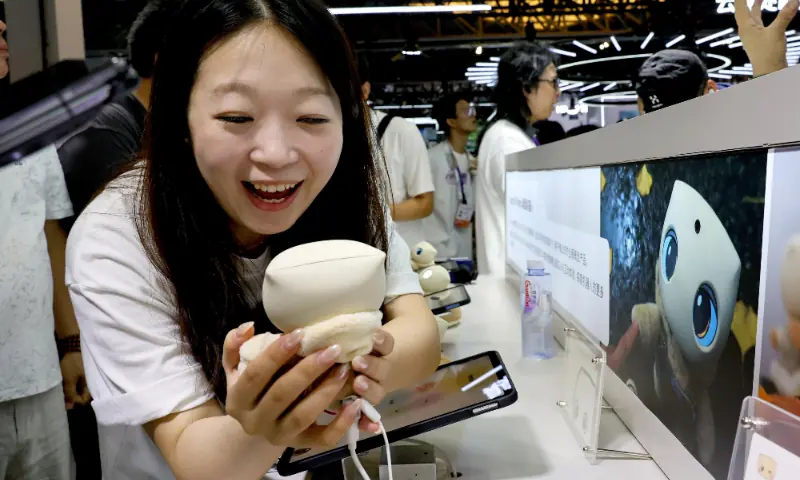
Another manufacturer, Honour, showcased an AI system for its “Robot Phone”, whose interactive camera flips up on a small robotic arm.
The company says its “companion-centric” device can interpret human gestures and bop to musical rhythms, as well as take selfies and steady videos.
An agent using several AI models, some co-developed with Alibaba, will be embedded in the robot phone when it goes on sale later this year, Honour told AFP.
‘No clear winner’
Shanghai-based AI startup StepFun also unveiled an “AI agent-native smartphone”, the STEPX Neo, ahead of the World Artificial Intelligence Conference.
StepFun’s chairman Yin Qi said “deep partnerships” had been established with several major Chinese platforms, including Alipay and ride-hailing giant Didi, according to a sponsored article in state news agency Xinhua.
“Leveraging these services, the smartphone can provide one-stop support for travel bookings, everyday purchases, local services, office productivity and video editing,” it said.
Outside China, big tech companies such as Google are busy infusing smartphones with increasingly advanced AI features such as the ability to book appointments.
US startup Brain Technologies launched an agentic “Natural AI Phone” which went on sale in Japan in April in partnership with mobile giant SoftBank Corp.
At a demonstration given to AFP in April, Brain Technologies’ phone — which connects with a handful of apps including social network LINE — messaged a contact to apologise for being late on just an audio command, although it also often failed to carry out requests.
“There is no clear winner in this race yet, which is why it is currently quite a hot topic,” said Marc Einstein of Counterpoint Research.
But in five or 10 years time, we won’t be using apps on our phones “like we do today”, he predicted.
“This will fundamentally change the digital economy and disrupt business models.”