Yemen's Houthis declare maritime blockade of Saudi Arabia
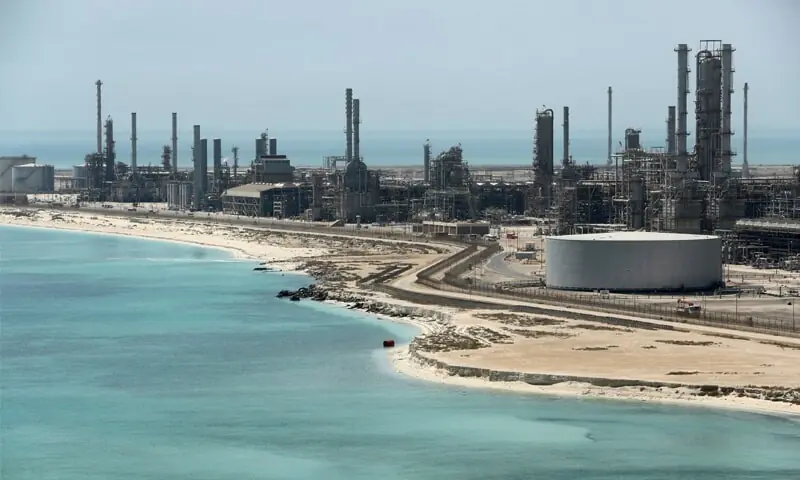

Yemen’s Houthi rebels announced a maritime embargo of Saudi Arabia on Monday, stepping up the US-Iran war as the rebels threatened the top oil exporter’s ability to bypass the Strait of Hormuz.
The group did not say how it planned to impose the embargo, whose declaration came as Iran said it was back to a “full-scale war” with the United States, and as Washington and Tehran battled to control the strait.
Saudi Arabia and the Houthis traded fire last week for the first time in years, threatening a 2022 truce that has held despite expiring.
The exchange of strikes was set off when an Iranian plane attempted to land in Sanaa, challenging Saudi Arabia’s hegemony over Yemeni skies.
The Houthis’ naval blockade, if enforced, could further strain Saudi Arabia’s economy by cutting off access to its Red Sea ports, which have been vital for oil exports as renewed fighting limits passage through the Strait of Hormuz.
The blockade is also expected to hurt global markets that rely on Saudi Arabia — which produces over 10 million barrels of crude per day — for energy imports.
The rebels declared “a maritime embargo against the criminal Saudi enemy, based on the equation of ‘an eye for an eye’, effective immediately”, military spokesman Yahya Saree said.
Stephane Dujarric, spokesman for the UN secretary-general, warned that the threat from the Houthis risked an “even wider” regional conflict.
“A simultaneous crisis at Hormuz and Bab al-Mandab would produce a much larger shock than either blockade alone,” the King’s College London academic told AFP.
“Hormuz disruption constrains Gulf oil and liquefied natural gas exports, while Bab al-Mandab disruption interrupts the principal maritime connection between Asia, the Gulf and Europe.”
The Houthis previously launched attacks on ships transiting the waterway beginning in November 2023 during the Gaza conflict, forcing vessels to take lengthy detours around Africa instead of travelling directly from Europe.
Yemen shares a border and coastline with Saudi Arabia, whose Red Sea port of Yanbu has been crucial for exporting oil, bypassing Iran’s effective closure of the Strait of Hormuz during its war with the US.
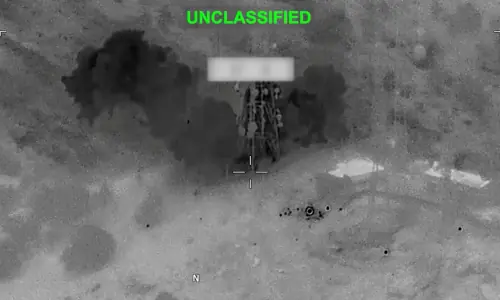
Earlier, Iran’s president said the country is fighting a “full-scale war” with the US as Washington expanded its strikes across the Islamic republic, including a city hosting a nuclear power plant.
Iran kept up its own attacks across the region in response, with its Revolutionary Guards announcing they had hit targets in Bahrain, Jordan and Syria, while Bahrain said Tehran had targeted its air navigation systems.
“The reality is that today the Islamic Republic of Iran is engaged in a full-scale war,” said President Masoud Pezeshkian, according to a presidency statement.
He added that “we must be realistic and accept the natural consequences of this resistance”.
His comments came after state media and local authorities reported US strikes on Monday in the north and centre of the country, further than areas near the blockaded Strait of Hormuz waterway through which a fifth of world oil supplies transited prior to the war.
The Middle East war resumed after a weeks-long lull prompted by an agreement signed in June, and oil prices surged to a one-month high as the foes battled to control the vital Strait of Hormuz.
As its truce with the US collapsed, Tehran reimposed its blockade of the waterway, while Washington hit back by again blockading Iran’s ports.
All of the Iranian provinces hit on Monday host military bases and air defence systems.
In Bushehr, home to the country’s only operational civilian nuclear power plant, governor Mohammad Mozaffari told state news agency IRNA: “A few minutes ago, several locations in Bushehr city were hit by American enemy’s projectiles.”
In East Azerbaijan province in the north, the head of the local crisis management unit Majid Farshi told IRNA that “one person was martyred and several others injured” in an attack there.
Despite the latest attacks, Iranian foreign ministry spokesman Esmaeil Baqaei said diplomatic exchanges with the United States via mediators were ongoing.
“Ideas have been conveyed to us by certain mediators,” he told a press conference in Tehran attended by AFP.
Ship on fire
In Hormuz, meanwhile, sailors abandoned a vessel set on fire in an attack, according to the UK Maritime Trade Operations agency.
The Revolutionary Guards had earlier said that two oil tankers trying to transit the strait “exploded and were brought to a halt”, according to a statement reported by Tasnim news agency.
On Sunday, US Secretary of State Marco Rubio called on countries around the world to share the burden of protecting global shipping.
But Baqaei said on Monday that Tehran would not allow the strait to be used by its foes “to threaten Iran’s security and national interests”.
US Central Command (Centcom) said on Sunday that it successfully completed the ninth consecutive night of strikes against Iran, while Rubio said he would “continue to try” to reach a diplomatic solution.
The fresh fighting came after a weekend in which the US announced three new US military fatalities and one service member missing in action.
Two were killed during Iranian missile and drone attacks on Jordan on Friday, while another service member died in northern Iraq during the controlled detonation of unexploded ordnance from a downed Iranian drone, Centcom said.
President Donald Trump said US strikes on Iran “hit them very hard” in honour of the American fatalities.
The deaths brought to 17 the confirmed number of American military fatalities since the conflict began with a massive US-Israeli strike on the Islamic republic.
On Friday, Iran’s health ministry reported that 50 people had been killed in recent fighting and more than 500 wounded.
Iran strikes neighbours
Meanwhile, Iran’s Revolutionary Guards announced on Monday that they had hit targets in Syria, Jordan and Kuwait overnight.
In Syria, Iranian forces launched “a surprise attack on the enemy special operations command centre in the Al-Tanf region”, according to a Guards statement carried by state media.
The US withdrew its troops from Al-Tanf in February.
In Jordan, the Guards said it targeted US military aircraft stationed at Aqaba Airport “with ballistic missiles, causing severe damage to a number of them”.
The Guards also said they hit US military targets based in Kuwait, including an early-warning radar system that was “completely destroyed”.
Kuwaiti air defences were “engaging hostile drone attacks following Iranian aggression”, its army said on Monday.
Bahrain’s interior ministry also said that its air raid sirens had sounded and urged citizens and residents to head to “the nearest safe place”.