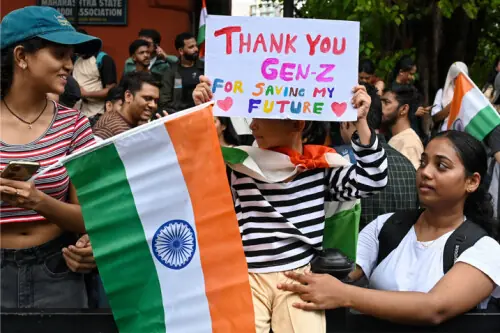

INDIA’S Gen Z uprising may not have swept away the government as it did in Bangladesh and Nepal, but it has certainly challenged an increasingly repressive system. Led by students and disgruntled youth, the protests — triggered by widespread allegations of leaked exam papers — grew into a mass movement. Demanding justice for the millions of students affected and for the reportedly dozens of suicides linked to the scandal, the protests, unprecedented in their scale, began in New Delhi and quickly spread to many parts of the country.
It soon turned into a wider democracy movement, drawing support from other sections of society. It is the most serious challenge the Modi government has had to face in its 12-year rule and has ripped open a fault line in the hard-line Hindu nationalist administration that has steadily eroded the secular character of Indian democracy. The protests forced the federal education minister to resign — a humiliating blow to Prime Minister Narendra Modi’s strongman image. Although the protests have now been called off, they have nevertheless shaken an increasingly authoritarian regime.
The Gen Z movement has upended India’s political landscape. The youth have rallied around a new political formation — the Cockroach Janta Party (CJP) — that sprang into existence only months ago in response to an insulting remark about the youth by the chief justice of India. Very soon, a platform pledging to fight injustice and defend the democratic rights of the people turned into a formidable opponent of the right-wing Hindu nationalist government.
Although the protests led by the CJP centred on exam paper leaks and a decadent educational system, it was other issues — unemployment and democratic freedom — that truly galvanised the youth. The movement further exposed India’s controlled mainstream media, a reflection of the shrinking freedom of expression in that country. The protests in India may have ended, but the Gen Z movement is not dead. Notably, social media platforms have served as major mobilising tools, allowing the youth to circumvent a controlled mainstream media often described as the ‘Godi’ (lapdog) media.
A ‘demographic dividend’ could turn into a demographic catastrophe.
India’s Gen Z movement may not share the same intensity, but in many ways it echoes the youth-led movements in Bangladesh, Nepal and Sri Lanka that toppled autocratic and corrupt governments and pulled those countries back towards democracy.
The youth revolt in Bangladesh was triggered by unfair job quotas for the children of ruling-party members. It quickly broadened into a countrywide uprising against an authoritarian regime that had effectively established one-party rule. The Sheikh Hasina government’s use of force, which killed hundreds of protesters, further inflamed public anger. The uprising finally ended with Sheikh Hasina fleeing the country — the movement’s defining victory and the prelude to a freely elected government.
Similarly, the Gen Z movement in Nepal was triggered by a ban on social media platforms critical of the government. The action ignited deep-seated anger over elite capture, widespread corruption and growing youth unemployment. Mass protests erupted across the country. The government’s attempt to crush the protests with brute force aggravated the people’s ire. Dozens were killed in what is widely regarded as the worst civilian massacre in Nepal’s modern political history. Angry protesters torched the parliament building and several politicians’ homes. Within days, the prime minister stepped down and the army briefly intervened to restore order before an interim government was formed. Elections followed a few months later, with a young leader installed as prime minister. A social media ban had lit the fuse that blew apart the entire power structure.
Sri Lanka is another South Asian country where the youth protests brought down the government. Sri Lanka’s 2022 uprising — known as the ‘Aragalaya’ (the struggle) — was one of the most dramatic protest movements in the country’s modern history. Unlike in India, Bangladesh and Nepal, where a single issue became the trigger for a wider movement, Sri Lanka’s case was somewhat different: it was not sparked by a single sudden event but by a slow-burning explosion. The crisis was no accident — it was the product of years of economic mismanagement by a family dynasty that had dominated the country’s politics. High inflation and unemployment exacerbated the situation.
What has unfolded in these four South Asian countries is a lesson for Pakistan, which not only has a large youth population but also suffers from political and economic problems. Pakistan’s Gen Z population (born between 1997 and 2012) is believed to number nearly 70 million. This has dire implications for a country where basic rights are in jeopardy, the media and free expression are restricted, and unemployment is rising. A ‘demographic dividend’ could turn into a demographic catastrophe, with Pakistan occupying practically the lowest rung on South Asia’s human development ladder. The legitimacy of the regime — which is losing its grip in several parts — is being questioned. The economy, meanwhile, is dependent on external assistance, which restricts financial autonomy. Public discontent — driven by inflation, unemployment and political repression — has created a volatile situation.
Whatever is unfolding in Balochistan, KP and Azad Kashmir reflects a pushback against an elite-dominated power structure. Hundreds of political and human rights activists are said to be behind bars. The judiciary itself is shackled, restricting avenues for those seeking justice. News from these areas may be kept off the mainstream media, but reality cannot be hidden in the age of social media. Curbing access to social media cannot work in the tech age. Given the tensions existing along Pakistan’s borders, more unrest could have far-reaching consequences beyond the frontiers, as the regional landscape is highly volatile. Pakistan must restore democratic rights before it is too late.
The writer is an author and journalist.
X: @hidhussain
Published in Dawn, July 29th, 2026