Europe’s shrinking rivers curb power output and company earnings
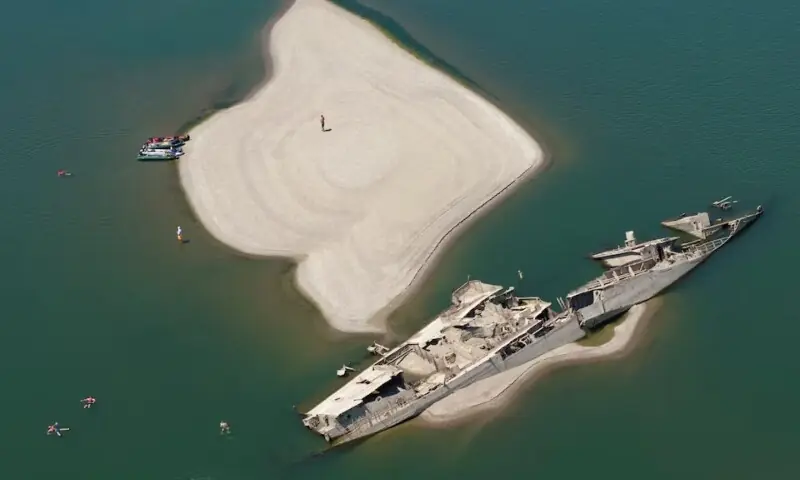

PARIS: Record low water levels in Europe’s major rivers have curtailed the transport of goods, reduced electricity output and shrunk company earnings, stoking fears about the economic impact of searing heat and erratic rainfall. As Europe experiences the fastest warming of any continent and record-breaking heatwaves, drought has exposed the need to reconsider business practices.
From the bustling port of Rotterdam to hydropower plants in Serbia, waterways have become a less reliable way to transport goods such as grains and oil, or to produce much-needed electricity when millions are seeking to cool their homes.
“It’s affecting not one region like we’ve seen in the past, but the whole European landscape,” said Alessandro Armenia, a power analyst at commodities data and analytics firm Kpler. “Given the current dynamics, it means either we’re going to see blackouts or we need to invest way more.”
Hydropower, nuclear output cut
Production of nuclear power in Hungary and hydropower in Serbia have fallen because of record low water levels along the Danube, which passes through major cities like Vienna, Budapest and Belgrade on its route from Germany to the Black Sea.
The Paks nuclear power plant, which generates nearly half of Hungary’s electricity, will be shut down on Monday, possibly for weeks because water levels on the river, which supplies cooling water to the facility, are expected to stay too low for it to operate safely.
At Djerdap 1, Serbia’s largest hydropower plant, output has fallen to 20 per cent of capacity, the plant’s production director Davor Maljokovic said, as the once broad shipping channel beside it has shrunk to expose sandbanks and gravel bars.
The lack of water has also disrupted cooling systems at Serbia’s Kostolac coal-fired power plants, forcing them to cut output, Serbia’s power utility said.
Both Serbia and Hungary say they will make up for the losses by importing electricity, a costly measure when demand on the spot market is high. Romania’s state nuclear power producer also had to shut one of its two reactors earlier this week for the same reason, with the second expected to soon follow, potentially depriving the country of a fifth of its electricity needs.
France has also had to reduce nuclear power generation because of low water levels or rising river temperatures.
Transport disrupted
Energy is not the only loser.
Cezar Gheorghe of Romanian grain market consultancy AGRIColumn said farmers along the Danube were having problems shipping their crops because low water levels stopped barges from using several river ports.
Only the ports which are closer to the Black Sea are still operational. Barges can’t go through the others, Gheorghe said.
Crop buyers could offer farmers lower prices and load them in trucks, although there might also be a shortage of trucks.
Meanwhile, the volume of cargo transported to and from Rotterdam – Europe’s largest sea port - to the Rhine has fallen slightly each week since the beginning of July and is around 10pc lower than normal, a port spokesperson said.
Chemical and oil product tankers and dry bulk carriers are particularly affected because of their normally greater draught compared to container barges, which means they sit deeper in the water and require greater water depths.
Company earnings
Apart from the natural devastation of wildfires and temperatures that have caused thousands of excess deaths, companies’ balance sheets have suffered from the changing climate.
Austrian utility Verbund, which produced about 85% of its electricity from hydropower last year, said on Thursday that drought conditions reduced earnings by about 370 million in the first half compared with a year of normal hydrological conditions. French state-owned utility EDF said on Friday that full-year earnings before interest, tax, depreciation and amortisation for 2026 were expected to fall by 10pc because of low market prices and as heatwaves reduced power output.
In Italy, the Po River basin has entered a state of high water scarcity, threatening rice crops and drinking water supplies across the north. Chief Executive of regional utility A2A, Renato Mazzoncini, said he expected hydropower production this year of 3.9 TWh compared to a historical average of 4.1.
Published in Dawn, August 1st, 2026