Presidential nod delay hits judiciary appointments

ISLAMABAD: The delay in presidential assent to judicial appointments has begun to affect the functioning of the superior judiciary, with the term of an additional judge of the Sindh High Court (SHC) having already expired and four additional judges of the Peshawar High Court (PHC) facing a similar situation within days, despite recommendations by the Judicial Commission of Pakistan (JCP) for the continuation of their services.
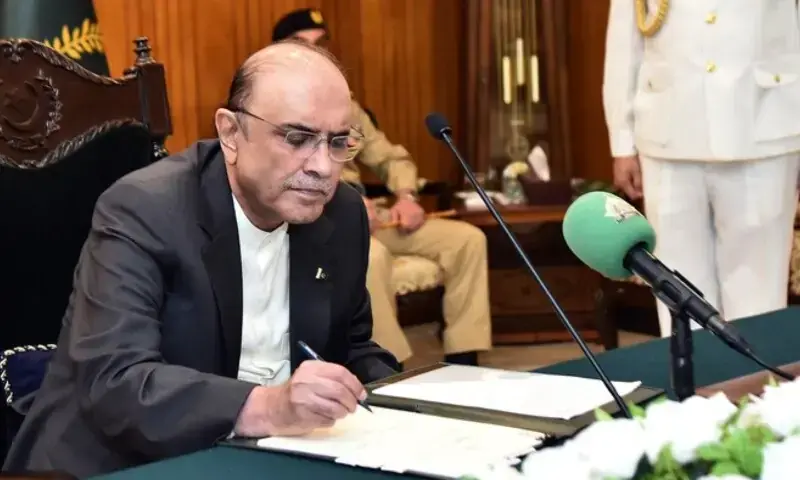
Justice Khalid Hussain Shahani of the SHC was appointed as an additional judge on Jan 29, 2025, for a one-year term. On Jan 22 this year, President Asif Ali Zardari approved a six-month extension in accordance with the JCP’s recommendation, extending his tenure until July 29.
Before the expiry of his tenure, the JCP, at its meeting on July 20, recommended another six-month extension and forwarded the recommendation through the constitutional channel to the president, who is the appointing authority. However, the summary has remained pending with the Presidency and no notification has yet been issued.
With no formal approval forthcoming, Justice Shahani’s term expired on July 29. Despite this, the SHC included his name in the latest roster of judges constituting benches, anticipating that the notification would be issued in the meantime.
SHC judge’s term lapses as four PHC judges face similar uncertainty
Sources in the Presidency maintained that an additional judge could not continue to hold office beyond the expiry of his tenure unless the president formally approved the extension and the Law Ministry issued the notification.
The sources recalled the case of former Islamabad High Court judge Justice Shaukat Aziz Siddiqui, whose confirmation as an additional judge was rejected by then president Asif Ali Zardari in October 2012 despite the JCP’s recommendation. The matter was later resolved by the Law Ministry, but when it reached the Supreme Court, the apex court observed that, following the 18th and 19th Constitutional Amendments, the president’s role in the appointment of judges had become largely ceremonial and that he was bound to act on the prime minister’s advice.
When contacted, SHC Registrar Asif Qureshi said he would examine the matter.
A similar situation is emerging in the Peshawar High Court (PHC), where the tenure of four additional judges — Justice Farah Jamshed, Justice Inamullah Khan, Justice Sabitullah Khan and Justice Aurangzeb — is due to expire on Aug 4.
The four judges were appointed as additional judges on Feb 4, 2025. When the JCP met on Jan 15 to consider the confirmation of 10 PHC additional judges, it confirmed six as permanent judges while recommending a six-month extension for the remaining four. The president subsequently approved the extension, which is now nearing completion.
The JCP has since recommended a further extension for the four judges, but the matter, like that of Justice Shahani, is awaiting presidential approval.
The uncertainty comes days after the Presidency also delayed assent to the appointment of additional judges to the Islamabad, Lahore, Sindh and Balochistan high courts, prompting concern within judicial and legal circles. The recommendations, approved by the JCP on July 20 and 21, have yet to be notified, while the government is said to be examining constitutional options should the delay persist.
Pakistan Bar Council Vice Chairman Pir Masood Chishti said an additional judge whose notification had not been issued by the president could not continue to perform judicial functions after the expiry of his or her tenure. “Once the president grants approval and the Law Ministry issues the notification, the judges can resume office,” he said.
Supreme Court Bar Association President Haroon Rashid criticised the continued delay, arguing that the president could not indefinitely withhold confirmation of, or appointments recommended through, the constitutional process.
Published in Dawn, August 2nd, 2026