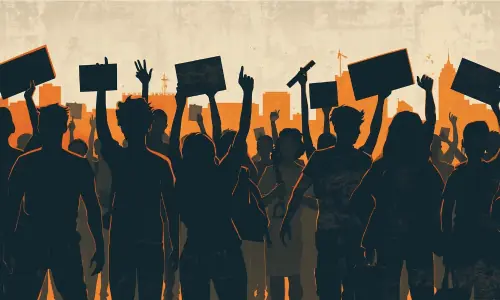

YOUTH are highly innovative in expressing their anger. Meanwhile, ruling elites struggle to understand that the existing power structure can no longer meet the aspirations of the young. The context of this statement is neither the events in Delhi, where the youth-led Cockroach Janta Party (CJP) succeeded in achieving its demands, nor the violent protests in Azad Jammu and Kashmir, nor the recent provocative statement by the federal interior minister about the state system. Rather, the reference is to a silent protest by the youth of Khuzdar in Balochistan, in which they succeeded in having their demand met. Is it not a unique event in Pakistan when the demands of the youth are met?
What was the youth’s demand? The reopening of a local library, where students study and prepare for their civil service examinations. The library was closed by the local bureaucracy, quite likely with the consent of superior institutions, which see books and libraries as sources of dissent. One cannot spare the bureaucracy either, which has a narrow vision and has been taught to rule like colonial masters. There is a high probability that in Khuzdar, too, they would have seen the youth’s inclination towards books and literature as a potential threat to security. It is ironic that most students, including many female students, were using the library as a safe and peaceful space to prepare for their exams. Most of them aspired to become bureaucrats, but the bureaucracy itself had shut down the library and closed the door to their future.
Whatever factors were involved in the library’s shutdown, the youth adopted a unique and peaceful way to protest. They held a sit-in outside the library and converted the footpaths and adjoining street into an open-air study space. They did not raise any slogans or attempt to confront the police or the local administration; they simply continued sitting silently and studying. Finally, the Balochistan chief minister intervened, and the library doors opened again.
This peaceful protest happened in a conflict-torn province where an insurgency is at its peak. The state has cracked down on violent actors. Sadly, those who participate in peaceful political and civil rights movements are also targeted. The district of Khuzdar has its own complex local, tribal and political context, and sardars, good or bad, have made the local people’s lives miserable. Yet the youth found a way to register their protest.
The youth are not politically blind; they see how the system works and how it is manoeuvred.
The protests by the youth in Khuzdar and by the CJP in India were related to education and inspired by the idea of getting a fair chance in life. Power structures have lost sight of the fact that equal opportunities and a fair system are essential for the youth. The youth are not politically blind; they see how the system works and how it is manoeuvred.
Whether it is referred to as Gen Z or Alpha-Z, this is a different generation with a different worldview. A dominant trend, especially among the more privileged youth of this generation, is to try out new modes of production and expand their class influence. Their forefathers accumulated leverage for their protection through wealth and relationships within the power structure. Less privileged youth are becoming less interested in civil services and industries and more interested in the corporate and financial sectors.
Certainly, the majority still belong to the middle- and lower-income groups, and they try every avenue they believe can empower them. They know that power is the only pathway to economic prosperity. Civil services and public-sector jobs of any sort are their shortcuts to finding a way out.
When someone tries to block the path to their dreams, they resist and protest. The older generations respond to the new generation in the conventional way, claiming that the new generation knows nothing. Where the youth have brought about political change, as in Nepal and Bangladesh, senior figures in the system dislike them and see their worldview as flawed.
A crisis is unfolding in Pakistan, particularly for the country’s youth. A draconian shift is taking place in the world of politics, where the older generation of politicians is transferring its legacy, power, and values to the next generation — not through legitimate constitutional and political means, but through shady deals with the most powerful. This process is occurring in every party, and the transition is frightening because those to whom power is being transferred have very little connection with political processes. They believe they are chosen to rule and can do anything to retain power. The youth of the country, then, has nothing to be proud of or to be inspired by in the existing political order.
This piece is not meant to predict any Gen Z-style uprising in Pakistan, but to point out that the political structure has become so tarnished and corrupt that it cannot sustain the burden of the economy, create new economic engines, or effectively utilise the existing sources of wealth. The bureaucratic structure is incapable of running governance and is becoming increasingly ruthless. A sense of deprivation is a common thread among young people from the middle- and lower-income classes.
Those in power are unwilling to review their practices; instead, they believe in an authoritarian, hegemonic style of controlling the system, in which subjects are expected to behave and follow whatever those in power dictate. The concept of citizenship was eroded long ago, and those who are powerless are treated merely as subjects. If they protest and their demands are fulfilled, they must consider themselves lucky, be thankful to the powerful, and forget that their success has anything to do with their ability to express themselves differently.
The writer is a security analyst.
Published in Dawn, August 2nd, 2026