
IT is not so much what he said as who said it. We all know that the existing political system has failed to deliver, but that admission coming from the all-powerful interior minister raises many questions. Mohsin Naqvi is himself a product of a system whose legitimacy he is now questioning. His statement points to the unravelling of the hybrid arrangement. What he said cannot be dismissed as merely his personal views, given his perceived association with the powers that be.
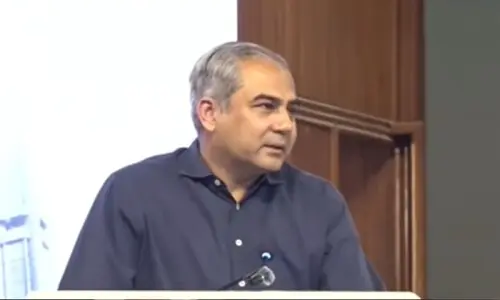
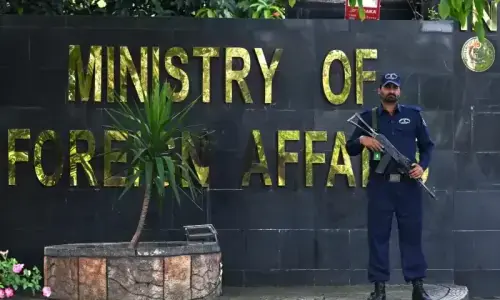
Speaking at the Pakistan Economic Summit last week, the interior minister said the current system of governance had “collapsed” and that it was fundamentally incapable of resolving the country’s problems. He stressed the need for structural reform to address Pakistan’s mounting challenges.
No one can disagree with Naqvi’s assertion. But his suggestion of creating new administrative units as a means of improving governance and his thinly veiled criticism of his own government’s policies have laid bare the fault lines within the hybrid political structure established after the controversial 2024 elections. Naqvi’s statement was later tacitly endorsed by the military spokesman, who also urged political parties to consider an administrative reset to improve governance, arguing that the country’s security and stability depended on adapting its governance structure to the requirements of modern times and a growing population.
The statement has also generated speculation about the Shehbaz Sharif government’s survival less than halfway through its term. Given the historically brief tenures of civilian governments, such uncertainty is deeply rooted. The interior minister’s remarks have jolted the ruling coalition, with some federal ministers questioning Naqvi’s own credentials. Yet while chastising him, they understand that he is not answerable even to the cabinet or the prime minister.
The interior minister should focus on security rather than administrative reorganisation.
In the words of Defence Minister Khawaja Asif, Naqvi is a “powerhouse” who is not answerable to anyone. A man for all seasons, as he is referred to by some, Naqvi deals with everything from cricket to security and even ventures into foreign policy. He seldom attends cabinet meetings or appears in parliament. He is not a member of any political party, yet is arguably the most powerful person in the government after the prime minister. Most analysts agree that he draws his power from close ties with the establishment.
Naqvi’s journey from media professional to one of the most powerful political positions in the country began when he was appointed caretaker chief minister of Punjab, the country’s most powerful province, in 2023. He joined the federal cabinet after the 2024 elections. Recently, he was also involved in Pakistan’s mediation efforts during the US-Iran war. His meteoric rise defines where the balance of power lies. His indictment of the government was not just a spontaneous outburst; it lays out a plan for a political and administrative reset. The statements of the interior minister and military spokesman must be read together to make sense of what appears to be in store. The ‘restructuring’ plan is likely to intensify the existing chaos rather than bring political stability. While both officials pointed to the absence of governance, the real cause behind this state of affairs wasn’t mentioned.
It is easy to blame the politicians for all the problems, but there is no mention of other obvious factors. Naqvi regretted that the ‘failed system’ had been dragged on for seven decades. He is absolutely right, but he failed to mention the dominant influence of the security apparatus for much of the country’s history. The decline of the present hybrid, and increasingly autocratic, system was long foretold.
A mere change of face and creation of new administrative units will not solve the state’s problems. Many view the statements as an attempt to redirect public attention from the real issues and tighten control. More important than the creation of new provinces is the devolution of administrative power to the local level and the restoration of democratic rights. Any imposed plan for the creation of new provinces or administrative units would further destabilise the country.
While the current political discourse has been revolving around the two statements and speculation about impending changes, the country faces an existential internal security threat, with terrorism now spreading despite the establishment’s claim that the situation is under control. The latest terrorist attack in Swat, which killed several policemen, is a grim reminder that terrorism has returned to the district after years of calm.
Notwithstanding the claim of successful intelligence-based operations, there seems to be a complete breakdown of law and order in KP, with an increasing number of terrorist attacks targeting an underequipped police force, whose personnel are sitting ducks in the face of sophisticatedly armed militants. Some protests by police have also been reported from the troubled districts over being left alone to fight the better-armed terrorists.
Meanwhile, the situation in Balochistan and Azad Kashmir has worsened, with the state relying entirely on kinetic options to deal with a largely political problem. The ongoing elections in AJK have been marred by reports of violence and allegations of electoral manipulation. No blackout of the news can change the reality on the ground. Would it not be better for the interior minister to focus on his main job of ensuring security, rather than trying to create more administrative units?
The latest poll controversy has unravelled the ruling coalition and exposed the hypocrisy of the component parties. The PML-N and the PPP are now at daggers drawn, accusing each other of being undemocratic. Although it is a beneficiary of the system itself, the PPP is now accusing the PML-N of being a product of Form 47 — a fact it had previously refused to accept.
The writer is an author and journalist.
X: @hidhussain
Published in Dawn, August 5th, 2026